Blueberry coffee cake


We go to DH’s aunt’s house in Nebraska for Thanksgiving every year. We love it. It’s quirky, it’s fun, it’s conservative in every sense of the word.

In one of those senses, it is very difficult to add different things to the menu, or leave anything off. This is probably true of Thanksgivings everywhere, it seems to be a menu we are married to, for better or for worse.

So, I like to bring things that fill in the gaps, stuff for breakfast, stuff to snack on with leftovers.I avoid anything that is too traditional, because when you mess with tradition, people are always disappointed. Nothing with sage, nothing with pumpkin.

DH brings avocados and makes his world- famous guacamole- (the secret ingredient is love).

Last year I brought cinnamon twists, which I baked on Tuesday night, brought in the car Wednesday, fed to people on Thursday and Friday morning, then when we were getting ready to leave, people hugged us, and murmured, “are there any of those cinnamon things left?” To my mind they were kind of stale, but how often do you get real homemade sweet rolls?

This year, I am trying coffee cake. I don’t know how it will go over, will people reminisce about the cinnamon rolls? Is that how menus become fixed?

I seem to remember an old issue of Cook’s Illustrated with a perfected coffee cake recipe. I’ll have to dig through my copies of the magazine, because the coffee cake story on the Cook’s website is behind a pay wall.

You won’t get my credit card number, Christopher Kimball!!! Actually, he probably will eventually, but not today. Even though I complain that Cook’s Illustrated is mostly just American food, and pretty meat-heavy at that, sometimes you want, even need, Meat Heavy American Food. Particularly at Thanksgiving in Nebraska.

I SAID NO PUMPKIN!
Bagged Apples, update


It isn't beautiful, but it isn't as visually intrusive as I thought it would be. That is, I never looked at the tree and thought, "dang, that's ugly!"

Back in June, I wrote a post about growing apples organically by using paper lunch bags to form a barrier against the critters that might want to lay eggs in my apples.  I just picked the apples a few weeks ago, and it worked pretty well.
Some of the bagged Golden Delicious fell off in July or so. My total “harvest” from the Golden Delicious tree is only 7 apples. Sigh.
My other tree (name unknown) had a zillion apples on it, and I only wound up bagging a dozen or so before my stapler died. The bags have to be removed before I pick them so they have a chance to redden. I did pick one, to test for ripeness, and it did need more time.

I will definitely do this again next year, with two differences.

I will put the bags on earlier, and thin the fruit at the same time. I’ll get bigger individual apples, without spraying poisons.

I will pay better attention to when to harvest. The sour apples, from the tree that was here when we bought the house, need time in the sun to ripen. I’ll have to pull the bags off well before the first frost date, which on average is mid September here on the Front Range of Colorado although we didn’t freeze in my yard until October, which is crazy.

Actually, one more difference- I’ll get a better stapler.

A year’s worth of garlic, part 2


I saved the largest bulb of my “harvest” to plant, and ordered some from eBay.  The kind I saved from what I planted last year is soft-neck, which is ordinary grocery store garlic, and in fact, this came from an ordinary grocery store. The kind I got on eBay is a hardneck variety, which is supposed to have a different flavor (there’s a question- how different can it be, and still be garlic?) and also it forms flower stocks and blossoms, which are called scapes.

We got some scapes in our CSA veggie box a few years ago and I had never seen them before- they’re really interesting. You could wear them as bracelets to ward off vampires- long green spirals. I sliced them for stir fry, and they had a bright, super-garlicky taste. Growing hard-neck garlic  means you get an earlier harvest, something to pick before the garlic is actually ready to dig. This helps with the year’s worth deal. Once the bulbs in the basket have either been eaten or started to sprout, there is something to pick that tastes like garlic.

Yes, I know I could just go to the grocery store.

Why bother growing my own? Honestly, carbon. How much diesel fuel is used to plow, plant and harvest garlic in California, or China?      http://www.npr.org/templates/story/story.php?storyId=11613477  how much energy to ship it here?

I am okay buying olive oil, because I can’t grow that here in zone 5, but I swear, garlic grows itself.

Before the fall equinox, I loosened some soil, broke the garlic heads into individual cloves and planted them. I put them in an area where the compost pile was, so there’s plenty of humus. I’ll cover with mulch, and wait until spring. I won’t water at all until next summer, and then it will still take less water than most people use on their lawns.

Grow garlic!!!!! Seriously!

No photo on this one- better artists than I can take beautiful pictures of bare soil.

She’s a sad tomato


One lonely ripe tomato was all I had as of August 29.

Up until this past weekend, I had only picked one ripe tomato off the Mexican Jungle that my veggie garden has become this year.  Because of the Mexican Jungle effect, I can’t tell you the name of the variety, because the little tag got swallowed up by greenery. Let’s just say  I planted things too close together, again.

On Friday, before we left for the mountains, I picked some beautiful chocolate cherry tomatoes, and a couple of Romas, and some more of these, whose name I don’t know. There are a ton more green ones, threatening to knock over the trellises. As long as we don’t get an early freeze (average first frost date here is September 15, but last year it didn’t happen until early October) the green ones will get a chance to ripen and become salsa, and salads and tomato sauce, and maybe dried tomatoes. Nom nom nom.

The grape tomatoes ripen a deep purple, and taste great on their own, but with these, I sliced them in half and threw them in with some pasta and vinaigrette. Now I have lunch this week.

According to my journal, these are "Chocolate Cherry", started from seed by a friend. They go dark, almost army green before they go purple. They are rich and sweet and filled with jelly.

Tinto de Verano


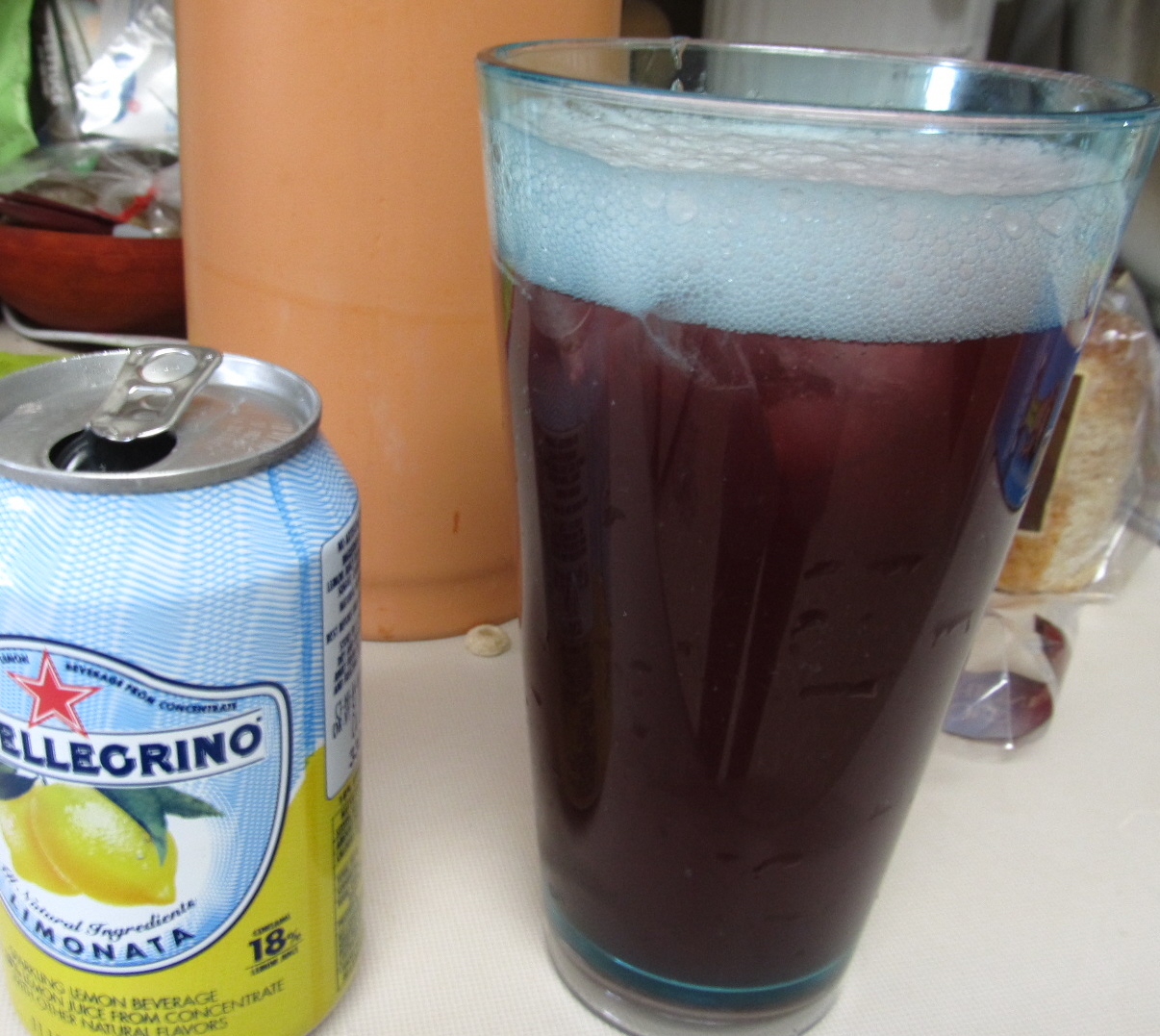
Tinto de Verano- summer wine. Waaaay classier than Bartles and Jaymes...

” (alcohol) is a common disinhibitor that works against the prioritizing capabilities of the forebrain… It helps transform shy people into gregarious ones, and can make the shy vivacious.”  “Thumbs, Toes and Tears” by Chip Walter

I’m not a beer drinker, and I have tried many of the non-beer options for when I’m at a party or barbecue, and would like to drink an adult beverage, but not get blitzed. There is a time and a place for blitzed, I guess, but a family barbecue is not either.  Well, maybe your family. When the weather is hot, sweet stuff is too cloying, most mixed drinks are too strong for me- nobody wants me to sing another chorus of “Margaritaville.”

Enter Tinto de Verano.  It’s fizzy lemonade mixed with red wine over ice. Yeah, that’s the recipe. Tall glass, lots of ice, red wine, top with fizzy lemonade.  It isn’t too sweet, or strong at all, but I can get a little loopy, get some nice social lubrication at the pool party. It isn’t enough of a “disinhibitor” to get me dancing on the table, and that’s a good thing.

You might be thinking that this is essentially a wine cooler, and you’d be right.  It is not nearly as sweet as most wine coolers, or hard lemonades or whatever so you can drink it all afternoon and not feel rotten.

A year’s supply of garlic


A bucket of garlic, with the dirt still on it.

Last fall I planted around 50 cloves of garlic- just the boring kind from the grocery store. How do I know how many? Because I just harvested 50 heads of garlic, each of which started from a clove.
I don’t know if this will be a year’s supply- I know we don’t buy garlic every week, so 50 should certainly get us through the year, but many of the bulbs I harvested are smaller than the typical grocery store bulb. And, I need to save out some to plant again this fall.
Late September last year, I got a few heads of garlic, broke them up and put them into the ground- half into a brand new bed by the hillbilly goldfish pond and the other half in the Boy’s garden- a 2×2 space that I dedicated to him a couple of years ago so he wouldn’t dig holes randomly. Also, I was hopeful that if he was participating in his vegetable growth, he would be less picky. Not so much. I talked him into the garlic because he does like garlic bread… I planted the cloves about 2 inches apart, which was too close, it turns out. Next year, more space between.
Last week, the leaves were going brown, so I researched when to harvest, and discovered that the time to harvest was in fact, when the leaves were going brown, and while the soil was dry. The thunder was starting to reverberate while I was on the internet, so I went out before the rain came, so I could dig while the soil was still dry. I was extremely conscious of the metal digging fork in my hand as the storm moved in. Got it dug up and into a bucket before the rain, driven diagonal by the wind, came in.
The garlic is curing now- I knocked most of the dirt off the roots, and put the plants into bunches of about 20. I tied twine around the bunches, and I’ll hang them up in the garage, hopefully somewhere where I won’t bump into them every time I go in there. After they cure for a couple of weeks, I’ll trim off the roots and stems and store them in the basement.
I got most of my info from the fine people at http://www.gourmetgarlicgardens.com/growing.htm  which has great quirky information- more than you think you need to know about garlic, the native american flute and southwest US petroglyphs. it’s a rabbit hole right after my own heart.
I also plan to order some “boutique” garlic to plant this fall- with a bit more space, in a different location (rotate stuff in your garden, you know- the best way to avoid pests and disease is not plant the same stuff in the same place year after year.)

You might be wondering, why grow your own? it is cheap and legal at the grocery- per pound, it might be the cheapest produce around. Think about this- if your garlic comes from California, or China, what does it take to ship it here? What kind of pesticides and fertilizer? What’s the carbon footprint of your garlic butter? With very little work, and very little space, I have what I hope is a year’s supply.

Bag Those Apples


We have an old standard apple tree that came with the house- don’t know the variety, but it is sour, a pie apple, rather than a sweet one. I have also planted a yellow delicious, which is my favorite.

Most years, the big apple tree produces more than we could ever eat- we give away bags of them, and I made apple sauce last year, but many, many go on the ground, and in the compost pile. I don’t spray for worms, and because I don’t kill the worms, there are more worms every year.

I’ve been researching what to do, because even though we don’t love the pie apples, the golden delicious, which is my favorite, is just getting big enough to produce- we had two apples from it last year, but this year it bloomed well, and there are a bunch (get the number) I still don’t want to spray poison, so I researched what to do to get organic apples. Organic apples with no worms, I mean; mine have been organic for years, with a nice shot of protein…

Most websites I found suggested sprays and traps and pheromones, which I don’t really want to mess with. Expensive and time consuming.  Then I came across this guy (http://www.finegardening.com/pages/g00062.asp)at Fine Gardening magazine, and got a paradigm shift- instead of trying to kill all the bugs, why not just prevent the bugs from getting to the apples?


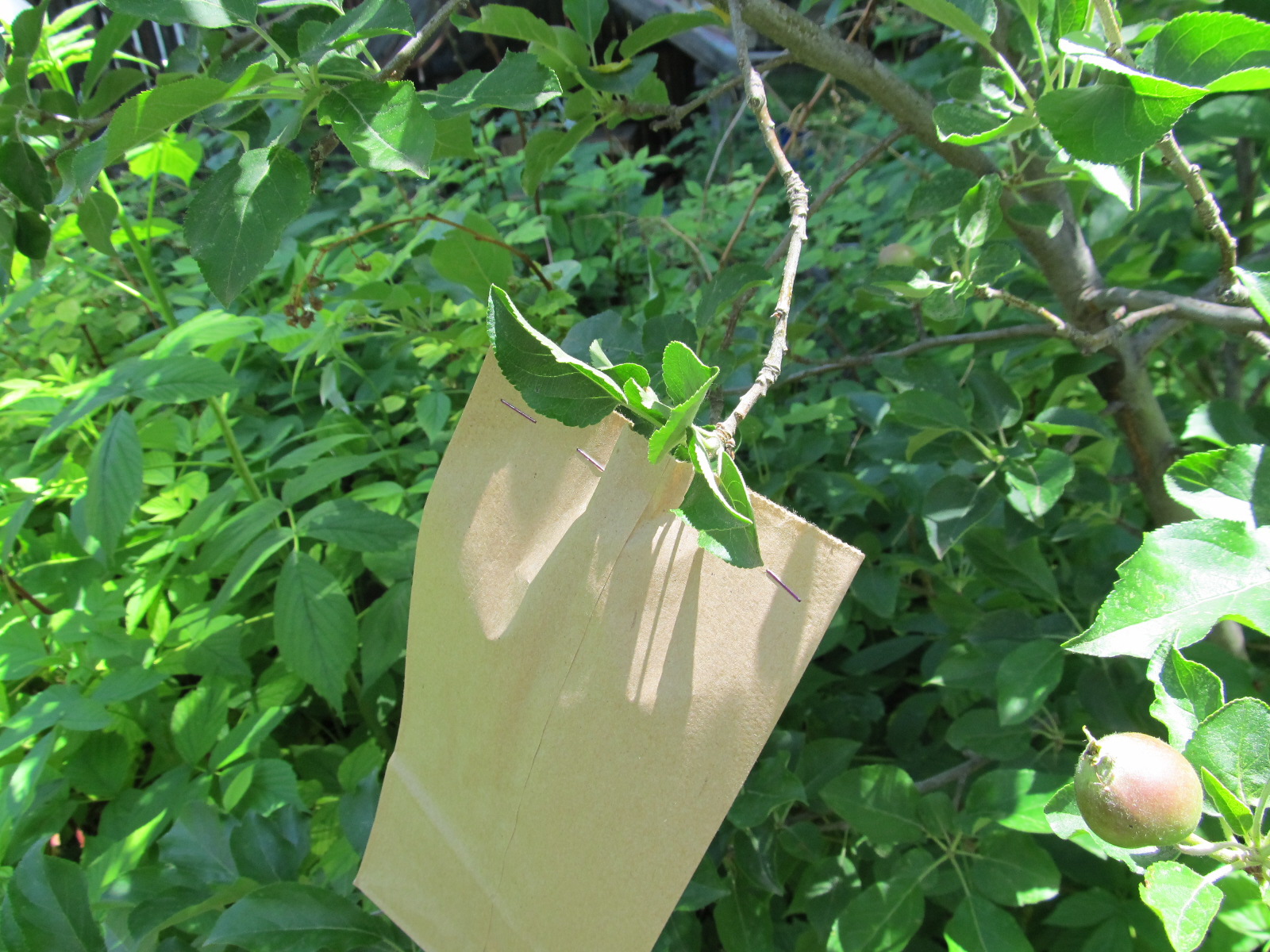
Put staples in the edges of the bags while sitting in the shade, then slip the bag on the apple and do the last staple.

So, it’s late June, 4-5 weeks after my apples bloomed. I go through, select the biggest apple in each cluster that I can reach, and staple a paper lunch bag around it. The apple will grow inside the bag, moths won’t get to it to lay their eggs, and by picking off the smaller apples in the cluster, the chosen one will get bigger. The paper bags are kind of ugly, but I am hoping they will fade into the background- I’m not hosting a garden tour or anything.

I will start with the golden delicious-(it’s my favorite, did I mention that?) and then put bags on the big tree for as long as my patience (and my stapler) holds out. I bought a package of 100 bags, but I don’t think I’ll get that far. This fall, I’ll update how it goes.

Lazy Granola with Chinese 5 Spice


I’ve been cleaning out the freezer in the garage, not cleaning cleaning, you know, just sorting out what’s in there and eating it if possible. I came across a quart of peaches in vanilla sugar that I had sliced and frozen last summer. Since we are only a month away from new peaches, I figured I should do something with them.
Last year I made a peach crisp and instead of using cinnamon, I used some Chinese 5 spice powder. I had gotten it at our co-op, where you can buy bulk spices and herbs. I like being able to buy a tiny bit of things I’ve never tried before. I open the jar, smell it, scoop a little in a bag- it winds up being like 25 cents for a recipe’s worth. (It drives DH crazy, though, because I never label the bags, so there are all these bags of green herbage in the cabinet)
I had first used the 5 spice in a dry rub for steak, which got a thumbs- down from DH, and a thumbs up from me. So, then I tried it in peach crisp, and loved it, but it got a thumbs down from basically everyone else that I made taste it. We are picky around here, I tell you.
According to the Spice House website, which is a supplier of herbs and spices, their 5 spice mix is: “Gently hand mixed from China Tung Hing cassia cinnamon, powdered cassia buds, powdered star anise and anise seed, China No. 1 ginger and ground cloves. http://www.thespicehouse.com/spices/chinese-five-spice-powder By my count, that’s only 3 spices, unless the seeds of anise taste way different from the pods…and the cassia buds taste different from the bark… which I guess it could, but that still only makes 4. It’s a mystery.
Frontier is the distributor of the bulk spices at my co-op, and their website doesn’t list any ingredients at all- their listing reads like the J. Peterman catalog: “Chinese Five Spice Five Spice Seasoning includes all five tastes: sweet, sour, bitter, salty, and hot or spicy. Thought to create a balance of yin and yang, this spicy blend makes for a great twist on American dishes too. And it’s salt free!
Maybe I should sell it harder with my kids, “C’mon, try it, you know how you’ve been needing to balance your yin and yang!”

I loved the 5 spice, but I am virtually the only one in my house who does. So, then, I figured the streusel topping stuff was essentially granola, and wouldn’t life be easier if I could just slice some peaches, put yogurt on top and sprinkle it with granola. I could cook up a big batch on a cool day, and have it ready for peaches any time I wanted.
Lazy Granola
2 cups rolled oats
1/3 cup oil
1/3 cup brown sugar
2 teaspoons 5 spice powder, or cinnamon, or whatever spice floats your boat
½ cup almonds
Dump everything into a bowl and mix with a wooden spoon- all of the oatmeal flakes should be pretty evenly coated with the sugar/oil mixture. Preheat oven to 250, pour the granola mix into a sheet pan and toast for an hour. Shake and stir it every 15 minutes so it browns evenly. When it cools, store in an airtight container.

No photos- beautiful arty pictures of year-old frozen peaches, or uniformly brown granola are beyond my food stylist skill level right now.

Asparagus Update


The shoots of Asparagus in the new, horseshoe-shaped bed are up- thinner than pencils, but they show me the plants are alive. I’ll carefully layer more compost on top (carefully, because I don’t want to knock anything over). I’ve had to grub out some thistles that like the compost and moisture, too. Once the trench is up to ground level, I will put on a thick layer of mulch to keep down the weeds.

Little asparagus shoots, before I dug out the grass and thistles.

Asparagus Bed- do it right once…


I got 25 asparagus plants in the mail a couple of weeks ago. Actually 50, because I split an order, but 25 were mine. I knew they were coming, but kind of put them out of my mind, because they are a lot of work. Planting asparagus is the kind of thing that if you do it right, you only have to do once… it’s a lot of pressure.

I put in 10 purple asparagus plants about 4 years ago, and did them in a raised bed. My thinking was that all the directions say to dig a trench, then as the plants grow, add soil to them. I thought, why not put them on the ground, then add soil as the plants grow? I had excavated for our flagstone patio, and had a lot of topsoil, so I thought it would work…I thought wrong.

It is dry here in Northern Colorado, and one of the benefits of the trench method is that the plants get more water. Out of the 10 that I planted, only about 3 are still alive, and I have never gotten a meal out of the planting. Last year, I was able to pick about 20 spears, but not on the same day, of course. I just ate them raw out in the garden.

So, this year, I am working harder on it.  Last Spring I put some horse bedding down in an area near the apple tree (I planted some perennials, but they didn’t work out (moment of silence for dead lady’s mantle)) so I had an area about 10 feet across with some pretty decent soil. It was also the area I had hop-scotched my compost bin around, so there would be some pretty nice compost there, too.

My poor little poin-and-shoot camera- it's like, "what did you want me to focus on here? the shovel? the dirt? what am I looking at here?"

 I figured instead of digging a long trench, I would do it in a horseshoe shape, and use the space in the middle as a vegetable bed this summer. This is where my tomatoes and peppers will go, so they can benefit from the water and compost, too.  In Permaculture books, they call this a keyhole bed, because you access it from stepping stones in the center- it minimizes the amount of path you need to get to plants.

The weekend the plants arrived, it had rained lightly, so the soil was actually digable- the end that hadn’t gotten as much horse bedding was clumpy and hard to get through, but the side that had been mulched was like slicing chocolate cake.  Well, maybe not like cake, but it was certainly easier.  We have clay soil, so the more organic matter, the better.  I dug down about the depth of my shovel blade, and put the loose dirt in the center of the horseshoe.

The following day, I placed the plants- about a foot apart in the trench. I then mixed the loose soil with a few bags of coffee grounds I had gotten at Starbucks, and covered up the plants. All of them already have shoots on them, and in the last week, I have scooped more of the soil from the center on top, slowly filling in the trench. God has been helping out with the rain- (Thank you, God) making up for a very dry winter with a nice wet spring. As they grow, I’ll continue to add more soil on top, and compost. I won’t eat any spears from this year, but by next year I should be able to harvest for a week or so, then more and more. I hope not to have to do this job again. Unless we move…

Previous Older Entries Next Newer Entries