Water in the west


A dusty spider web, waiting for rain.


I recently learned about  Liebig’s law,( http://thearchdruidreport.blogspot.com/  ) an ecological principal I wasn’t familiar with before. I always blame my lack of scientific knowledge on the fact that my junior high science teachers were ski coaches, and then I had the football coach for biology in 10th grade. By the time I got Mr. Marta in my junior year, I was already on the road to being an English major. I’ve been trying to make up for it in recent years.  Anyway, Liebig’s law is basically that whatever resource that is necessary for an organismto survive is in the shortest supply is what puts an upper limit on the carrying capacity of an environment for that organism.  For worms, it might be organic matter, for tomatoes calcium, humans on the Planet Express Ship, oxygen… in my garden, in Northern Colorado, the limiting factor is water.

I read a lot of organic gardening books, and magazines, and most of them are centered on the east coast, where wet soil is the problem. There is lots of information about drainage, and raised beds to dry out your soil faster in spring, and waterlogged roots and certain plants not liking “wet feet”

 I noticed today that there are cracks in the soil of my flagstone path. The sand that separates the pavers is falling thru to the center of the earth. There are probably cracks in the beds too, but the mulch hides them. I have run the drip system in the beds, and the sprinkler in the lawn, but I don’t water paths, so the cracks will get bigger until it rains. We had a misty day last Saturday, enough to make it cold and unpleasant for the boy’s soccer game, but it didn’t close up the cracks in the soil.

I went to Massachusetts on vacation this summer, and it rained solidly much of the time we were there. I asked landscape professional (okay, he was a tree trimmer) how much rain they averaged in that area, and he didn’t know how much rain they got. He shrugged, and looked at the other guys on his crew, and guessed about “an inch a week?”

 Around here, people tend to know , to the fraction of an inch, exactly how much moisture we’ve gotten- they’ll say “well, the weather service says half inch, but I only had three tenths in the rain gauge.”

It has not rained here for almost a month- we’ve had some scattered showers, but the soil is cracking, and the woods are burning. The fire in Boulder has made national news, my great uncle has had to evacuate his house. There was another fire near us, DH took the kids up to take pictures for the paper (link). A big pile of hay is on fire in Fort Collins, with sunny and warm in the forecast for the next week.

Mulch and compost help, and using native plants, and the Denver water board has a ton of information on dry climate planning and planting (www.denverwater.org/Conservation/Xeriscape ) I am experimenting with a sunken bed, the opposite of raised, obviously. I have dug out about 4 inches of soil next to my horse tank, and I’m adding some compost when I put in tulips and irises. I’ll let you know how it goes.
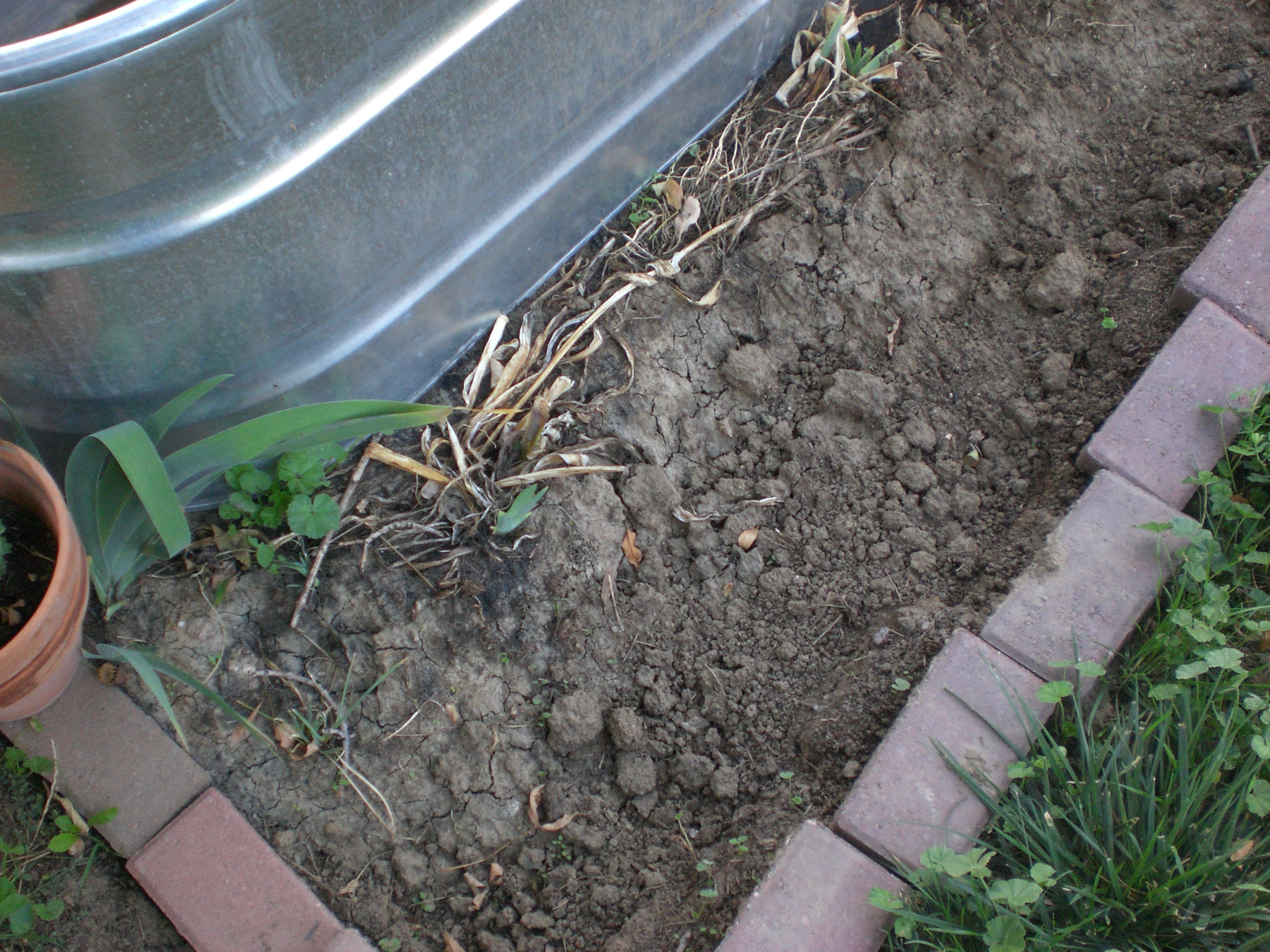
I dug out a couple of buckets of soil, and will fill this in with compost. It's ugly now, but wait til next year...

 When I see the smoke in the air, I wonder about the future- I can drag the hose to the raspberries, and run the sprinklers to keep the trees alive.  I hope for rain, though 
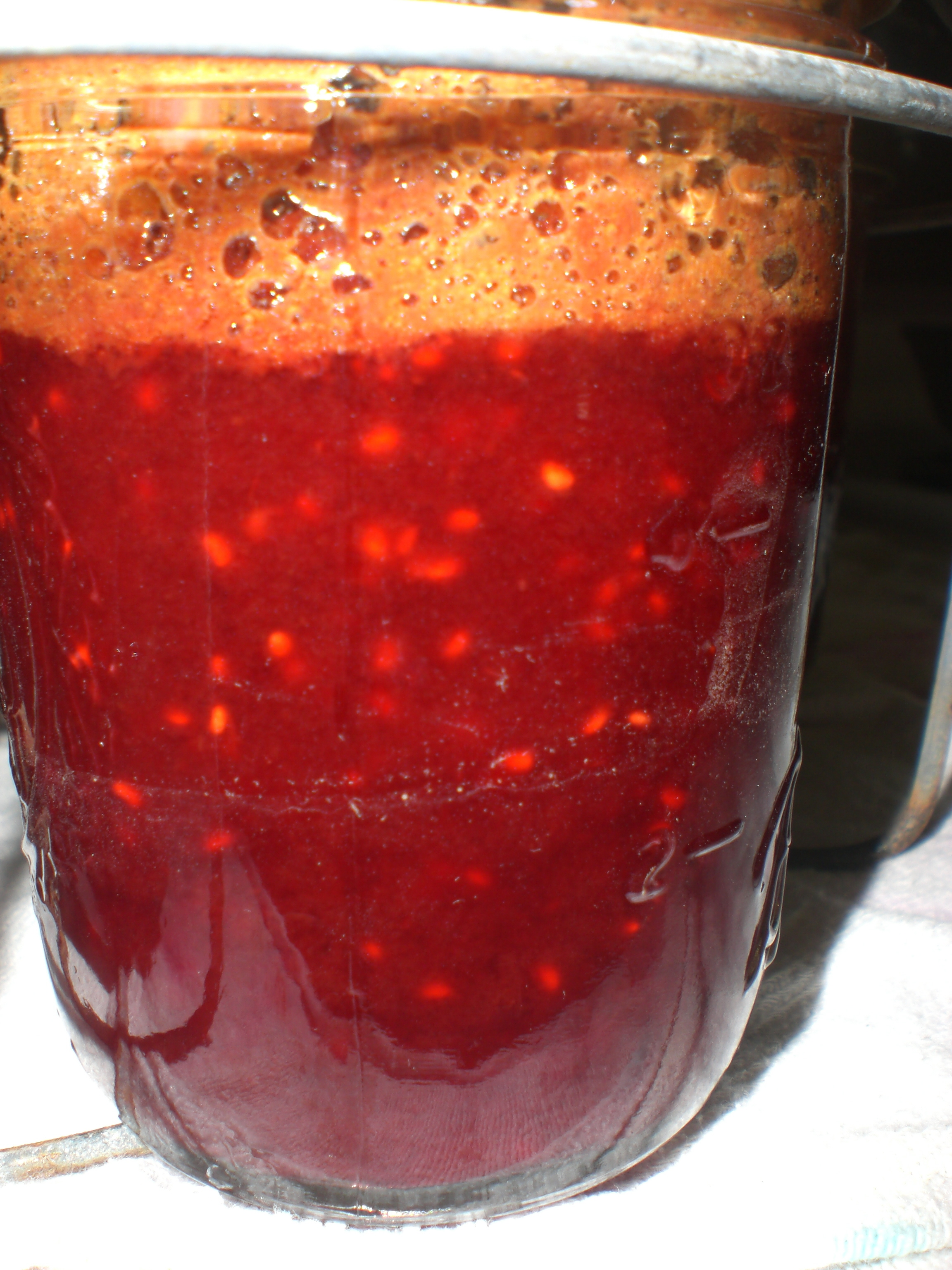
 

Why homemade jam? Why not?


You're supposed to skim the foam off to make it prettier, but I didn't.

Our first jar almost finished- 6 days after it was made.

Even though only the girl and I are eating this stuff, we are zooming through it. Looking for excuses to put jam on stuff. You know, I could go for a piece of toast right now.

So, in a world where you can buy jam at the store, where there is a whole grocery aisle devoted to it, why bother making it at home?  I’ve been thinking this a lot lately, as I’ve been making bread, buttermilk, soup stock, lots of  stuff from scratch that my mom, for instance, never made. What do you make from scratch?

The short answer is that I enjoy it, mostly.  It feels good to have stock bubbling away in the crock pot, and then turn that stock into soup. It is kind of fun to stir fruit and watch it bubble and thicken in a pan, then spoon it into jars. 

Cost enters into it as well- buttermilk costs 4 times as much at the store as it does to add some old buttermilk to fresh milk and let it culture. Once you have started a jar, you have a lifetime supply.  I did a little research on line to see what organic raspberry jam would cost, and prices varied from $4-$9. I would never pay that much for jam.  As it is, the berries were from my garden, so free ( ha ha, if you don’t count the labor and the water…) the pectin was about $3 for 6 jars, and it was probably $2 worth of sugar. 

The quality is the last, best answer.  The reason I couldn’t find the price of raspberry chocolate jam is that no one appears to sell it. And it is reallllly good.  To make it, I add a tablespoon of  cocoa powder to the recipe on the insert of the pectin package, and follow the other directions as stated. It could probably be done with cherry or strawberry, too. Experiment.

Pat Daly and the Fukuoka Pumpkin


            The summer I got married, a bunch of my friends were living in a rental on Plum Street in Fort Collins. None of them were college students at the time, but this was a classic college student rental house- old, near campus, big trees, but unkempt. I was over one day, eating a carrot, and got to the stem end of it. I looked around for a compost bucket on the counter, because I knew Pat Daly had had a compost pile at his old house. I asked him, and he took the end of carrot out of my hand and opened the back door and hucked it out into the bushes. I must have looked a little surprised.

“Have you read One Straw Revolution?” he asked. “Masanobu Fukuoka,” he pronounced carefully.  “He’s this Japanese guy who says don’t plow, or turn the soil, just plant everything in mulch, and use everything to mulch with, instead of big compost piles.” That was his summary of the philosophy- mulch everything, and anything can be mulch. There’s probably more to it than that.

We stepped out into the back yard- knee deep in grass and weeds, a squash plant trailing through, tomatoes ranging around.  Later that summer they would get a letter from the city telling them to mow, because of complaints from neighbors. I still haven’t read One Straw revolution”- it was out of print, and I hadn’t come across it in my used book store travels. A quick look on Amazon shows me that it has been reissued, so maybe I need to pay 10 bucks and get an education. http://www.amazon.com/One-Straw-Revolution-Introduction-Natural-Classics/dp/1590173139/ref=sr_1_1?s=books&ie=UTF8&qid=1284220635&sr=1-1

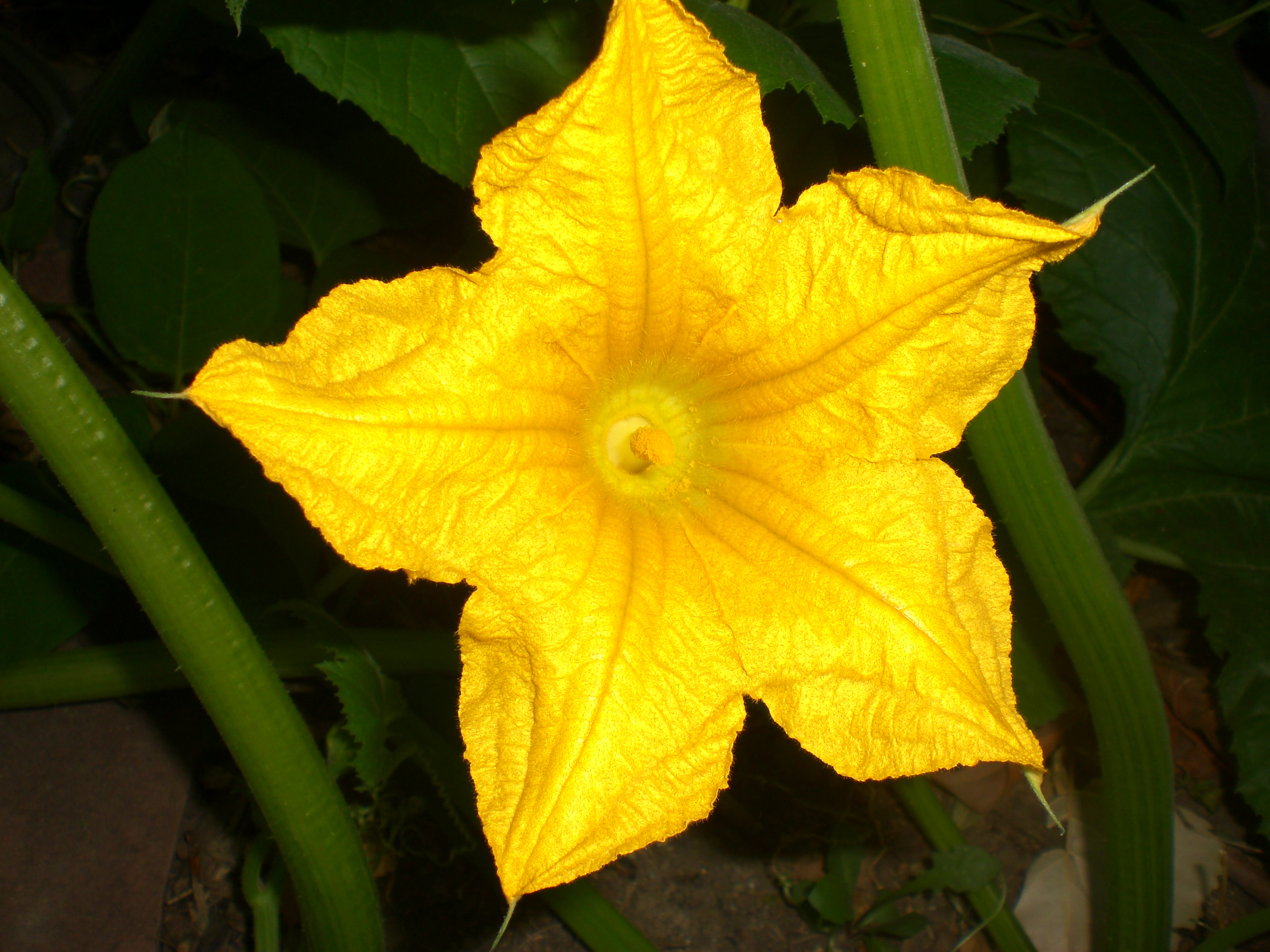
I thought about Pat Daly and his Fukuoka experiments earlier this summer when I noticed a sprout growing next to my back door- when it was little, it was hard to tell if it was a cucumber or sqaush- they look alike to me.  I didn’t pull it, even though I didn’t technically plant it. Sometime last fall when I was emptying the compost bucket, I was  too lazy to walk out to the bin. Maybe it was snowing, or just dark, or…honestly, I don’t remember. Seeds got dumped in amongst the leaves by the veggie bed, and one sprouted this spring. A month or so later, the plant was growing into the path, so I turned it 180 degrees, and now it’s growing behind the bed towards the house. Maybe it’s a weed, but free squash is good squash.

What kind of squash? Who knows?

What is it? We got a lot of different squashes from our CSA last year www.grantfarms.com pie pumpkin, decorator pumpkin, gourd, acorn squash, weird lumpy green ones that tasted really good but made the pie look like baby poop…It could be any of them, or a cross. There were male blooms, and just now, female blooms with fruits growing behind them. Still unidentifiable.  I have my fingers crossed for a bumper crop of mystery gourds. We’ll just call them Fukuoka pumpkins.

Slight digression- one of my favorite sites on the interwebs is One Straw www.onestraw.wordpress.com  the saga of a suburban guy who is turning his lawn into a microfarm. There’s a man who knows the value of mulch.

Accidentally planted, carelessly nourished, cautiously harvested...

More compost than you know what to do with?


"Luke, I am your compost bin..." "NO!! thats impossible!"

“Do you ever find that you have more compost than you know what to do with?’ My colleague Lindsey asked me this one winter day a few years ago. I tried to keep my cool, tried not to frighten her as I thought about how to get this bounty of excess compost into my pick-up truck.  Lindsey and her family are vegetarians, and they don’t garden. They keep a compost pile for environmental reasons.  I am not a vegetarian, I do garden, and I can never get enough. 

            “Too much compost eh? Well, I could take some off your hands…” I didn’t quite rub my hands together and laugh evilly, but it was close. In talking to her, it turned out she didn’t have too much, it is just that her bin is small, and decomposition had slowed down in the winter, but she and her family were still producing potato peels, apple cores and other vegetable matter.  I advised her to move the bin to a new location, spread the half-finished compost under her trees, and put the new material into the bin in the new location.    

            I have two compost piles, and never enough compost for my desires. I spread it on my vegetables, around my flowers and shrubs and herbs. The rough, chunky unfinished stuff becomes mulch. The finished stuff, the compost you read about in garden books, goes into my containers mixed in with potting soil, and it goes in the holes for new plantings, to add humus to the soil and give plants a jumpstart. People say I have a green thumb- I owe it all to compost.

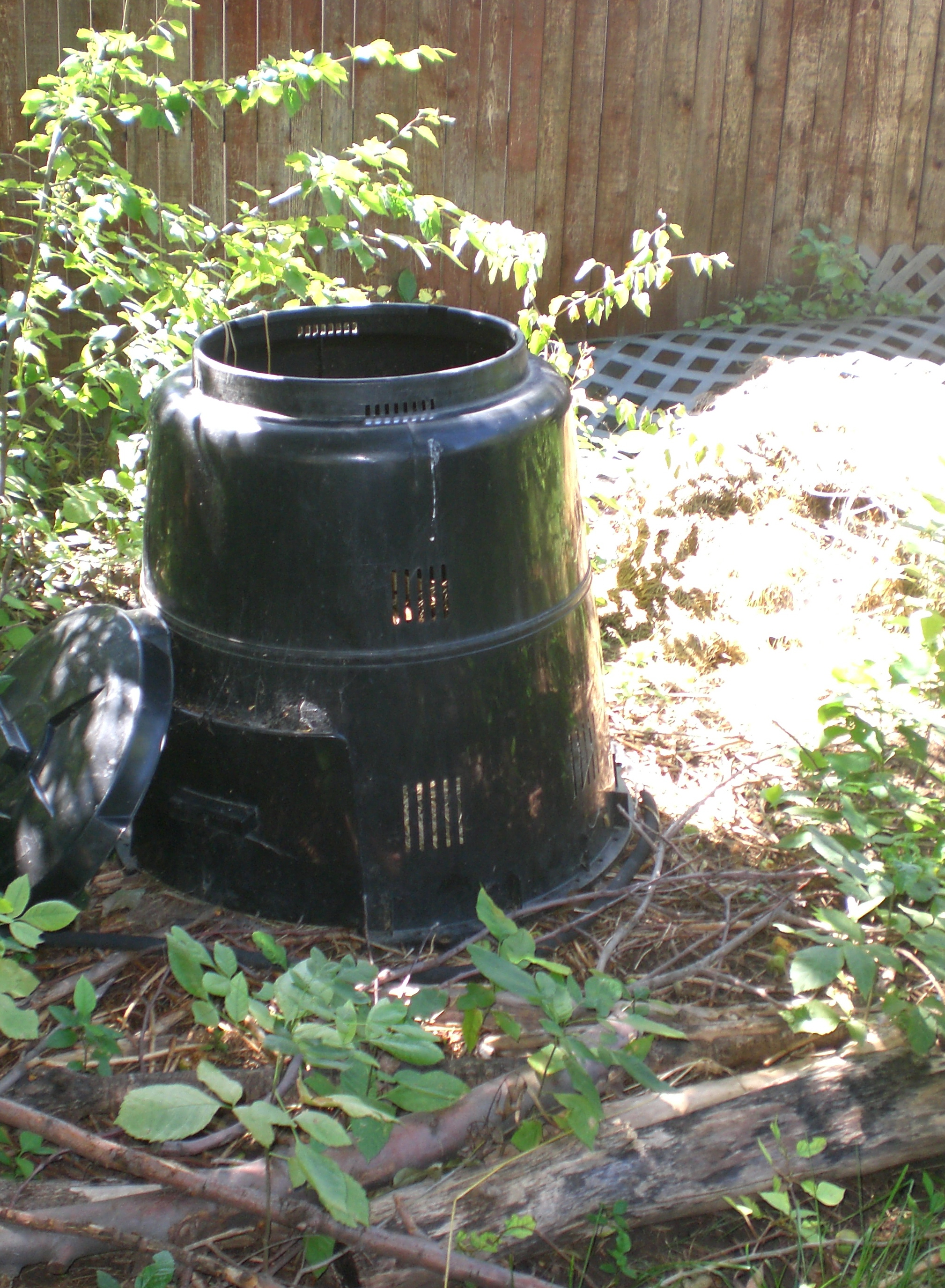
            One of my bins is black plastic- I bought it from the city a few years ago. It looks like Darth Vader is buried up to his neck in my yard. (link to compost bin?) It would look cool, if that were the look I was going for. It isn’t, so I try to hide it behind a tree.(link to self)  The black plastic helps the bin heat up, speeding decomposition.  In the summer, at the height of weed season, I can stuff the bin full, hose it down and put the lid on. In a week, when I have another trash barrel full of weeds, there is already room for it.  The bacteria and fungi in the bin have eaten up the organic matter so quickly that it breaks down by half in only a week.  It’s amazing, even if it is a little gross.

            My second bin is enormous. The design is my brother’s invention- two plastic lattice panels wired together into a circle five feet in diameter and four feet tall.  If you read the same books I do, you know that a compost bin has to be at least 3 feet in all dimensions in order to heat up enough to kill weed seeds.  My lattice bin holds about 2 cubic yards, and heats up so effectively that I have never been able to fill it. I can add bag after bag of leaves in the fall, barrel after barrel of weeds in the summer, and it just continuously boils down. 

            On a  sunny day in the spring, I  spread out the finished compost, move the bins and start over.  This is the only work I do with my compost bins- some people do turn theirs, but I am not one of those people.  For a peek into another world of largescale compost production, see One Straw’s posts at htt[:/onestraw.wordpress.com .  If you have a yard cart that the trash trucks pick up, you probably pull weeds and rake leaves and then wheel that material to the curb. I just wheel my material to my bins and dump it.  The difference is, I get to keep the free compost.

Simple Pleasures


I love my new watering can. Shortly before mother’s day, we strolled into Jax, which is a curious hybrid- farming/camping/ military surplus/ high end housewares store. There was a display of galvanized watering cans out front, and I said, ooooh, and made goo goo eyes at them. My husband took a risk, (I am hard to buy gifts for, did I make goo goo eyes seriously, or was I being ironic? is it wrong to give a practical gift, or should the mother’s day gift be gushy and romantic?) anyway, he took a risk, and bought it for me, and it is even better than I expected. It is my new favorite gardening tool.
I use my pond as a garden water source sometimes- I’ll dip a watering can in and spot-water my tomatoes, and any other new plantings that need it. Then, I use a hose to top off the pond, so the goldfish get fresh water, and the plants get lightly “fertilized” water with the chlorine burned off. This is absolutely the best watering can to use for this- it has a bucket handle, and a pour handle, the spout comes off at an angle very close to the bottom of the can. It is also well balanced, easy to carry, even when full- it holds about 2 gallons. Because the opening on top is so big, it fills very quickly when I plunge it into the water.
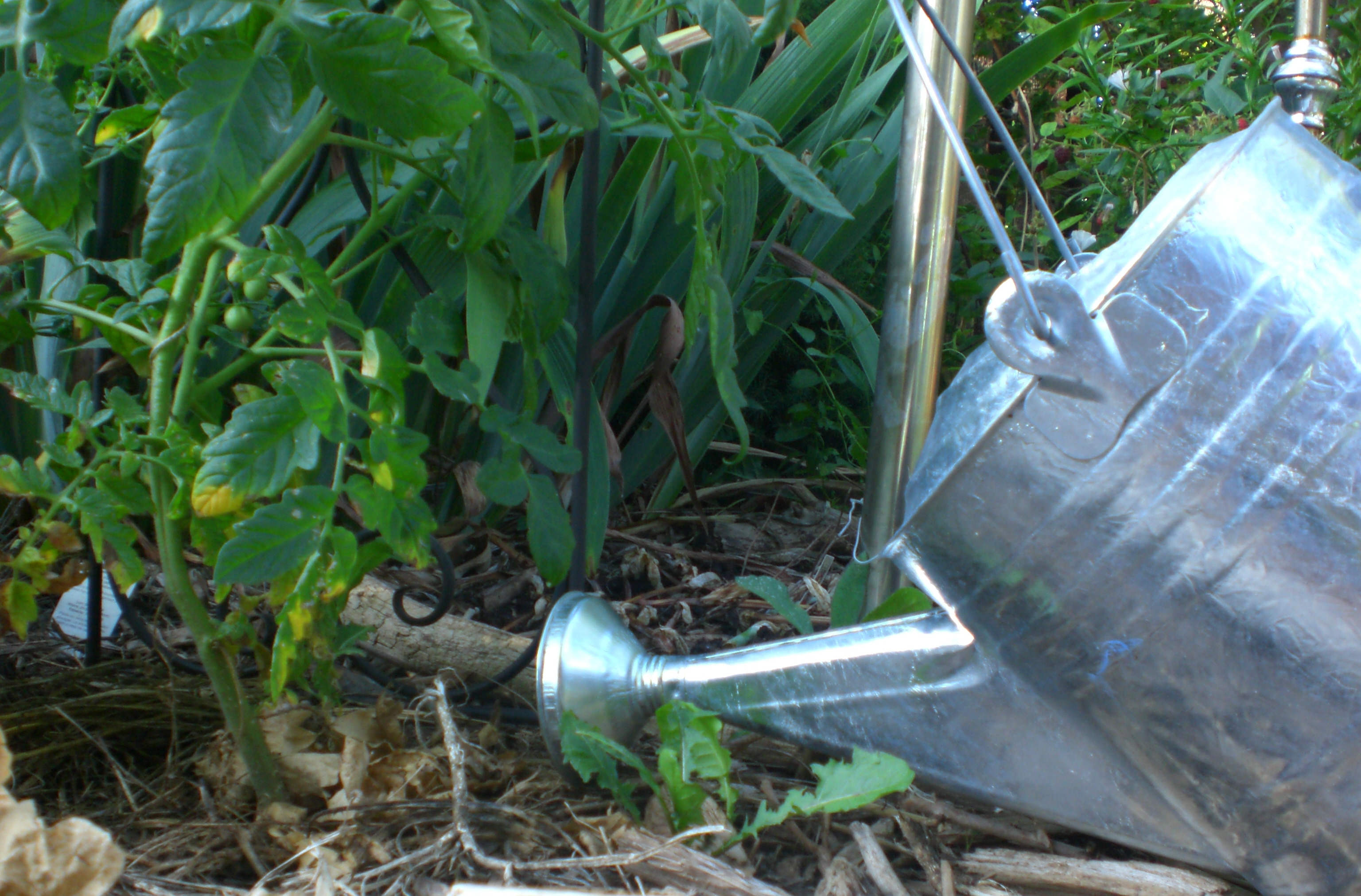
My favorite part, I discovered by accident. I was watering a tomato, and set the can down, hoping to kind of prop it up so it would still water for a minute while I pulled a weed. It balanced perfectly, tipped up, slowing pouring the 2 gallons of water out onto my tomato plant. I don’t have to stand around with a can in my hand any more, I can set up the water, pull some weeds, deadhead a few flowers, then refill the can and set it up again.
Why, you ask, don’t I just use a hose? I do, sometimes. I have a soaker hose set up in most of my beds, but really, most of my plants don’t need to be watered on a daily basis. Some, like the tomatoes, really do need water regularly. Some, like lavender, actually resents it. Rain water is enough for a lot of my herbs, and most of my “xeric bed” is set up to thrive on precipitation. Living in a semi-desert area, it works for me to just spot-water the things that need it. Your favorite gardening tool?

Propped up watering can

This is the can in action, soaking an Oregon Spring tomato plant. Yes, that's a dandelion right under the spout. I just pulled it.

Surprising Cilantro


I’ve been planting cilantro for years, enjoying the young, lower leaves in salsa, pad thai, and other yummy international dishes. I’ve always cursed when it would flower and go to seed, I’d pull it up and plant something else in its space. I even bought “large leaf” cilatnro seed, with promises from the seed catalog (oh, seed catalog writers, let me believe your sweet, sweet, lies…) that it was “slow to bolt.” Bolting means flowering and going to seed.
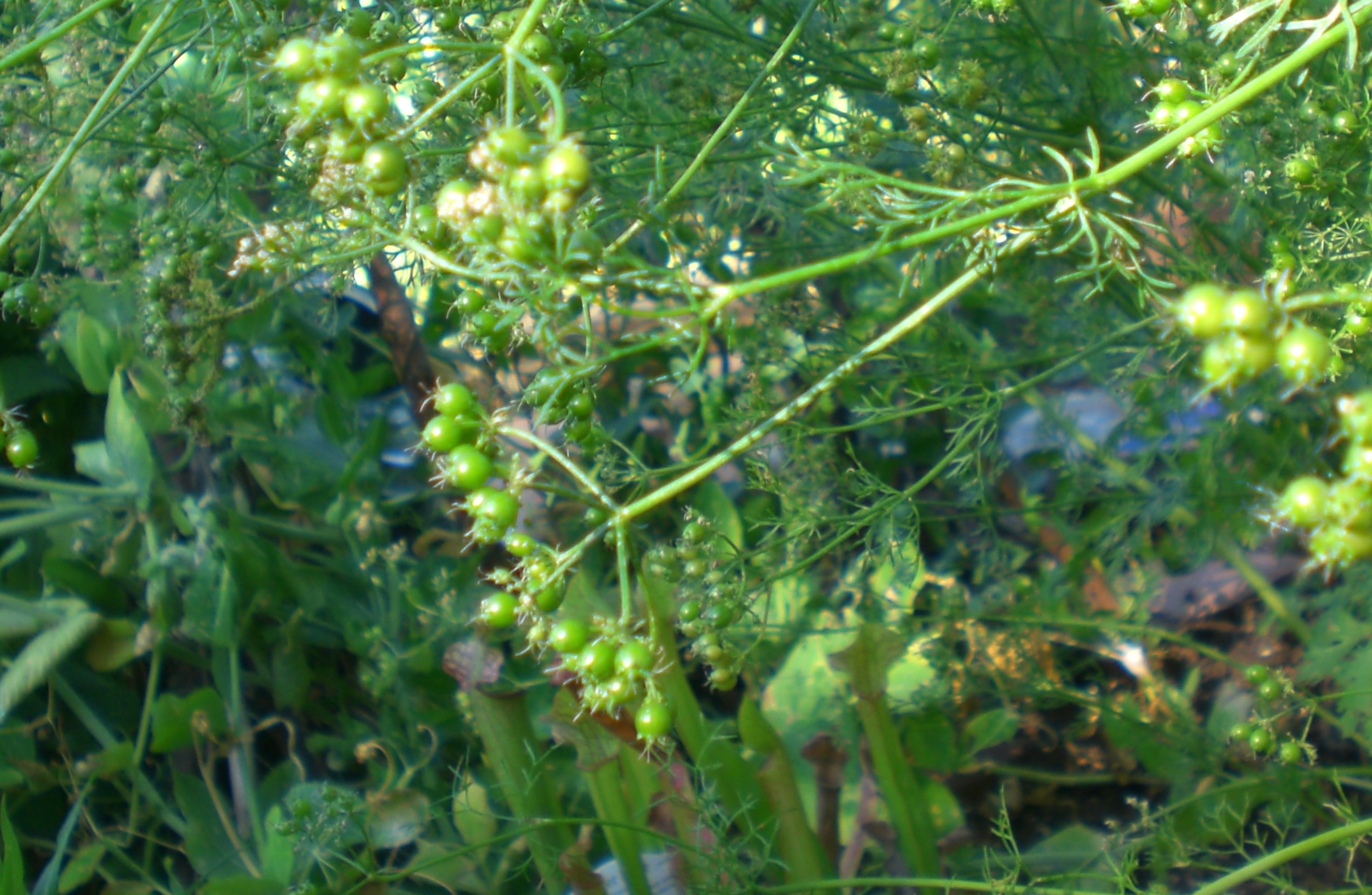
But this year, I let the cilantro in the boy’s garden flower, and it is lovely- cilantro is umbelliferous, cousin to carrots, queen anne’s lace and yarrow- beautiful white flowers that dance on the wind. Now, the seeds are forming, and once they turn brown, I’ll harvest the them. At this point, they’re called coriander, for some reason. I’ll plant some next spring, and use the seeds this winter to put in dry rubs, stir fries and maybe bread…I wonder if they’ll sprout, like alfalfa sprouts….that might be weird, actually,on a sandwich. Anyone tried sprouting coriander?

The leaves are called cilantro, and used in ethnic cooking

You can see why the type of plant is called "umbelliferae" the flowers come out of the stem in a shape like an umbrella.

A Radical suggestion


            I would like to make a radical suggestion: buy your Christmas tree now.

            In garden centers and big box stores, there are evergreen trees, spruces, pines, firs, beautiful future Christmas trees.  You could pay 20 dollars for a decent sized evergreen  Add another twenty or thirty dollars for a pretty pot, and you have a great specimen  that will add structure to your yard or patio, and next Christmas, a tree for inside.

            Now, wait, you say to yourself, you read all those articles back in December about choosing between a cut tree and a fake tree, and there was always a brief mention of the third road, the live tree.  However, there is the implication that it is a lot of work: you have to dig a hole before the soil freezes, you have to special-order a ball-and-burlap tree, only bring it into the house for a few days lest it break dormancy, and put it in the ground a soon after Christmas as possible.  I am here to say it simply isn’t true. 

Maybe I should have said this before Christmas, and I did, to anyone who would listen, but let me tell you now, in July, it is not only possible, but pleasant to have a living holiday tree in your house.   I have bought three Christmas trees in the last eight years.  The first was an Alberta Spruce, purchased for five dollars, and plunked in a pot.  I know I paid more for the pot than for the tree. It was only about 15 inches high, and was a great tree for two Christmases.  When we bought our house, I planted it in the garden, and it is still only about 30 inches tall. It is a dwarf, after all.  

The first year, we left it outside in its pot, watering often in the summer, and whenever I remembered in the winter.  We brought it inside the weekend before Christmas, and watered it with ice cubes, to keep the root ball cold. We always undecorate for Christmas on January 6, 12th night, and that year, as I recall, it was warm, so we just put it outside. A few branches had broken dormancy, and sprouted, so they froze when the weather got cold, but it did no lasting harm to the tree.  Tell me there was no lasting harm to the tree you bought at the tree lot.  The following year, we did the same, My daughter was toddling, and I thought it was nice to be able to put it on the table, out of reach, but my husband expressed a desire for a bigger tree.

So, the next spring I chose a three foot tall Colorado Blue Spruce, and bought a 20” terra cotta pot to go with it.   I honestly can’t remember whether I paid more for the pot or the tree, but it probably doesn’t matter, because I still have them both, five years later.    We have it down to a science now: bring the tree inside just before Christmas,  water with ice cubes, put it back out two or three weeks later, and take care of the tree as a large potted specimen the rest of the year. It is a nice anchor for one of my flower beds, adding height and structure. 

Are there any disadvantages? Well, you have to water the tree during the summer, and it might die.  I could point out that you have to water petunias, or geraniums, or any other plant you might have in a container, so why not a tree?  As far as the risk of killing the tree, the one you buy from the Lion’s club is already dead, and the artificial one was never alive, and they were both probably shipped from somewhere very far away.  A little live tree is much easier on the environment.

  Another disadvantage is the small size. In our house it doesn’t matter. We have a ranch house built in the ‘60’s with low-slung ceilings- it has a very horizontal feel. The pot for our current tree is about 20 inches high, and the tree is 40 inches, so the whole thing, including the angel on top, is shorter than I am. If I had a huge entry way, with a grand staircase, the tree might feel… puny.  However, I suspect there are more people in the world with little houses than big, anyway. In our house, our tree feels just right, it might feel just right in your house, too.   

So, go out and get yourself an evergreen.    In order to keep your tree in the same pot for a few years, find a pot that is 20 inches in diameter or bigger.   Use good quality, well draining potting soil, and mix in slow release fertilizer. Place the pot in full sun, and water regularly. Then next winter, when the question of “real or artificial” comes up, you can sniff and say, “we don’t have a tree carcass in our house, we have a live tree.”

Next Newer Entries