Cold-Brewed Coffee- oh my gosh!


I’ve written before about deciding to spend less money on trips out for coffee, and I mostly have. The hot brewed coffee using the little Melitta filter funnel has been great. The magic moment, though, was when I learned about brewing coffee at room temperature to use as iced coffee.

 Holy cow- there are apparently devices that you can get to make it for you, but honestly, if you have a jar and a strainer…
Here’s what you do- put about a cup of coarsely ground coffee into a jar, then add a quart of room temperature water. I’ve tried it with filtered water and straight out of the tap, and I don’t think there’s much of a difference. We have good tap water here- if it’s good enough to drink, it’s probably good enough to brew cold.
So, where were we? Oh yeah, coffee in jar, water in jar, let it sit…I go about 12 hours, or as long as I can remember. A woman at City News, a non-Starbucks coffee institution, told me they brew it for 24 hours. I think the longest I’ve gone was about 16 hours. Then strain- I strain it through a mesh strainer, then use a coffee filter as well.It gets muddy if you skip the second straining.

No photos…jars with coffee… a more talented photographer maybe could make that work.

 I keep a jar in the fridge, and pour it over ice, with a bit of milk and a little raw sugar. I drink it through a straw, so I get little chunks of undissolved sugar on my tongue…bliss. Caffeinated bliss.

Citrus in containers


 When the girl was just a twinkle in her dad’s eye, I bought 3 citrus trees from a catalog- tangerine, lemon and lime, all for around 10 bucks. When they arrived, they were tiny- the largest was the lemon, and it was about the size of a pencil, the others were stems with roots. I put them in 8 inch pots, and put them on our west facing porch for the summer. When it got cold in the fall I brought them in, put them in a south window, took care of them through the winter, waited for them to bloom.
And waited…
The girl was a kindergartner when the tangerine tree bloomed, and produced tiny sour fruits… it blooms every other year, or so, and the lemon more regularly. The lime only has bloomed once.
The best winter for them was a year when I took them to school with me- my classroom at the time had a wall of north facing windows, and the heat was turned off at night. Perfect conditions. Indirect sun and cool nights are what everyone recommends for citrus in pots, and that room was perfect for it.

One of my favorite memories of the tangerine is from that year I brought it to school- I had a student who was hungry all the time- all teenage boys are, to a degree, but this guy- hungry all the time. The tangerines were hanging from the branches, still green, still wickedly sour. I was on hall duty, the bell rang and I came inside. The air was fragrant- I could tell someone had picked and eaten a tangerine- “Who?” all the boys tried to look innocent, especially Miguel, whose lips were in a permanent pucker.

Unfortunately, I only had that classroom for a year, and now the trees have to suffer through winter at my house.We have a low-slung ranch house, and there are no north windows, the west ones are shaded. The citrus live in the boy’s room, which therefore has a jungle aura to it. He doesn’t mind, at this point…

I underplanted the lemon with a jade plant- neither seems to suffer, although I can’t say either is benefitting. I have wondered if I should try to separate them, but I think I’d wind up killing both. It’s in a 14 inch pot, near a west window that is shaded. I move it outside in May, and watch the low temperature predictions.
The tangerine is the giant of the bunch, and it bloomed tremendously this winter. Because it bloomed inside, there weren’t any pollinators around, so I had to play bee. I took a paint brush out of the boy’s watercolor set and went around transferring pollen from one blossom to another. There are tiny green marbles on the plant now- although not as many fruits as there were flowers…not an exact science.
The lime is still the tiniest of the three, I may move it to a different pot, with new soil, this spring to see if that will jump start it.

So, at 11 years old,, are these plants thriving? Not really. If I lived in a place where citrus could grow in the ground, and these were ten year old trees, I think I would have more fruit than I could give away. In containers, they are much more like pet houseplants than anything that contributes to my food pantry. The Logee’ s book I reviewed the other day has some helpful tips, that I mostly already learned the hard way, in keeping them alive for 11 years.

 Someday, when I get my conservatory (dreams can come true) maybe they’ll produce more, but right now, I’m kind of disappointed.

 But, hope springs eternal, I’ve ordered a Meyer lemon, also cheap and tiny, and I’ll nurse it to adulthood as well, fighting for window space in my kids’ rooms. It arrived the other day, and I’ll now count down the years until I can make lemon curd. We’ll have a party, with vanilla ice cream, too.

Book Review: Growing Tasty Tropical Plants


I decided I needed a vanilla plant….never mind why… and did a little research on how hard it would be to take care of. I found a very discouraging website that told me vanilla orchids are vines that won’t bloom until they grow 20 feet tall, and that a person needs a large greenhouse to even think about having one.  I was sad. Cue the Charlie Brown music.

Then I went to the Denver Botanic gardens, and found hope. As we were getting ready to leave, at the greenhouse in the children’s section, I saw an employee wrapping a vine around  a structure that appeared to be made of chicken wire and sheet moss. I asked him what it was, and when he said, “Vanilla,” I did actually squee. I told my wonderful mother in law that this meant her son didn’t have to build me a two story greenhouse. (he could, and I wouldn’t mind…but he doesn’t have to).  Vanilla can grow wrapped around a trellis, with bright indirect light, and with the right conditions will bloom in a couple of years.

I discovered the book “Growing Tasty Edible Plants” at the library, and it covers vanilla, as well as citrus, which I have had for a few years, as well as coffee, pomegranate, tea, passion fruit, which I am always tempted by when I see the plants in catalogues, as well as stuff I’ve never heard of before. Peanut butter fruit, anyone?http://www.amazon.com/Growing-Tasty-Tropical-Plants-grapefruit/dp/1603425772/ref=sr_1_1?ie=UTF8&s=books&qid=1302136284&sr=1-1

The authors are Laurelynn Martin and Bryon Martin, and they are co-owners of Logee’s Tropical Plants. Logee’s has a tropical fruit catalogue and nursery, and they’ve apparently appeared on Martha Stewart. I wouldn’t know, I’m much too cool to watch Martha…  The book is informative- it is obvious that these people know their stuff about plants. The writing isn’t stellar, but it is obvious that these guys have lived with the plants they are writing about, they have grown them inside regular houses and greenhouses, and they have eaten the fruit. I get tired of researching plants and finding people who are writing articles about plants they haven’t grown.  The Martins seem to know what they are talking about. 

I went ahead and ordered a vanilla orchid from eBay, and I’ll use the info in this book to help me keep it alive. We should be able to make homemade ice cream in about 2015. You’re all invited.

Artichokes, an excuse to eat melted butter


Bubble, bubble...

When I was a kid and my mom would go out of town, my dad would make special dinners- the kind of thing that either she didn’t like, or that she considered too messy. Artichokes were sometimes on the menu for these meals. And, funnily, I don’t remember anything else on the menu those nights, that was the whole meal- just artichokes, dipped in melted butter.
Daddy would cook them in the pressure cooker, spread out newspapers on the top of the portable dishwasher in the middle of the kitchen, melt butter in a tiny pan on the stove top (it wasn’t before microwaves were invented, but it was before we had one) and we’d all stand around, ripping leaves off, dunking them in butter and scraping the flesh off with our teeth.
Once we got down to the chokes, the feathery tiny leaves that stick in your throat, my dad would trim them with a paring knife and distribute the pieces of heart fairly. Fairness in heart distribution was a big issue.
It’s the kind of thing that if you don’t have a childhood memory of it, you probably don’t eat. They are a bit of a pain to make, and eat, and dispose of, as well as looking intimidating in the produce section.  However, they are so good- rich in their own right plus extra good with the butter….  Can I suggest that you create a good memory of it? right now?
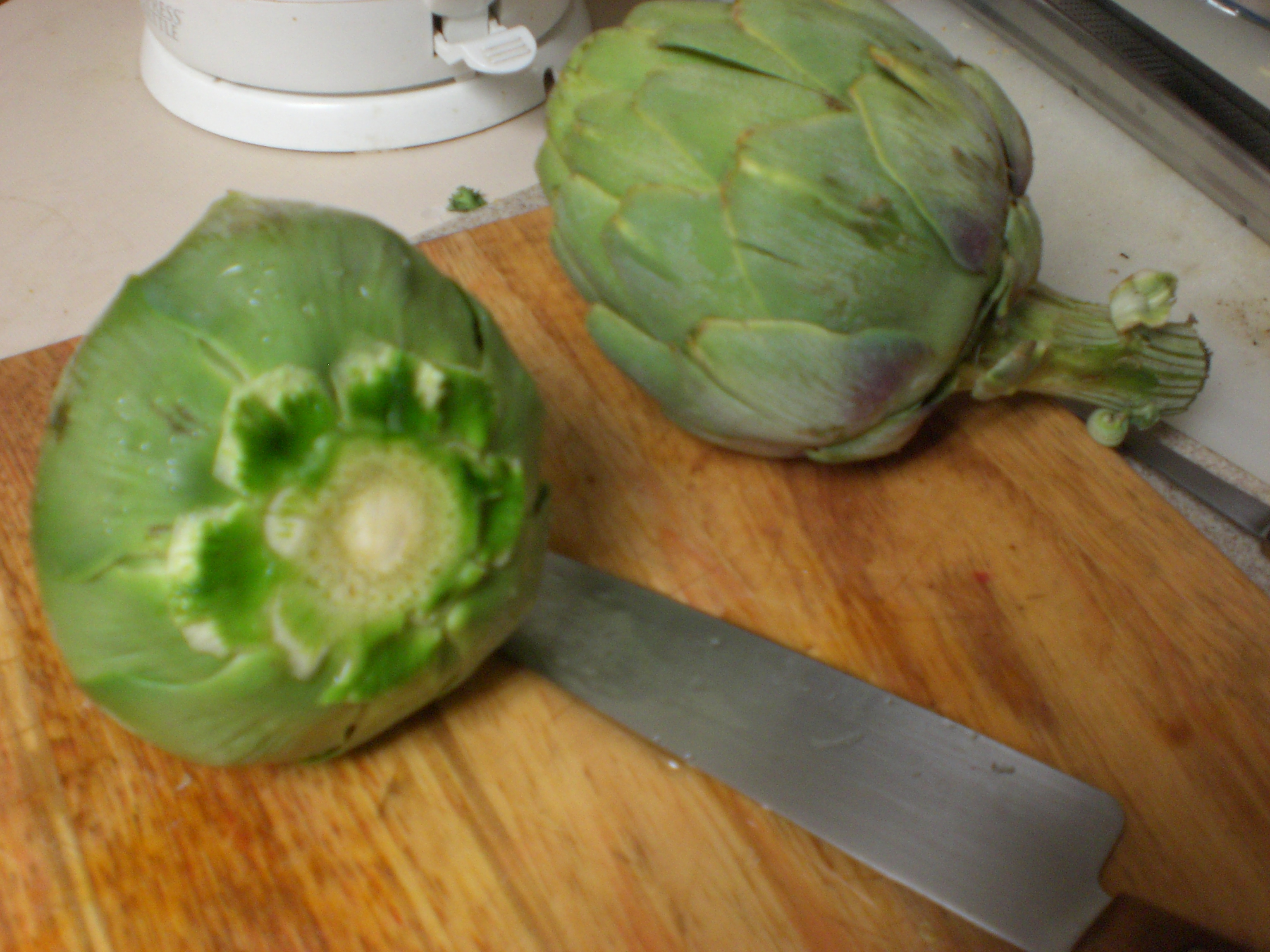
To cook- trim off the bottom stem, and the bottom row of leaves- these are tough anyway, and take forever to cook.

At our house, 3 of us like artichokes, and cooking 2 is enough.

Place in boiling water. I sometimes throw in a garlic clove, but not always. Boil until a knife goes into the stem end easily, about 20 minutes. Meanwhile, melt some butter (aren’t those some of the most beautiful words in the English language? right up there with “you look so much prettier without make-up” and “I’ve folded all the laundry”)
To eat, you pluck off the leaves, dunk in butter, then scrape off the soft stuff from the insides of the leaves with your teeth.

Turn the leaves upside down and scrape with your bottom teeth.

 The closer you get to the center, the more “soft stuff”  there is- once the tops of the leaves turn purplish, you can bite off the bottom 1/3rd of the leaf. 

Once you get to the stuff that looks like chick feathers, trim that off, and you have the heart- distribute it fairly. Sop it in the rest of the butter and enjoy.

I have tried to grow artichokes here in zone 5, and it is possible, although they don’t overwinter here. In warmer places, they are perennial, and produce more buds every year. I have read directions on the interwebs about pulling the roots at the end of the season, and storing them in the basement, the way people do with dahlias. I’ll try that this fall with the plant I have growing in the basement under lights.

Lemon Syrup and First-ever Giveaway


Brighten up late winter (yes, it's late winter, not spring, yet) with citrus.

Last summer I started making a lemon simple syrup to put in my iced tea- it adds sweetness and zing, without having to cut up lemons every time. Easy to make, and keeps a long time in the fridge. This winter I did it with Meyer lemons  and it had an amazing fragrance to it. However, Meyer lemon season is over, and my pint of syrup is gone, so it’s time for another batch. This could conceivably be used on desserts or pancakes as well, but around here, we just use it for tea.

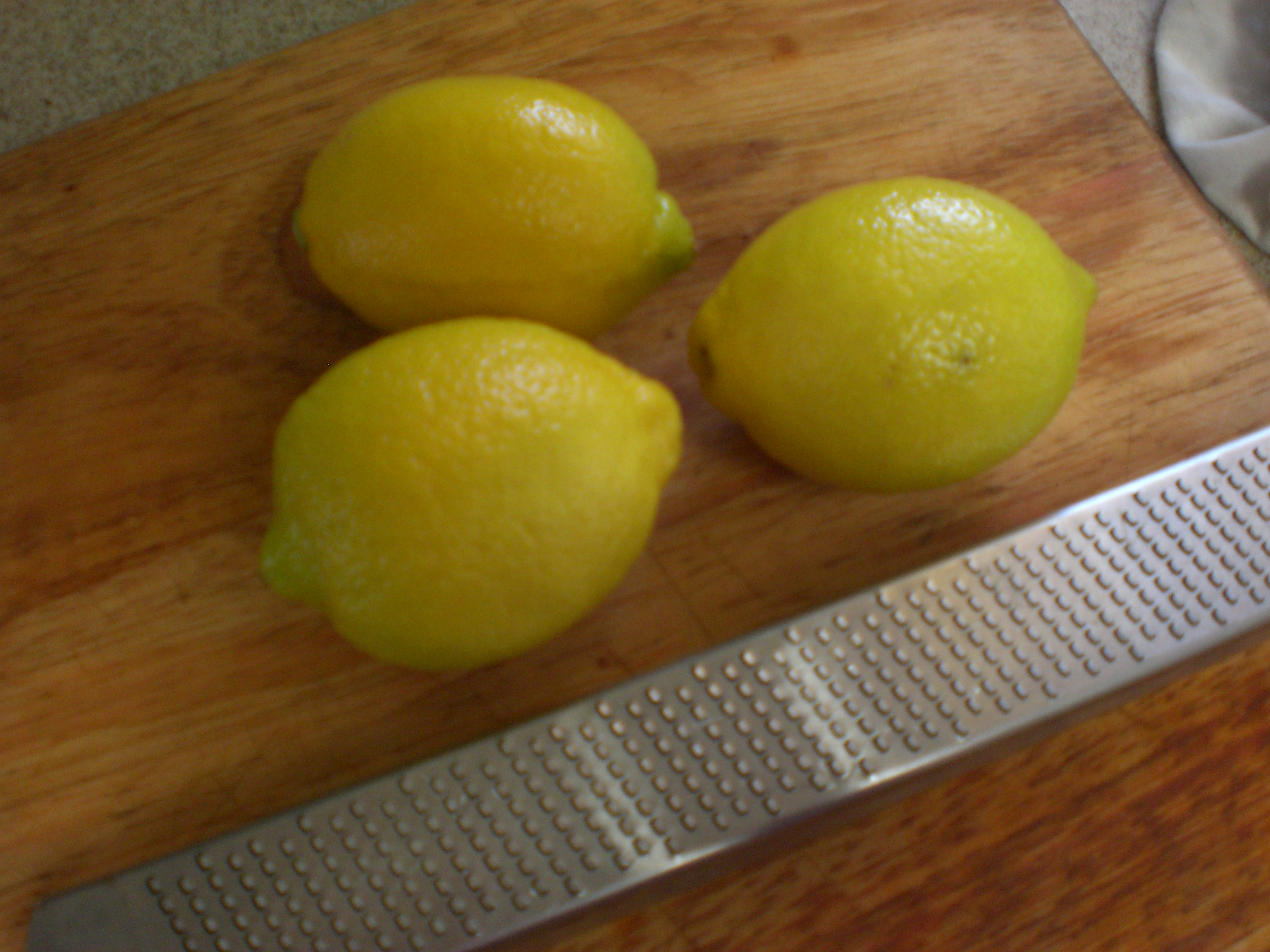
I use a microplane grater to get the zest, which is just the yellow part, of the lemon. I love this tool- it was originally designed for woodworking, but it works great as a very fine, very sharp grater. I use it for parmesan cheese, raw ginger and zest. When I was cleaning off the top of the fridge, I discovered one that I got a few years ago as a premium for subscribing to Cook’s Illustrated.  The best comment on this post before Wednesday 3/9 will receive it as a prize. Tell me why you need a microplane grater, why you deserve it, why you want one… Remember, I’m an English teacher – answers written in poetry might get bonus points.

Lemon Simple Syrup
zest from 3 lemons
juice from 3 lemons, plus enough water to make 1 cup
1 cup granulated sugar.

The most onerous task is zesting the lemons. I have a microplane zester, which I highly recommend,  but I can’t stand it when recipes require some tool which hardly anyone has. If you don’t win the zester, use a grater, or even a potato peeler. Be careful not to get the white part of the peel, it will make it bitter.

The girl was helping out, and the boy was giving unneeded advice.

Mix the juice, water, zest and sugar in a pan and boil, stirring until sugar is dissolved.

eyeew, maybe I need to clean the stovetop...don't simmer too long, you just want to flavor it, not reduce it.

Allow to simmer a few minutes, cool for a few minutes, then pour through a fine mesh strainer. I pour it into a pyrex measuring cup, then into a bottle with a pourer.  I store it in the fridge, although I don’t know how fast it would go bad on the counter…I wonder about doing this with other flavors- what about chai? or raspberry? The simple part means that it is an equal ratio- 1 part sugar and 1 part liquid, so it could theoretically be any flavorful liquid…I may have to experiment.

Book Review- Ratio


My only objection to the book is that the cover is yellow, but the spine is pink, so it is hard to find on the shelf. A small quibble.

I’ve mentioned this book before, and as I break it out to use to make cream puffs for my friend’s Oscar party on Sunday, I figured I’d write a full-blown review.
This isn’t like other cookbooks: it explains the why of cooking as much as the how. It does have recipes in it, but they are very simple ones, almost foundation recipes, and then you can vary them from there.

The chapter on roux has transformed (transformed, I say!) my relationship to gravy. And soup. The chapter on cakes has finally taught me the difference between sponge cake and pound cake, and the girl and I are now able to whip together a perfect little 2-layer-easy-bake-oven cake. It still takes forever to bake, because of the whole “cooking with a lightbulb” thing, but we can whip it up pretty fast.
There is a whole chapter on sausage making, which I can’t see myself ever delving into. Also, it’s fairly Eurocentric- no salsa, no rice, no stir-fries.  On the other hand, the 5 pages on making mayonaise is one of the reasons I asked for a stick blender for Christmas.

Michael Ruhlman is the author, I haven’t read his previous books, but this one is readable- he is a journalist who wanted to learn how to cook, rather than a chef who was hired to write a cookbook. One kooky detail is the blurb on the back,  by Alton Brown. It identifies him as author of “I’m Just Here for the Food.”  I didn’t realize he was an author, I thought he was a TV personality.

So, the recipes I’ll be using for Sunday are the pate a choux, which is a cream puff dough, and creme patisserie, from the chapter entitled “The Custard Continuum.” I love this book.http://www.amazon.com/Ratio-Simple-Behind-Everyday-Cooking/dp/1416571728/ref=sr_1_1?s=books&ie=UTF8&qid=1298677515&sr=1-1

edited to add: the cream puffs were amazing- we brought about 30 to the Oscar party, and they disappeared instantly.

Wonton Gluttony


I stopped in the grocery only to get milk the other day and somehow by the time I got past produce, I had decided to get the ingredients for dumplings. There had been a story in the paper about Chinese New Year, and it was like a time bomb ticking. (I have mostly had to stop calling it Chinese new year, by the way. I had a Korean student a few years ago who confided that it really bugged him when people said Chinese New Year, instead of Lunar, or Asian. It’s a hard habit to break, though)

I had a roommate just after college, Mei,  who was from Shanghai, and she taught me how to shape these little dumplings. The filling she used was pork-based.

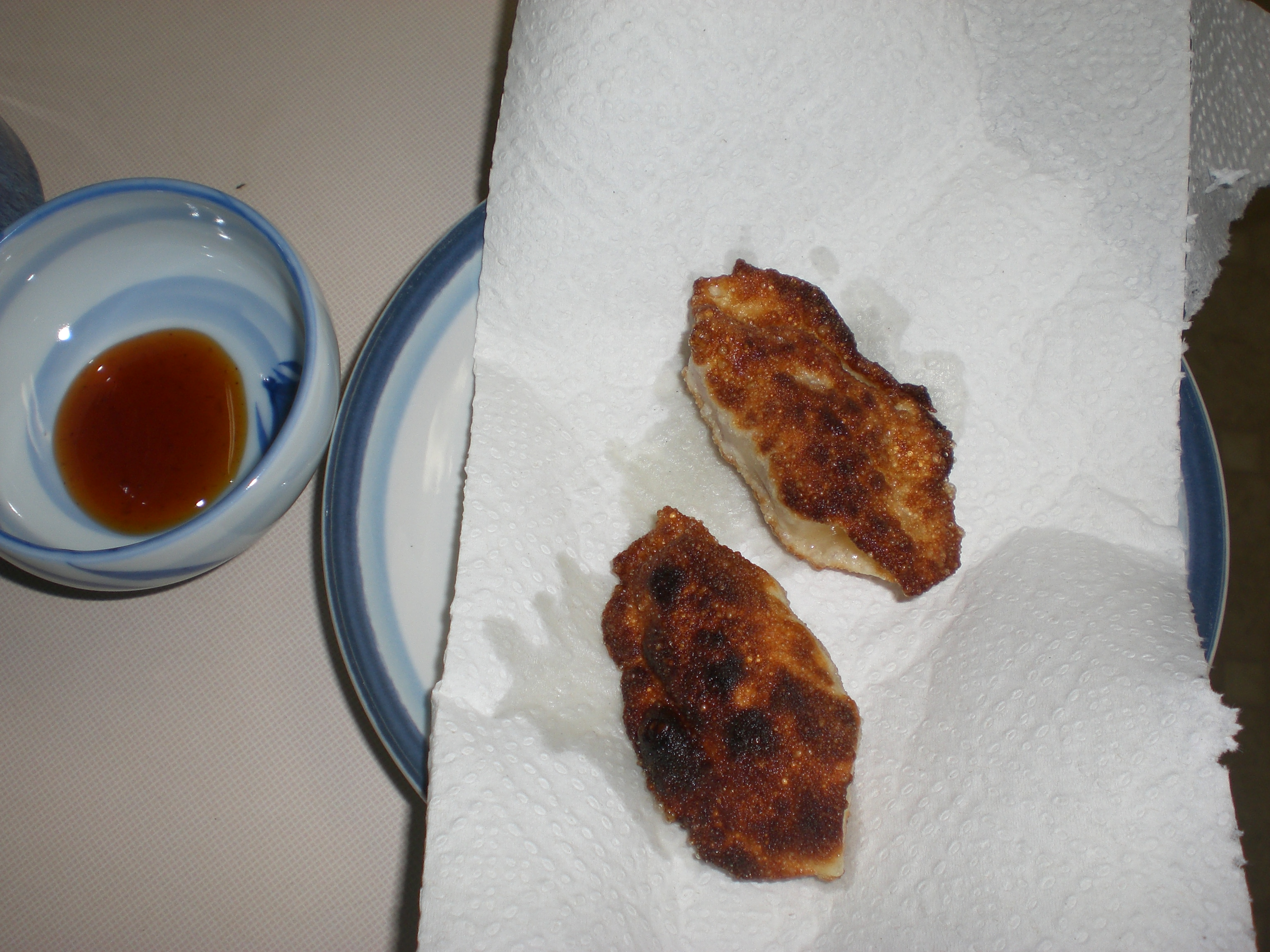
Two dumplings, hot out of the fryer.

I made mine last night with fake crab- krab with a k. My frugality bit me here- crab, or krab, is so mild flavored that I didn’t want to spend big bucks on something that would pretty much taste like ginger and onion. Looking back, though, I only used part of the package, maybe 4 ounces, so it wouldn’t have broken me to use real crustacean. If I lived closer to the ocean, I probably would. When Mei taught me to make these, we steamed them to ensure the pork cooked all the way through. Since the krab is already cooked, this is less of a worry. I steamed about 9 dumplings while the rice for the rest of our dinner was cooking, and fried the rest.

Oh my gosh. They are good both ways, but wow. the filling is bright, and the oil was hot enough, and I was eating them quickly enough, that they were better than I’ve had in a restaurant. I wouldn’t fry these for a party, because they’d lose that texture, and it would be a big pain in the ass.  But to make them for me and DH (and we ate an emabrrassing number) wasn’t too bad, frying a few at a time in 1/2 an inch of oil in a small frying pan. We leaned on the counter and talked about our days after he got off work, to the tune of sizzling oil.
Adjust the heat until the oil is hot enough to sizzle- too hot it just burns, too cool, it soaks up a lot of grease.

I didn’t really use a recipe for this filling, although I did google a bit for proportions. You’ll see from my parentheticals that this is extrememly variable. Put in the things that you like- DH didn’t say it, but he probably would have liked this better with chili paste in it. Watch, this will be the blog post that he comments on! It would be great with ground pork, or beef, or salmon, or scallops. Or tofu, if you insist.

Krab Dumplings (this quantity served 2 shameless people)

4 oz flake style krab (or whatever)

 1 knuckle sized piece of fresh ginger, minced

1 tablespoon minced onion (Traditionally green, but I had purple, so that’s what I used)

2 or 3 drops vietnamese fish sauce

1 splash rice vinegar (or lemon or lime juice)

1/2 package wonton wrappers (use the rest to make Krab rangoon next week)

Finely mince the onion and ginger, shred the krab and mix together. Put it all in a bowl and add the fish sauce (a little goes a long way here- it adds salt and savoriness, but too much and you’ve got 7th grade feet) and a splash of rice vinegar (my rice vinegar is unsweetened, but if you have the sugary kind, use it- I wouldn’t use regular vinegar, because it is way more acidic.)

I like round dumplings, so I use a juice glass to cut the corners off the square wrappers. Keep the wrappers covered so they don’t dry out, and try not to let them touch each other, or they’ll stick. It is surprizing how little filling goes into these. Half teaspoon, really. When you overfill them, they burst, or the liquid leaks out and makes the oil spit and sizzle. 

Now, the girl and I made a video showing how to fill and seal the dumplings, then I discovered I will have to pay extra to upload it to this blog. I balked. Maybe I’ll put it on Facebook.  So, now I’ll narrate the video as if you are watching it. Umm…so take the wonton skin and put a half teaspoon of filling in the center, then dip your finger into the water and run it along the edge of one side. Press together in the center, then dip your finger again and poke in the corners.

Steam: place in steamer basket or colander and put over boiling water with lid. Cook until wrapper is transparent. Some people put a lettuce leaf under the dumplings so they don’t stick, but I didn’t and last night didn’t have any trouble.

Fry:  I use my smallest cast iron skillet, about 6 inch diameter, and heat about 1/2 inch of canola oil til it shimmered.  I was going to check the temperature with my thermometer, but then the boy got upset with me because I told him he spelled Jurassic wrong, and all hell broke loose. Fry a couple at a time until they are goldn brown and delicious, place on a paper towel to cool. DH thought any dunking sauce was gilding the lily, bless his heart, but I used a little orange sauce (from a bottle- I’m not perfect)

Asian New Year is February 3 this year- I love stretching out the holiday season, and I can justify this better than having a big groundhog celebration. Happy New Year to you!

Zupa means soup


Last week I made some “Zupa Tuscana,” a complete ripoff of one of the soup choices from Olive Garden. For those of you not addicted to breadsticks, this is a potato and kale soup, with chunks of sausage. My home version was with homemade stock, and I actually went out and bought kale for it, something I swore never to do after having a glut of it two summers ago when our CSA would bring 2 or 3 bunches of it a week.
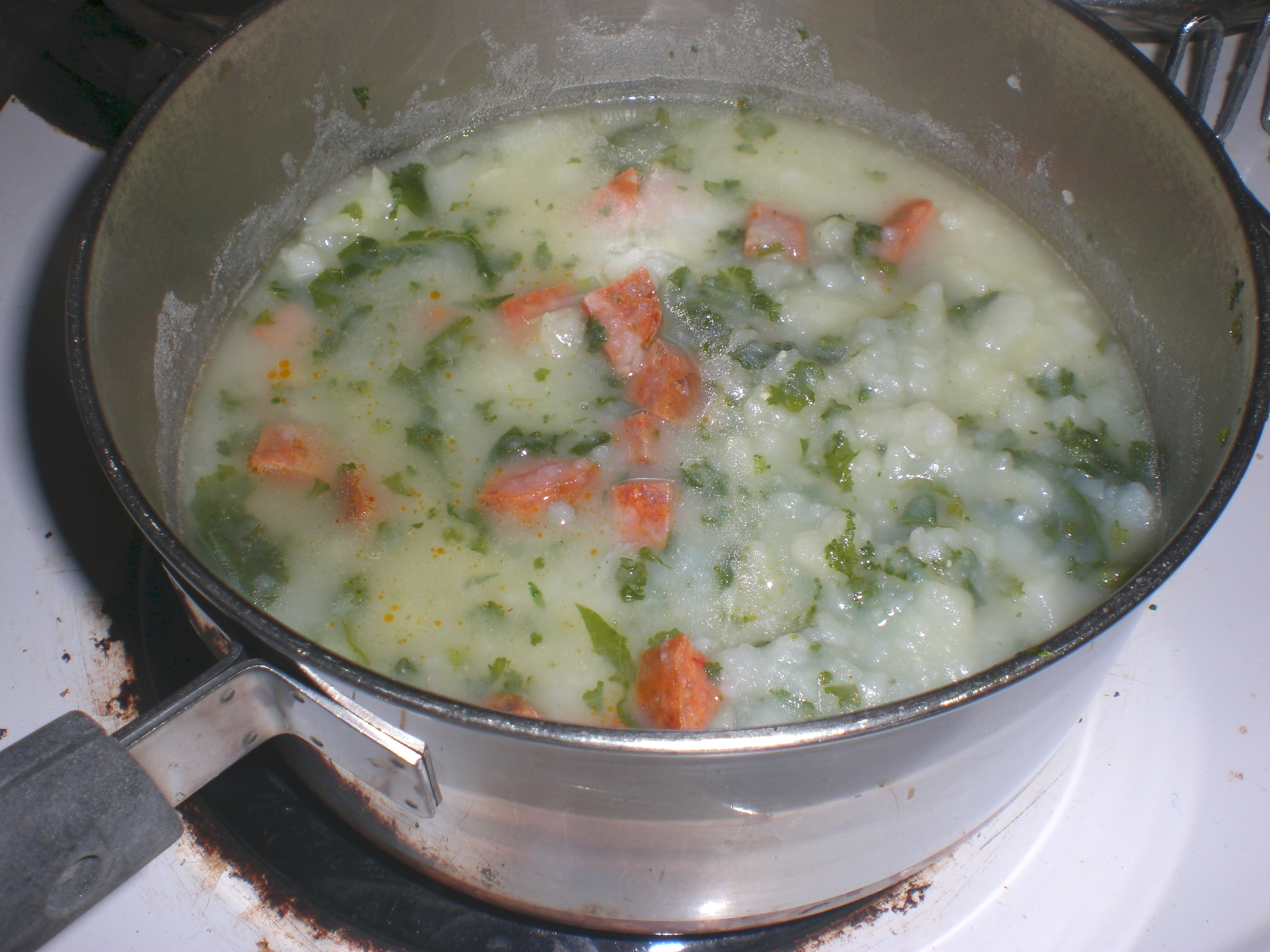
The soup was pretty good, got a thunbs up from DH, who is not usually a soup lover, unless that soup is called chili, and smothering a burrito. I decided to make it again, but make it less…soupy. I wanted it to have a mashed potato vibe… I believe there’s and English dish called bubble and squeak, which is mashed potatoes and cabbage (English food!? Too ethnic?) which I have read about, but never tried. The name is interesting, anyway.

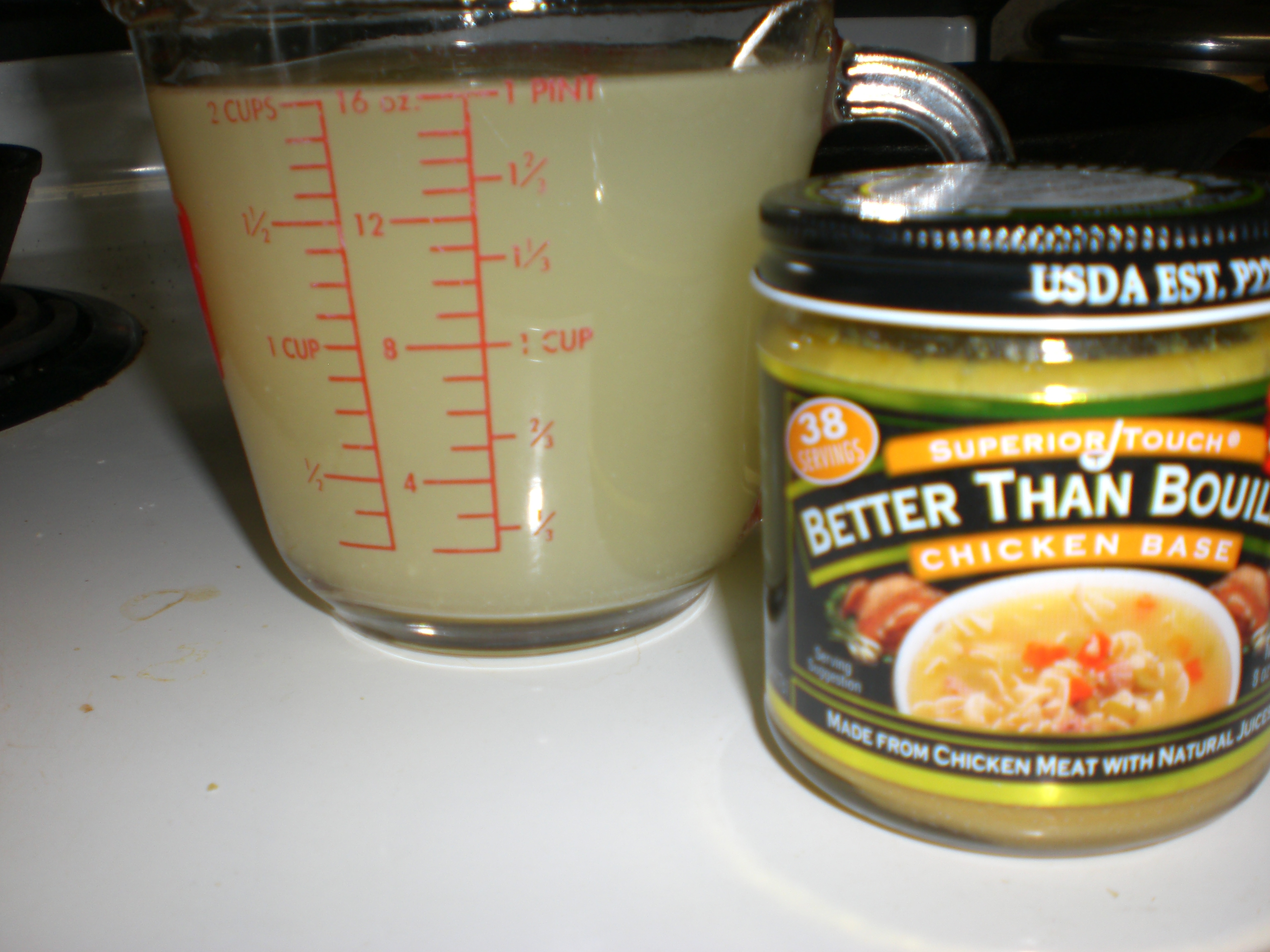
 So, I peeled and sliced some potatoes, set them up to boil with boullion to cover.

For two potatoes, two cups of broth were about right.

I’m out of homemade stock, and Better than Boullion is a good substitute. If you’ve never tried it, do. The name is accurate, it is better than boullion.

I then sliced some kale into thin strips, and put it in when the potatoes were almost tender. After a week in the fridge, the kale was a little the worse for wear- what was too gross for the soup went into the compost bucket, with a little leaf for the hermit crabs. Once the potatoes were all the way tender, I  mashed them without draining off the broth. I added some pre-cooked  Italian sausage at this point. No photos of those- I tried, but they all came out weird. I usually fry up a batch of Italian sausages at one time, and put the extras in the freezer.  

 The texture of the soup is somewhere between soup and side dish- serve in a bowl rather than a plate. With unlimited breadsticks, if you have them…mmmm, wish I had unlimited breadsticks.

ramen cabbage salad


I had extra napa cabbage left after I made kimchee, so I decided to make ramen noodle salad. I know- Michael Pollan says, “eat food that comes from plants, not food that was made in a plant.” but honestly we eat a lot of ramen at our house. We watched a documentary about how they make it, and it is really disgusting- the noodle part isn’t so terrible, but then it flows through a bath of oil to flash fry. Bleah. Not a foundation for a healthy diet. Still, it’s pretty good in this salad. Sources on the interwebs vary on whether the noodles are there to add crunch or if they should soften. I think it needs time to marinate, so the noodles soak up the flavor and soften. I put in radishes, green onions, carrots and whatever veggies I happen to have that would work with coleslaw.

Chopped veggies before the ramen and dressing have been added.

1 package of Ramen noodles with flavor packet
1/2 head of napa cabbage (or regular)
1/4 cup rice vinegar
1/2 cup olive oil
shredded carrots, radish, brocoli stem, or whatever else you want                                                                                                   

In a jar with lid, shake up oil, vinegar, and flavor packet. Chop up napa cabbage and other vegetables and mix with dressing in a large bowl.  Break up the noodles and stir in with the veggies. If you like it crunchy, eat right away, or if you’re like me, let sit several hours or overnight- this is one of those that gets better the longer it sits. Top with sunflower seed or almonds for crunch and protein.

Kimchee update: There are bubbles rising up in the jar. DH worried that it was the source of the funky smell…but no, something else in the house smells funky.  I think it was the trash- the jar smells fine. I am a little scared to taste it- is it too hot? Not sour enough? I know, I’ve just got to be bold and try it…

Ferment with me…


Got a new book the other day- “Wild Fermentation” by Sandor Katz. I got it with yogurt in mind, but it has a ton of stuff on pickled vegetables, too.

Yeah, it bugs me too, that they divided fermentation after the T, instead of between the N and the T.

A couple of years ago we had a glut of cabbages from our CSA, so I decided to make sauerkraut. I’m a white American, but I don’t have childhood memories of kraut- either my parents had it growing up and hated it, or it was considered “too ethnic” by both sets of grandparents. Anyway, I had a ton of cabbage, and all of the instructions I found online called for a ton of cabbage. The problem is, I wound up with a ton of sauerkraut…I didn’t know I didn’t like sauerkraut… yeah, I know, too ethnic.
Now, there’s a Mexican restaurant in town that serves pickled cabbage as a side. I learned it was called cortido, and it is essentially…Mexican sauerkraut. Too ethnic? No!

The recipe I found at the library made only a quart of it, which was just right.  The ease of the recipe inspired me to get this book- Wild Fermentation, for more recipes. I started a batch of Kimchee this weekend, which is like… Korean sauerkraut.  It has napa cabbage, radishes, carrots, onions and jalapeno peppers. The veggies are soaked in brine, and the spices are minced, then we drain the brine off and stirred in the spicy paste, then jar, cover with brine and let sit at room temperature for a week.

Minced jalapeno and garlic- see how fast my knife goes? No, it's just that I can't focus with my left hand.

 I’m very excited- just a few days for it to ferment, and I can try it.

I have a friend who loves pickles- only a week until we can try it.

 The cookbook has a ton of other ideas- I am thinking about sour dough and yogurt and a ton of other naturally fermented stuff. Not beer, though. Beer’s gross.

Previous Older Entries Next Newer Entries