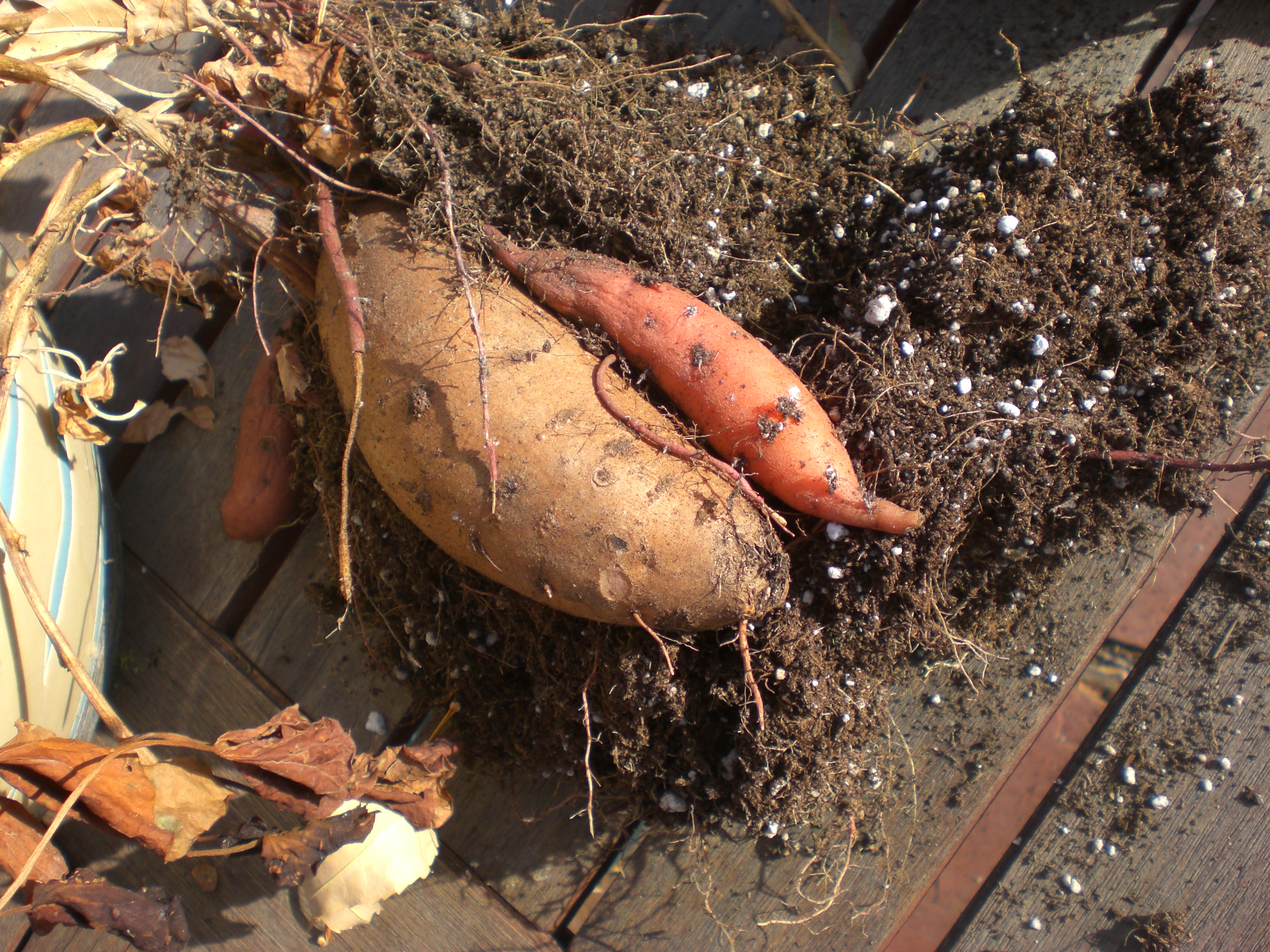
Way back last summer, there was a sweet potato sprouting in the bin, so I chucked it into an empty flowerpot, with some soil, of course, and put it out on the patio. Sweet potatoes have pretty, heart shaped leaves, and I enjoyed the greenery all summer, honestly not expecting it to have enough soil or water, or warmth, to produce tubers. I didn’t even check at the end of the summer.
Today it’s warm and sunny, so I went out to do some fall clean-up which I should have done when it was actually fall, and emptied out the pot with the sweet potato plant. Imagine my surprise to see an actual sweet potato. there were a couple of small mushy ones, but one was the size of one you’d see at a grocery store. I’m going to eat it on Christmas.
I (accidently) grew a sweet potato!
24 Dec 2010 1 Comment
in containers, food, free is good, gardening, Uncategorized Tags: containers, eating the harvest
What’s the opposite of rice pudding?
17 Dec 2010 1 Comment
in food, holidays Tags: Christmas, favorite things, food, holidays, tea
The boy’s first grade teacher asked me the other day to make up a batch of rice pudding for their “Christmas around the World” party on Friday. I thought, “ooooh, I can blog it.” Little did I know that everyone else in the world has blogged it also- google has a ton of extremely “authentic” Swedish rice pudding recipes. I threw out the ones that called for evaporated milk, and raisins (bleah! the texture!) and also decided I didn’t want to get into separating eggs and making a meringue to spread on the pudding, who cares whether that’s authentic or not?

So, first we weren't Jewish and making latkes, now we're not Swedish, and making rice pudding. I wonder what we aren't going to be next? Chinese, I hope, or Mexican...
I wound up taking what I know about rice, and what I know about pudding, and making a leap. I can’t really say it’s authentically anything, though. Note- I used 1% milk, because that is what we always have. This would probably be better with whole milk. Also, I just got a brainstorm, what about steeping a Chai tea bag in the milk? Of course, then it would not only be not Swedish, it wouldn’t be great for first graders, either…

Beating the eggs with the sugar, and then adding the hot milk a little at a time prevents the eggs from scrambling.
First Grade Rice Pudding
2 cups cooked rice (you know how to cook rice, right?)
2 cups milk
2 eggs
½ cup sugar
1 teaspoon vanilla extract
1 teaspoon grated nutmeg
1 teaspoon cinnamon
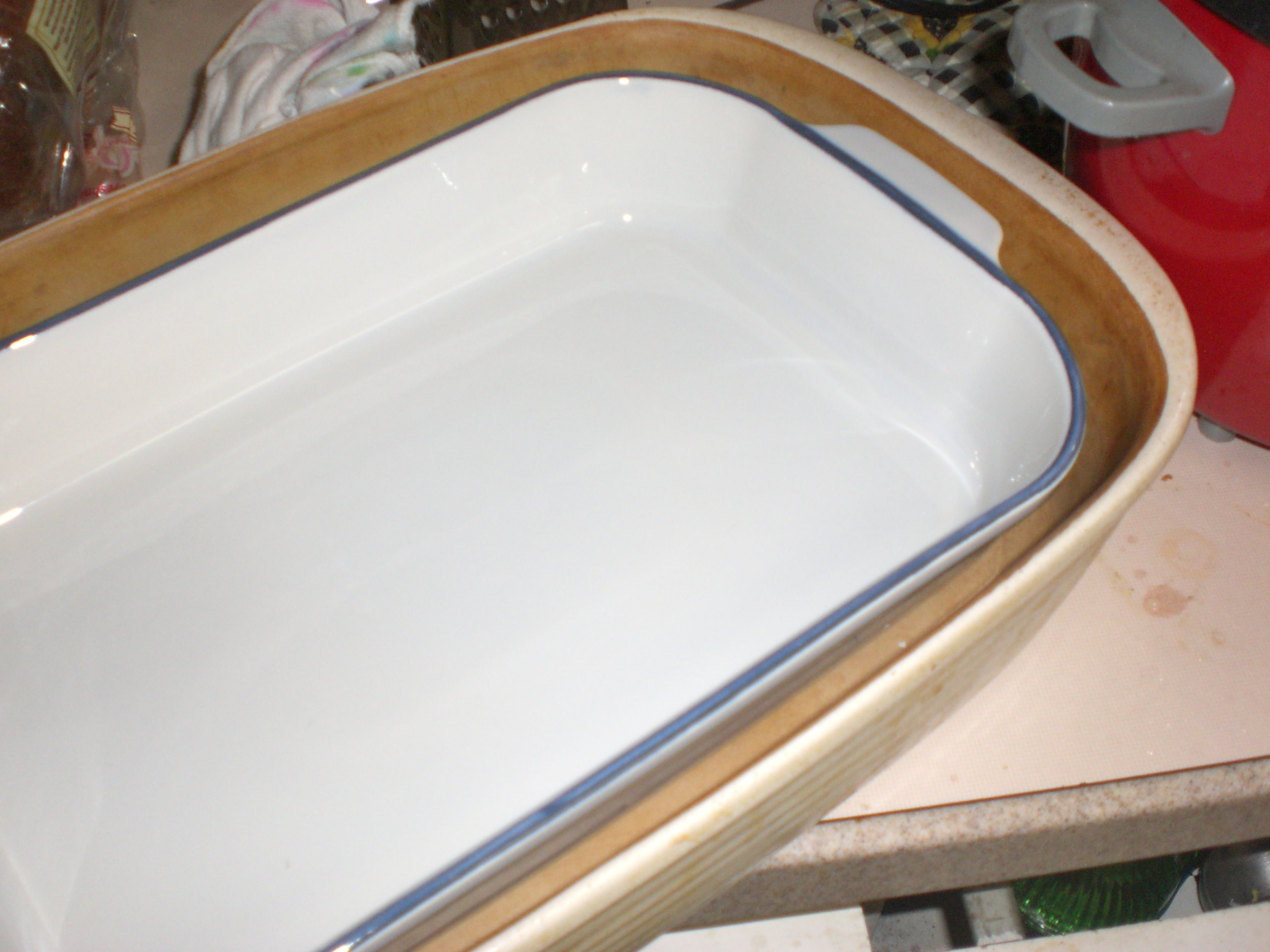
Heat the milk to almost boiling in a large, heavy saucepan. Meanwhile, beat sugar and vanilla into eggs. Temper the eggs by adding about half a cup of hot milk to the eggs and mixing, then add that mixture to the rest of the hot milk. Now add the cooked rice to the egg and milk mixture. Add all of it to a casserole dish nested inside another dish.

This is a casserole nested inside a 9x13 lasagne pan. I poured an inch of hot water in once it was in the oven.
Sprinkle with the spices. Place the pans in the oven, and carefully add hot water to the outside pan. This forms a water bath, and helps the custard cook evenly. Cook for one hour at 350 degrees, or until a knife inserted in the center comes out clean.
One of the traditional things Swedes do with this pudding on Christmas Eve is put an almond in it about 10 minutes before it is finished. Legend has it that whoever gets the almond in their serving will get married the next year. That will go over well with the first graders…
So, as I see it, rice pudding is a blank slate- what would you do with it?
Making Latkes
06 Dec 2010 1 Comment
in food, holidays Tags: food, holidays
We’ve been so busy this past week, that today is the first time we have to make some homemade Latkes. We’re not Jewish, but last year the girl came home with a recipe for Latkes, we made them and discovered how delicious they are with French Onion Dip, and a tradition was born)
The girl just learned how to peel potatoes at Thanksgiving, so she peeled some, and now she’s grating the potatoes. Sigh, my little girl, so grown up… Last year we didn’t have any applesauce, so we just grated some Golden Delicious apple- which was a tasty alternative. This year, we have some homemade applesauce, but I forgot to take it out of the freezer…so we might grate some apple again. Sour cream is also a traditional topping, but now that we have tried French onion dip, I’ll never go back.
2 cups grated peeled potatoes,
1 small onion, grated,
1 teaspoon salt,
grind of pepper,
1 tablespoon flour
1/2 teaspoon baking powder,
2 eggs, beaten
Soak the potatoes in cold water for an hour, then drain and press out as much water as possible. Mix the potatoes, onion, salt and pepper, then add the flour and baking powder. The flour makes the latkes hold together when they fry, but too much and you lose the crispiness. Add eggs and mix well. Drop the mixture by tablespoons in a well greased, hot frying pan. Spread out with the back of the spoon. Cook on one side until golden brown, then flip. Eat immediately, or save up on a plate in the oven set on 200. The advantage to doing this is that everyone gets to eat together, but the disadvantage is that they really are best fresh out of the frying pan. I think it is worth it for everyone to eat at the same time.
Simmering stock
21 Nov 2010 1 Comment
in food, holidays Tags: bones, cooking, holidays, leeks, leftovers, thanksgiving
For years, when we go to DH’s grandparents’ house for Thanksgiving, one of the aunts has gathered up all the turkey bones after dinner, and given them to the dog, Lady. I always thought of that Far Side cartoon, where a dog is sitting at a table, with a chicken bone sandwich in front of him, thinking, “I think she’s trying to kill me.” A couple of times I voiced my concerns about the poor dog eating poultry bones, but they usually ignored me and gave the bones to the dog anyway. Lady wound up living a long, full life, barking at strangers who drove out to the farm.
There’s a better thing to do with bones, though, than try to kill your dog. I’m talking about stock, of course. According to Ratio, http://www.amazon.com/Ratio-Simple-Behind-Everyday-Cooking/dp/1416571728/ref=sr_1_1?ie=UTF8&qid=1290297746&sr=8-1 which has become my new bible, homemade stock is what separates the good from the great. For example, I am doing braised leeks for my contribution to Thanksgiving dinner. So, I chop the leeks, wash the dirt off them, put them in a casserole and cover with broth, then throw in the oven for an hour. I could dissolve some boullion, or open a can of broth. But homemade stock has a feeling to it, and a rich flavor, that isn’t too salty or tinny. It is worth having around. And not that hard to make, with either turkey bones, or chicken.
So, you have some bones left over (I plan to beg some from our hosts before they give any to the dog. Sigh, Nate is the next generation of dogs risking perforation…) get out the crock pot, and cram the bones in.
Skin is fine, meat is fine, connective tissue, like in the rib cage or the wings, is great. As the connective tissue breaks down in the simmering water it will create a smooth “mouthfeel” in the stock. The crockpot is the ideal vessel because it stays at just the right temperature. When stock boils, it can evaporate too much water, and scorch. Trust me, this isn’t a smell you want in your house. To the crockpot, add a chopped yellow onion, some carrots and celery. These are for flavor, and you’ll strain them out later. The ratio book says do a 3:2 ratio of water to bones, by weight. I usually get a pitcher and pour water in until the bones are covered. Although, I did get a food scale for my birthday (thx DH) so maybe I’ll weigh the bones this time. Simmer all day, or night, if you can stand the smell of turkey soup when you wake up. I can’t- it gets into my dreams… Anywho, simmer all day, then decant. Use tongs to pull out the big pieces, then strain the stock in a fine mesh strainer. I have a five quart crockpot, which make a little less than 3 quarts of stock. I strain them into 1 quart yogurt containers, pile them in the freezer, and pull one out when I want to make soup. I use it to make rice and beans, as well. One of my favorite applications is just to mix it half and half with spicyV-8 juice. And, of course, making braised leeks for Thanksgiving dinner in Nebraska. After the pan comes out of the oven, it can wait until the next day. I add bread crumbs and fresh-grated parmesan cheese, then bake again until the cheese melts, then put it at the kid’s table. That way, I know I’ll get a good share of it.
Homemade Pizza
18 Oct 2010 Leave a comment
When I was a kid, my dad would make homemade pizza when my mom went out of town. We would get mix from the grocery, Appian Way brand, which if they still make it, is not available in my local megamart. It was quite the production, making enough pizza for 8 people, which is probably why my dad did it when my mom was out of town. It was always one of my favorite meals.
Now that I am a grown-up, homemade pizza is still one of my favorite meals. I don’t use a kit, I use a dough recipe that I think originally came from Better Homes and Gardens. I haven’t altered it beyond adding 1 cup of whole wheat flour, but I have lost the original clipping, so that’s why I don’t know the source. What I usually do is make the dough, and shape about half of it into rounds and bake them for 5 minutes, then we can top them with whatever we like, then bake again. What I love about minis is that everyone can have the toppings that make them happy, and we don’t have to pick peppers off mine, or meat off the boy’s. We’re picky.
Pizza or Calzone or Breadstick Dough
1 Tablespoon Dry Yeast
1 teaspoon sugar
2 cups warm tap water
1 Tablespoon olive oil
5-5 1/2 cups flour (I usually put in at least 1 cup of whole wheat)
2 teaspoons salt (don’t forget this- I have sometimes, and it is disappointing.)
Pour water over yeast and sugar, let sit a minute while you get the other stuff ready. Add 2 cups of the flour, olive oil, and salt, and mix with dough hook (or by hand if you don’t have a mixer:(. Gradually add remaining flour, and knead about 10 minutes total. Let rest- you can let rise about 40 minutes, and punch down, but I often just let them rest while I get the oven preheated, and work on the garlic butter or pizza toppings.
With the other half of the dough, I have started making garlic twists, according to the directions from the Frugal girl blog. http://www.thefrugalgirl.com/2010/06/wednesday-baking-italian-cheese-twists/ The first time I used the recipe, we ate up a dozen of them before DH got home from work. He came home to a house smelling like garlic bread, and only had one measly stick left… If I am planning far enough in advance, I’ll do the garlic sticks and spaghetti on a non-activity night, and prebake the pizza rounds while the oven is on. Then I bag up the pizza rounds, and we can decorate them a day or two later, when we are getting home from soccer and starving.
One last note- what makes this recipe, and most of my bread projects, possible, is that DH got me a Kitchenaid stand mixer a few years ago for Christmas. One of the best gifts I’ve ever gotten.
Rustic Apple Tart and Hand Pies
16 Oct 2010 Leave a comment
in favorite things, food, learning Tags: cooking, favorite things, food, learning, using the harvest
Hand pie- it’s a perfectly cromulent word.
Worlds collided today when the girl brought home My First Cookbook, which has a pastry recipe, and I picked a zillion apples from our tree. A surprising number of them weren’t wormy.

Look how many of them don't have worm holes! We don't spray or anything, so worms are the rule rather than the exception.
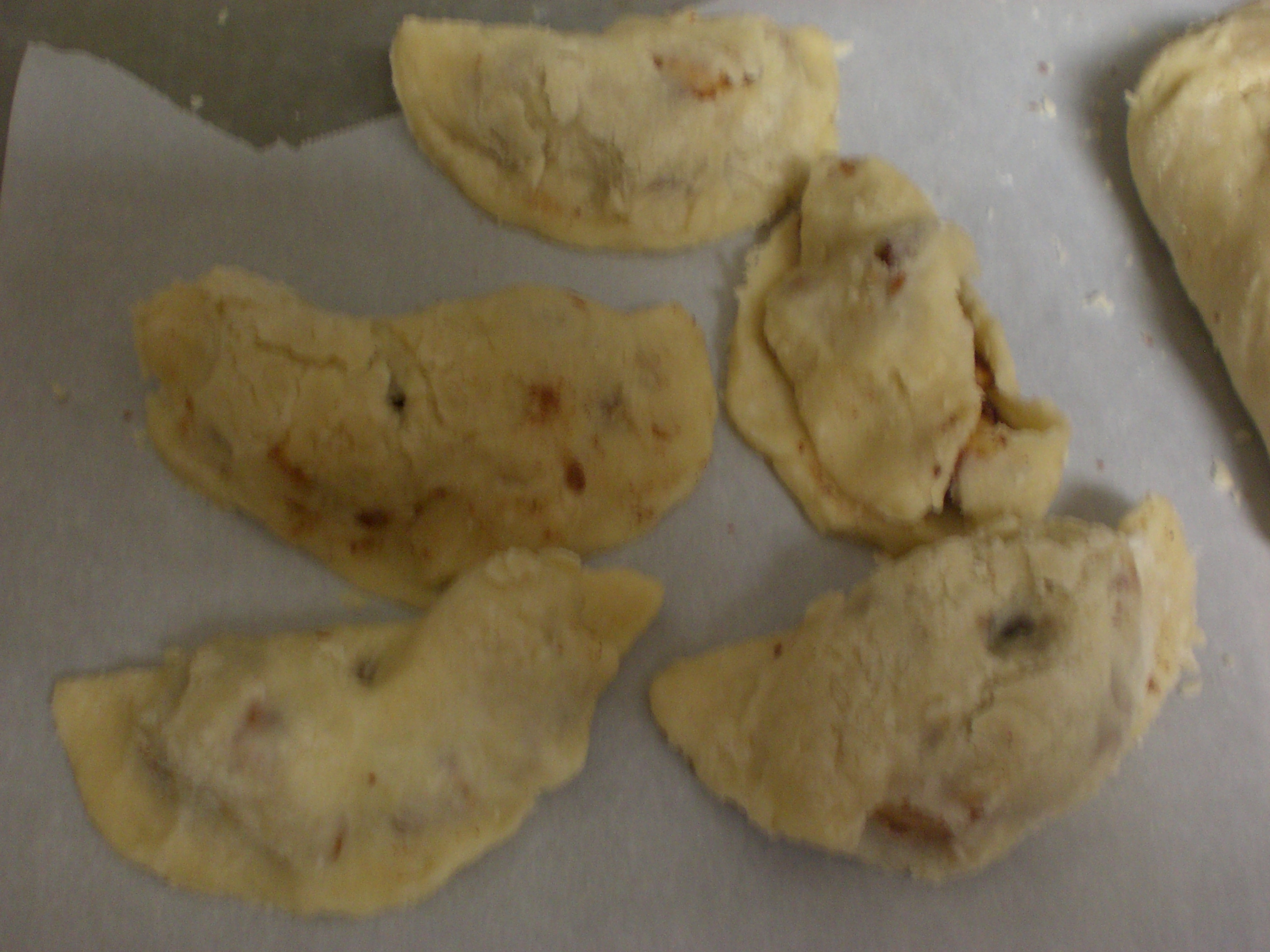
I chopped enough for a crockpot full of apple sauce, and a pie. Then the girl’s recipe turned out to be for tarts, and I said, what about hand pies? Hand pies, she asked, did you just make that up? Ummmm, no. I’m sure I’ve heard it somewhere. So, we’ll cut circles, put in apples, then fold them over. The circle we chose to use was the ring from a half gallon sized canning jar, which made lilliputian sized pies…They’re very cute. The girl made pie crust for the first time, and we actually should have asked Grandma or Great-grandma for lessons, because I think I’ve only made pie crust twice before in my life. The girl did a good job, though, it’s nice and flaky.
Baked them for a surprisingly long time- I guess I’ve learned something with this project, because I keep saying how surprised I am. It took about 25 minutes at 350, which was enough to brown the bottoms and lightly brown the tops. The apples are still a touch crisp, so it could have gone even longer. We had enough for 6 half moon shaped pies, and I rolled the scraps into a freeform circle, dumped the rest of the seasoned apples into the center, then folded the edges up over it, into a rustic apple tart. “Rustic?” she says, as if that isn’t a real word. Rustic is totally a word! The rusitc tart held together beautifully when cooled and sliced.
Rustic apple Tart
3 cups sour apples, peeled, seeded and chopped
1 tablespoon sugar
2 teaspoons ground cinnamon
1 tablespoon flour
your favorite pie crust recipe, or whatever instant pie dough solution you like best.
Toss the apples, sugar cinnamon and flour together in a bowl. Roll out the crust and cut reasonable-sized circles. On reflection, the canning lids, about 3 inch diameter, made very small pies. Place on a parchment paper covered cookie sheet, fill with the apple mixture, fold over and bake for 25 or more minutes. For once, we forgot to put sprinkles on top, but sprinkles would have been good.
For the rustic tart, I was recalling something I read in Cook’s Illustrated a year ago, so there are probably better sources of instructions. Roll out the dough, place apple mix in the middle, with a good 2 inches of border. Fold up the edges and crimp it, then bake for 35 to 40 minutes. Because the top is open, it is easier to test these for doneness- just stab an apple with a paring knife to see if they are soft enough.
Growing Lemons in Zone 5 and Other Crazy Hobbies
30 Sep 2010 Leave a comment
in containers, food, gardening in containers Tags: containers, food, gardening
It is nearly time to move my citrus trees in for the winter. I have a lemon, lime and orange in pots which spend the summer outside, then move inside when it is cold. The dream is one day to get a supply of homegrown citrus.
The reality is disappointing. One year we had quite a few oranges, and tremendous blossoms in January, but that was when the plants came to school with me- I had a classroom with north windows, and it wasn’t heated at night, and I think that was the perfect climate for them. I changed schools, and my current classroom doesn’t have windows ( I wonder what they were thinking, those school building designers of the late 60’s- “I know, those kids are getting distracted by looking out the windows, so lets make it so they can’t!”) so I have to cram them into the boy’s room, which has the best south and west windows, and hope for the best. They are all three in 14 in diameter pots, and some years they bloom and produce a few fruits, but I am a looong way from self-sufficiency in citrus.
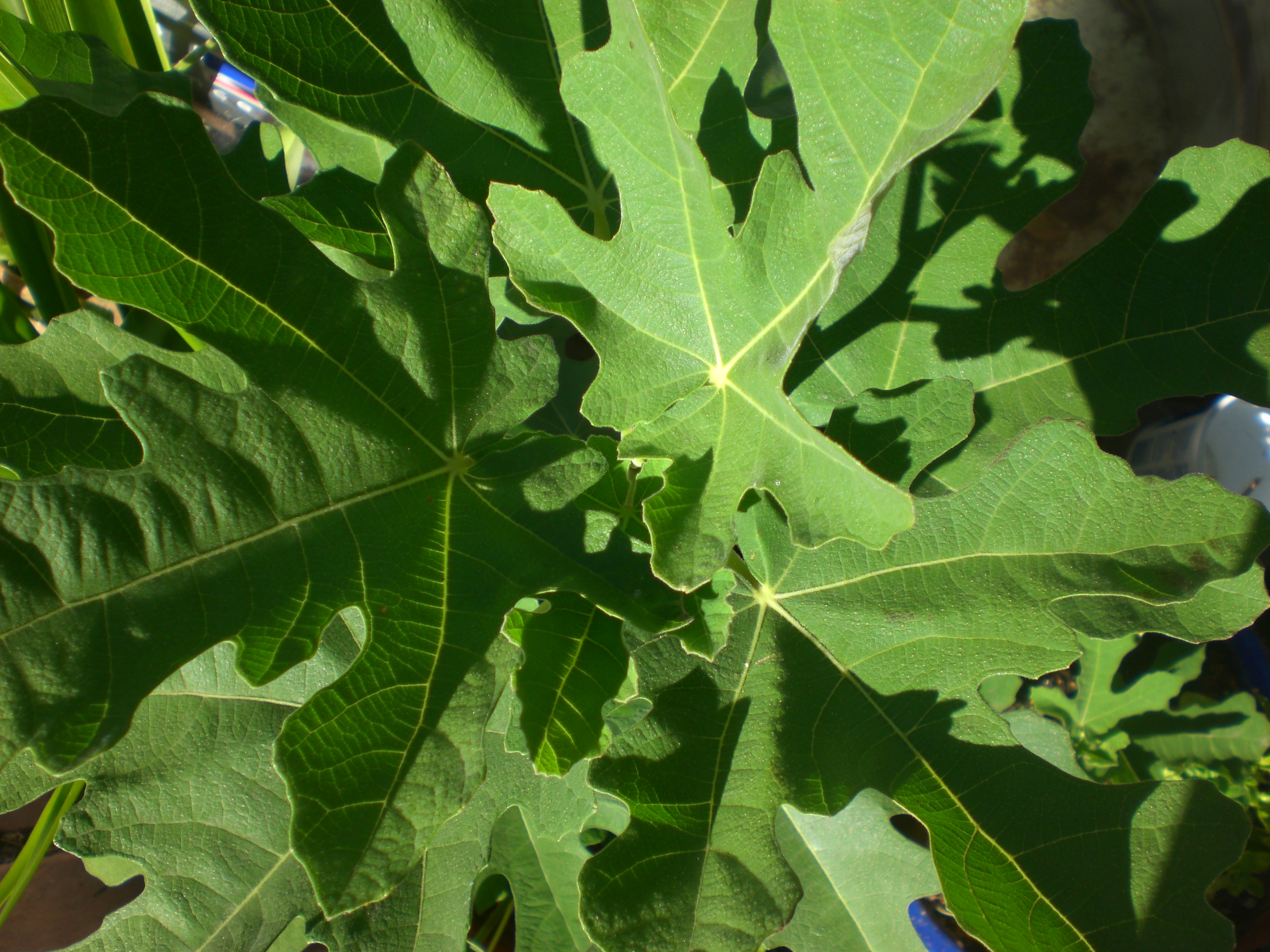
Last year I added another edible plant which won’t survive the winter here, a Chicago Hardy Fig.
(www.raintreenursery.com) It arrived at the end of the summer, a twig smaller than a pencil with two leaves and a hefty bundle of roots. The half page of instructions said: pot immediately, not let it get colder than 20, and when it went dormant bring it inside to a cool, dark place, keep it moist, but not wet, then bring it into the daylight when there was no longer risk of freezing temps. It was complicated, and made me a little nervous, but the plant made it through the winter, and is currently alive.

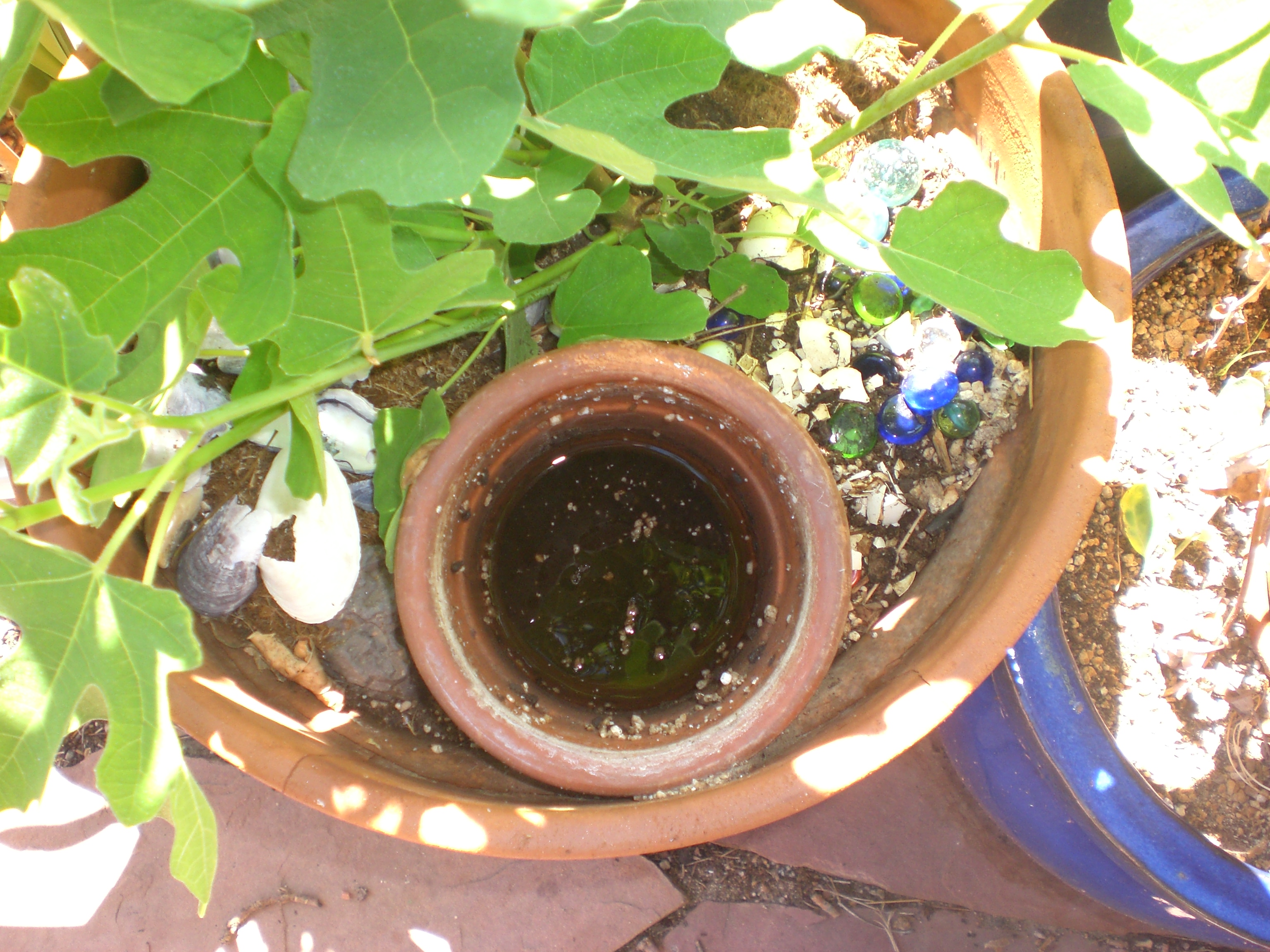
A porous clay vase turns any pot into a self watering container- it holds about 1/2 gallon, and seeps into the soil slowly.
I set up a large clay pot with a porous clay vase inside- the vase holds about ½ gallon of water and slowly seeps through to the soil. While it is outside I fill it every few days. I kept it in our guest room in the basement last winter, with the twig under a flowerpot to keep it genuinely dark, and periodically filled the vase with water. In April, I peeked at it, and saw that there were white buds popping, so I moved it to the back porch, ready to bring it inside when frost threatened.
It has grown beautifully all summer. I didn’t expect fruit for a few years, but there are 2 tiny figs on it. It is probably 18 inches tall, and sometime in October I’ll bring it down to the basement again, to start the process again.
Pomegranates might be next on my list of impossible fruits for Colorado- what else?
Why homemade jam? Why not?
25 Sep 2010 2 Comments
in food, free is good, gardening Tags: cooking, food, gardening

Even though only the girl and I are eating this stuff, we are zooming through it. Looking for excuses to put jam on stuff. You know, I could go for a piece of toast right now.
So, in a world where you can buy jam at the store, where there is a whole grocery aisle devoted to it, why bother making it at home? I’ve been thinking this a lot lately, as I’ve been making bread, buttermilk, soup stock, lots of stuff from scratch that my mom, for instance, never made. What do you make from scratch?
The short answer is that I enjoy it, mostly. It feels good to have stock bubbling away in the crock pot, and then turn that stock into soup. It is kind of fun to stir fruit and watch it bubble and thicken in a pan, then spoon it into jars.
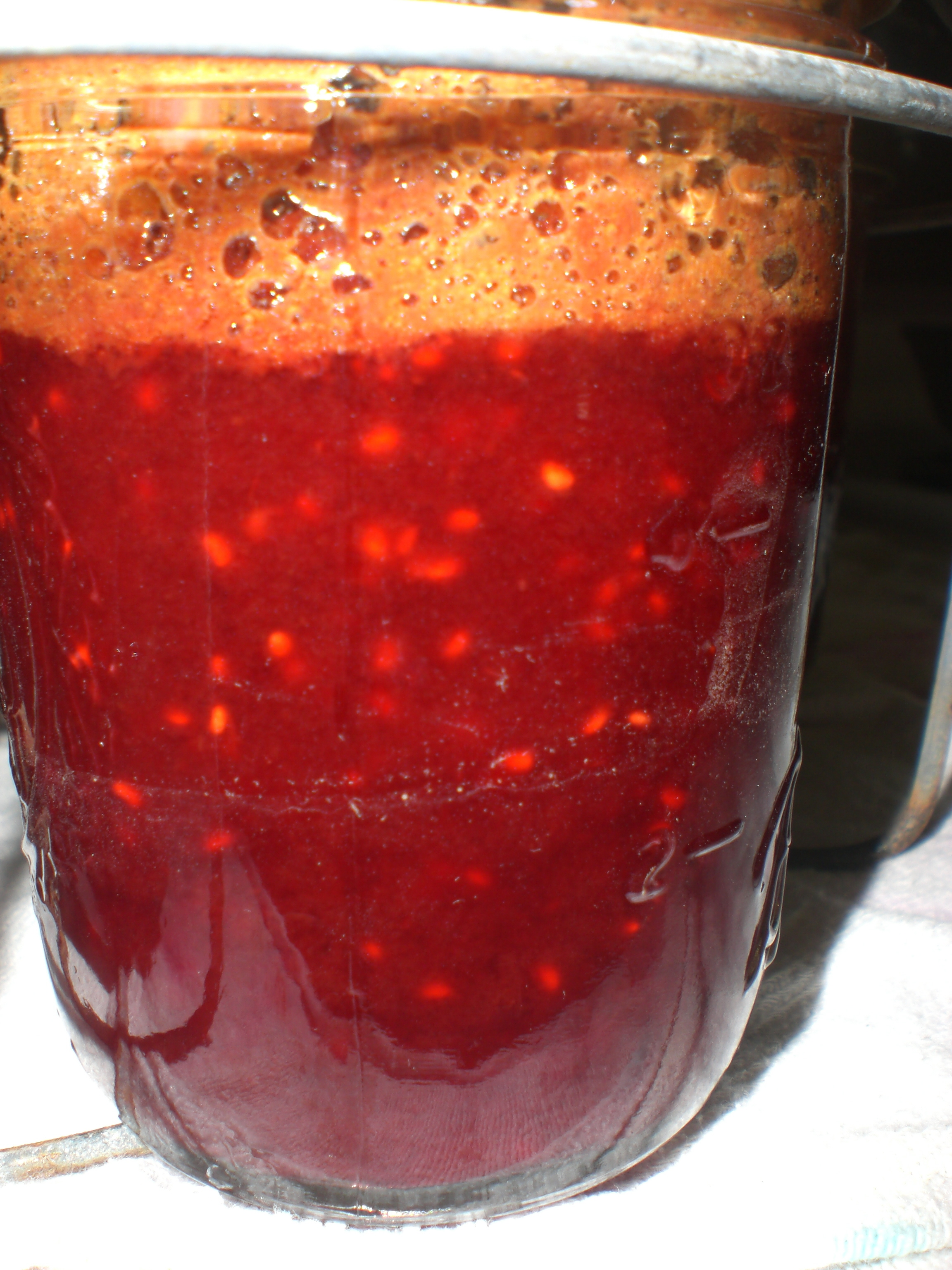
Cost enters into it as well- buttermilk costs 4 times as much at the store as it does to add some old buttermilk to fresh milk and let it culture. Once you have started a jar, you have a lifetime supply. I did a little research on line to see what organic raspberry jam would cost, and prices varied from $4-$9. I would never pay that much for jam. As it is, the berries were from my garden, so free ( ha ha, if you don’t count the labor and the water…) the pectin was about $3 for 6 jars, and it was probably $2 worth of sugar.
The quality is the last, best answer. The reason I couldn’t find the price of raspberry chocolate jam is that no one appears to sell it. And it is reallllly good. To make it, I add a tablespoon of cocoa powder to the recipe on the insert of the pectin package, and follow the other directions as stated. It could probably be done with cherry or strawberry, too. Experiment.
Pat Daly and the Fukuoka Pumpkin
11 Sep 2010 1 Comment
in food, free is good, gardening
The summer I got married, a bunch of my friends were living in a rental on Plum Street in Fort Collins. None of them were college students at the time, but this was a classic college student rental house- old, near campus, big trees, but unkempt. I was over one day, eating a carrot, and got to the stem end of it. I looked around for a compost bucket on the counter, because I knew Pat Daly had had a compost pile at his old house. I asked him, and he took the end of carrot out of my hand and opened the back door and hucked it out into the bushes. I must have looked a little surprised.
“Have you read One Straw Revolution?” he asked. “Masanobu Fukuoka,” he pronounced carefully. “He’s this Japanese guy who says don’t plow, or turn the soil, just plant everything in mulch, and use everything to mulch with, instead of big compost piles.” That was his summary of the philosophy- mulch everything, and anything can be mulch. There’s probably more to it than that.
We stepped out into the back yard- knee deep in grass and weeds, a squash plant trailing through, tomatoes ranging around. Later that summer they would get a letter from the city telling them to mow, because of complaints from neighbors. I still haven’t read One Straw revolution”- it was out of print, and I hadn’t come across it in my used book store travels. A quick look on Amazon shows me that it has been reissued, so maybe I need to pay 10 bucks and get an education. http://www.amazon.com/One-Straw-Revolution-Introduction-Natural-Classics/dp/1590173139/ref=sr_1_1?s=books&ie=UTF8&qid=1284220635&sr=1-1
I thought about Pat Daly and his Fukuoka experiments earlier this summer when I noticed a sprout growing next to my back door- when it was little, it was hard to tell if it was a cucumber or sqaush- they look alike to me. I didn’t pull it, even though I didn’t technically plant it. Sometime last fall when I was emptying the compost bucket, I was too lazy to walk out to the bin. Maybe it was snowing, or just dark, or…honestly, I don’t remember. Seeds got dumped in amongst the leaves by the veggie bed, and one sprouted this spring. A month or so later, the plant was growing into the path, so I turned it 180 degrees, and now it’s growing behind the bed towards the house. Maybe it’s a weed, but free squash is good squash.
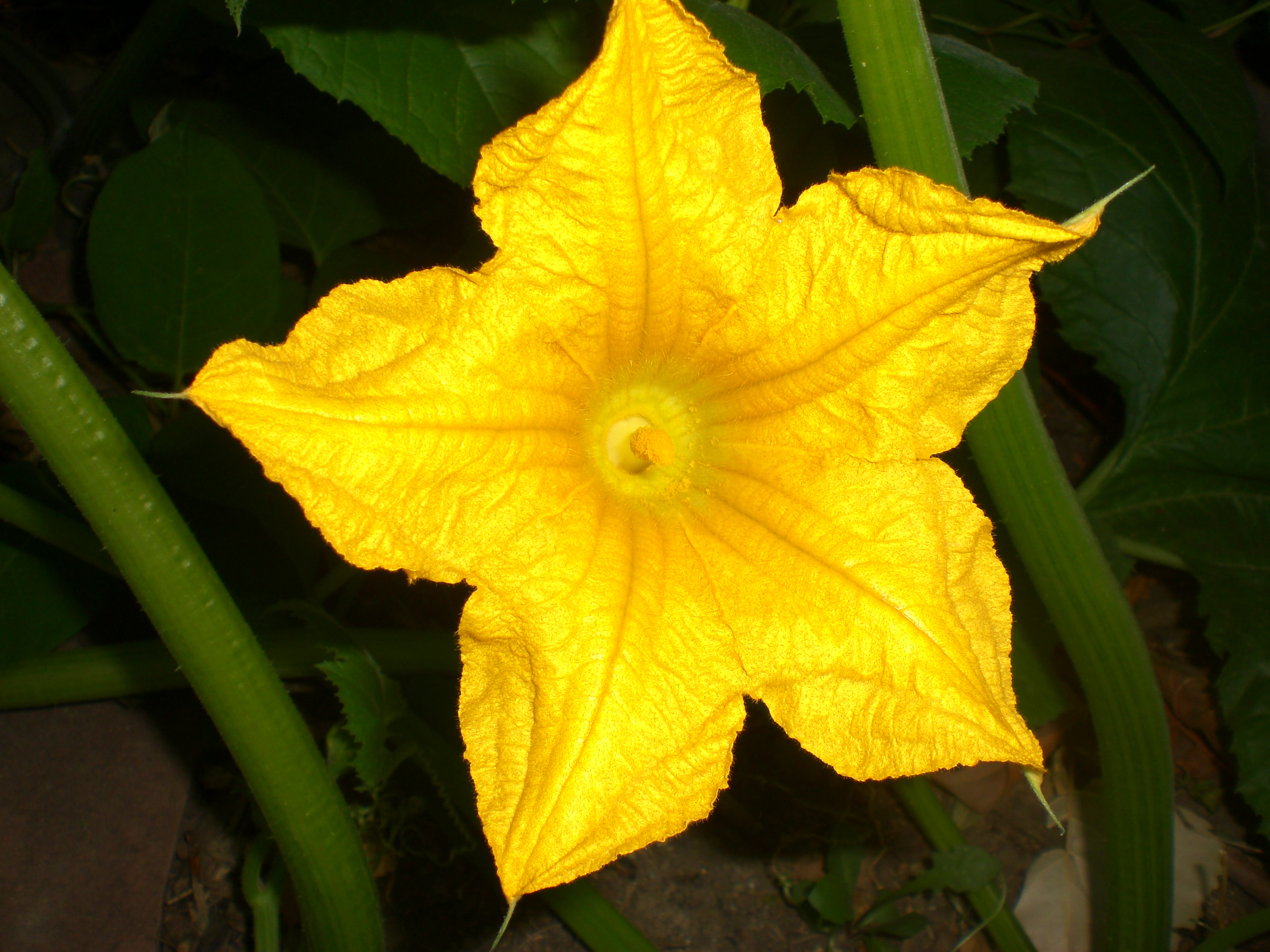
What is it? We got a lot of different squashes from our CSA last year www.grantfarms.com pie pumpkin, decorator pumpkin, gourd, acorn squash, weird lumpy green ones that tasted really good but made the pie look like baby poop…It could be any of them, or a cross. There were male blooms, and just now, female blooms with fruits growing behind them. Still unidentifiable. I have my fingers crossed for a bumper crop of mystery gourds. We’ll just call them Fukuoka pumpkins.
Slight digression- one of my favorite sites on the interwebs is One Straw www.onestraw.wordpress.com the saga of a suburban guy who is turning his lawn into a microfarm. There’s a man who knows the value of mulch.
Grandma Noodle Soup
26 Aug 2010 Leave a comment
in food, learning, Uncategorized Tags: food
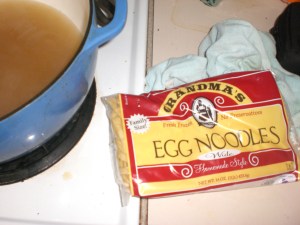
My old roommate Rhonda taught me how to love Chicken and Noodles and Mashed Potatoes, so I should probably call this Rhonda noodle soup, but instead at our house, we call it grandma noodles, after the premade frozen noodles that is a key ingredient. It could be made with dried egg noodles, but it wouldn’t be the same- check the frozen pasta section of your local mega mart, it is worth the search.
At it’s simplest, this is noodles cooked in broth, perhaps with chunks of actual chicken in it and carrots, if you like mushy carrots, then served over mashed potatoes. It is insane, I know, to pour a starch based food over another starch based food. It’s crazy. Crazy delicious.
2 quarts chicken broth
1 [pack size} grandma noodles
½ cup chopped carrots
1 cup precooked chicken or turkey- leftover is great- in fact, this is a great post-Thanksgiving recipe, because you can do turkey stock.
I have made this with store bought broth- Better than Bouillon is my favorite mix, but you can use whatever broth you like. I use homemade, lately, because I’ve learned how to make it. Look for it in a future blog post.
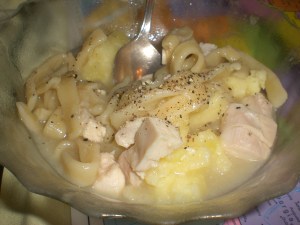
Take the noodles out of the freezer, stab holes in the bag and defrost in the microwave. Meanwhile, heat the stock to boiling. and chop up any leftover chicken or carrots or whatever, and scrub and chop your potatoes ( I usually leave the peel on, because I am kind of lazy. I also know it’s good for me. Fiber. I know. I’m old.) In another pan, cover the potatoes with water and boil until soft. (Huge digression- I am at about 5000 feet above sea level and potatoes take longer for me than they likely do for you- I knew this intellectually, but when I went to Boston this summer I kept burning my tongue on coffee- dang, how can you stand it? hot coffee is hot at sea level!!! Anyway, I guess that is a difference between knowing something “intellectually” and really knowing it.)
So, when the stock or broth is boiling, add the noodles and carrots and chicken, then simmer until the noodles are done. If you do it right, the soup will be done at about the same time as the potatoes.
Drain the potatoes and return to the pan. Throw in some buttermilk and butter- I never measure, just a glug of one and a chunk of the other. Then mash. I like lumps. I grew up on instant potatoes, and appreciate the lumpiness of real ones.
Dish up a serving of potatoes into a bowl and make a well in the middle, then scoop up some noodles and broth to cover. I made this as a back to school meal, but it works on a busy day, before trick or treating, after Thanksgiving, home from skiing, before basketball practice…anytime, I guess, that you want some starch with your starch. Be sure to have starch for desert, as well.