Citrus in containers


 When the girl was just a twinkle in her dad’s eye, I bought 3 citrus trees from a catalog- tangerine, lemon and lime, all for around 10 bucks. When they arrived, they were tiny- the largest was the lemon, and it was about the size of a pencil, the others were stems with roots. I put them in 8 inch pots, and put them on our west facing porch for the summer. When it got cold in the fall I brought them in, put them in a south window, took care of them through the winter, waited for them to bloom.
And waited…
The girl was a kindergartner when the tangerine tree bloomed, and produced tiny sour fruits… it blooms every other year, or so, and the lemon more regularly. The lime only has bloomed once.
The best winter for them was a year when I took them to school with me- my classroom at the time had a wall of north facing windows, and the heat was turned off at night. Perfect conditions. Indirect sun and cool nights are what everyone recommends for citrus in pots, and that room was perfect for it.

One of my favorite memories of the tangerine is from that year I brought it to school- I had a student who was hungry all the time- all teenage boys are, to a degree, but this guy- hungry all the time. The tangerines were hanging from the branches, still green, still wickedly sour. I was on hall duty, the bell rang and I came inside. The air was fragrant- I could tell someone had picked and eaten a tangerine- “Who?” all the boys tried to look innocent, especially Miguel, whose lips were in a permanent pucker.

Unfortunately, I only had that classroom for a year, and now the trees have to suffer through winter at my house.We have a low-slung ranch house, and there are no north windows, the west ones are shaded. The citrus live in the boy’s room, which therefore has a jungle aura to it. He doesn’t mind, at this point…

I underplanted the lemon with a jade plant- neither seems to suffer, although I can’t say either is benefitting. I have wondered if I should try to separate them, but I think I’d wind up killing both. It’s in a 14 inch pot, near a west window that is shaded. I move it outside in May, and watch the low temperature predictions.
The tangerine is the giant of the bunch, and it bloomed tremendously this winter. Because it bloomed inside, there weren’t any pollinators around, so I had to play bee. I took a paint brush out of the boy’s watercolor set and went around transferring pollen from one blossom to another. There are tiny green marbles on the plant now- although not as many fruits as there were flowers…not an exact science.
The lime is still the tiniest of the three, I may move it to a different pot, with new soil, this spring to see if that will jump start it.

So, at 11 years old,, are these plants thriving? Not really. If I lived in a place where citrus could grow in the ground, and these were ten year old trees, I think I would have more fruit than I could give away. In containers, they are much more like pet houseplants than anything that contributes to my food pantry. The Logee’ s book I reviewed the other day has some helpful tips, that I mostly already learned the hard way, in keeping them alive for 11 years.

 Someday, when I get my conservatory (dreams can come true) maybe they’ll produce more, but right now, I’m kind of disappointed.

 But, hope springs eternal, I’ve ordered a Meyer lemon, also cheap and tiny, and I’ll nurse it to adulthood as well, fighting for window space in my kids’ rooms. It arrived the other day, and I’ll now count down the years until I can make lemon curd. We’ll have a party, with vanilla ice cream, too.

Book Review: Growing Tasty Tropical Plants


I decided I needed a vanilla plant….never mind why… and did a little research on how hard it would be to take care of. I found a very discouraging website that told me vanilla orchids are vines that won’t bloom until they grow 20 feet tall, and that a person needs a large greenhouse to even think about having one.  I was sad. Cue the Charlie Brown music.

Then I went to the Denver Botanic gardens, and found hope. As we were getting ready to leave, at the greenhouse in the children’s section, I saw an employee wrapping a vine around  a structure that appeared to be made of chicken wire and sheet moss. I asked him what it was, and when he said, “Vanilla,” I did actually squee. I told my wonderful mother in law that this meant her son didn’t have to build me a two story greenhouse. (he could, and I wouldn’t mind…but he doesn’t have to).  Vanilla can grow wrapped around a trellis, with bright indirect light, and with the right conditions will bloom in a couple of years.

I discovered the book “Growing Tasty Edible Plants” at the library, and it covers vanilla, as well as citrus, which I have had for a few years, as well as coffee, pomegranate, tea, passion fruit, which I am always tempted by when I see the plants in catalogues, as well as stuff I’ve never heard of before. Peanut butter fruit, anyone?http://www.amazon.com/Growing-Tasty-Tropical-Plants-grapefruit/dp/1603425772/ref=sr_1_1?ie=UTF8&s=books&qid=1302136284&sr=1-1

The authors are Laurelynn Martin and Bryon Martin, and they are co-owners of Logee’s Tropical Plants. Logee’s has a tropical fruit catalogue and nursery, and they’ve apparently appeared on Martha Stewart. I wouldn’t know, I’m much too cool to watch Martha…  The book is informative- it is obvious that these people know their stuff about plants. The writing isn’t stellar, but it is obvious that these guys have lived with the plants they are writing about, they have grown them inside regular houses and greenhouses, and they have eaten the fruit. I get tired of researching plants and finding people who are writing articles about plants they haven’t grown.  The Martins seem to know what they are talking about. 

I went ahead and ordered a vanilla orchid from eBay, and I’ll use the info in this book to help me keep it alive. We should be able to make homemade ice cream in about 2015. You’re all invited.

Ack! Undormant Fig Tree!


I peeked under the laundry bag which had protected my Chicago Hardy fig from any light in the basement this winter, and was shocked to see that it had leaves, it had buds, it had broken dormancy. Crud. (no pictures, I seem to have misplaced my camera, again) It is warm out, but too cold at night to expose tender new growth. I had also been planning to transplant it into a bigger pot with a self watering resevoir in the bottom, but I don’t think I’ll be able to manhandle it out of the current pot, root prune it, then stick it in the new pot without killing the thing. Or myself.

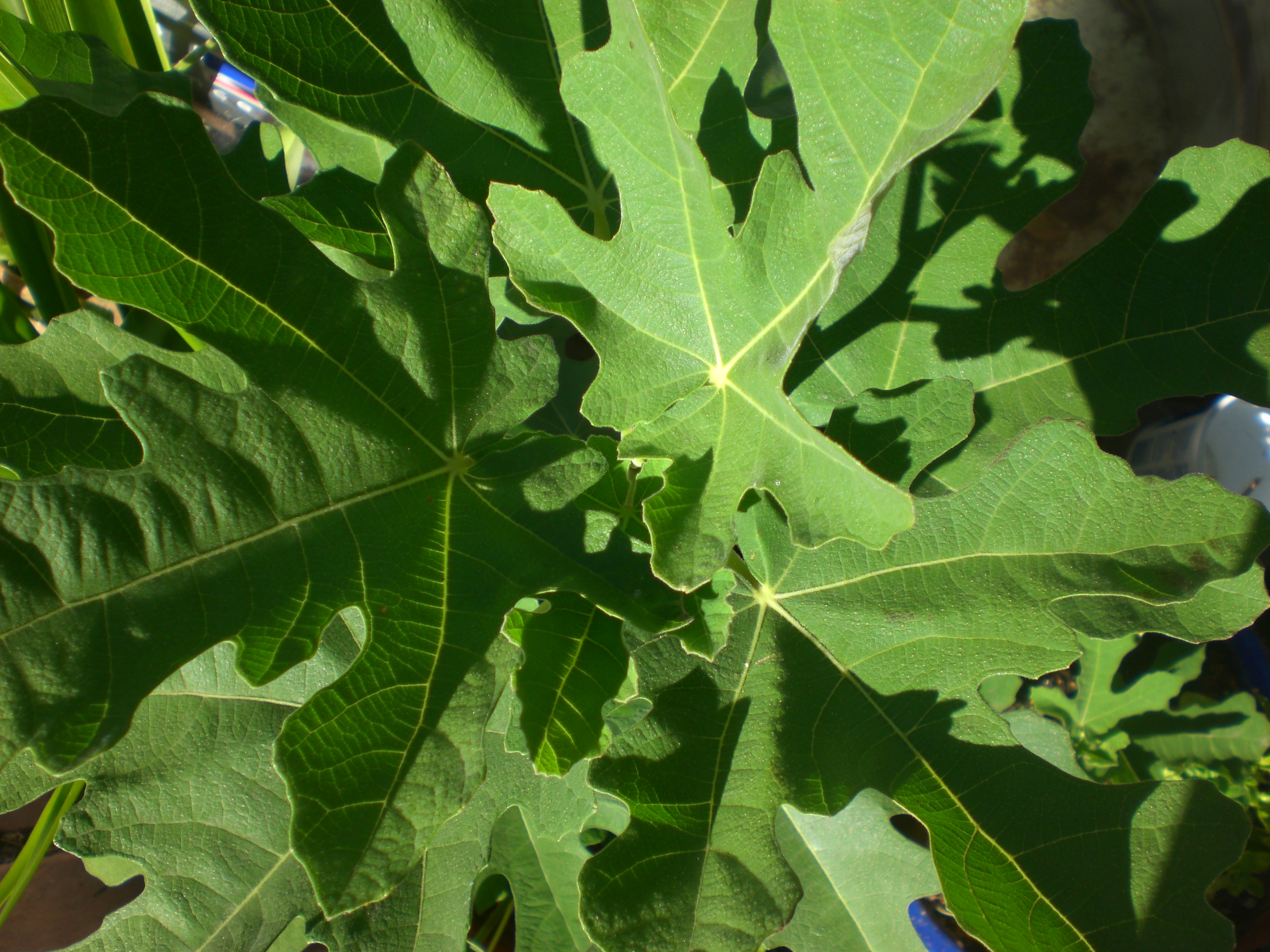
But it is such a cool plant! Big biblical leaves, dark and shiny in the summer, and last year, it actually produced 2 real live figs- they tasted just like Newtons, except without the cookie part. I think in a bigger pot, with more reliable water, it can produce even more. Here in zone 5, it is not likely to be hardy in the ground, so I am struggling with the pot, and the dormancy. 

I know, some people buy figs at the grocery store. Or they just don’t eat them. Or, they don’t complain about their trees.  From what I have read, though, figs have a long history of people messing with them- I’ve read about Italian immigrants in the Northeast wrapping their fig trees in tarpaper and straw. So, my plan is, wait two weeks, bring it upstairs and put it on the covered porch- it will get more sun, a little cold, but not enough to freeze the new growth, we hope. Next step, ask for help in the transplant process, so I’m not dragging it around myself.

The Logee’s Catalogue


I am on so many plant mailing lists- they know a sucker discriminating plant buyer when they see one. www.logees.com Got a new one the other day, and on one hand, it drives me crazy, and on the other hand, I feel very want-y about,  like, 6 different items. Logee’s specializes in tropical and subtropical plants for containers and greenhouses. I crave almost everything in this thing.

What drives me crazy is the organization. Flipping through it, there are figs and citrus on this page, then blueberries and passionflower, then…more figs and citrus…then papaya and sugar cane, then…another page with figs. Then more citrus. OOh, vanilla! But I have researched this already, and to grow vanilla you need a 2 story greenhouse. (SOMEDAY!)

What tempts me is the Meyer lemon plant, at only $11.50. In most other catalogues, Meyer lemons run about $50. I realize it will be tiny, and I will have to wait many years for the sweet little aromatic lemons to grow to maturity. At this point in my life, though, I honestly do have more time than money.

Also tempted by a tea plant- imagine, I could grow my own tea!!! And a coffee plant- I could grow my own coffee!!! And papyrus- I could grow my own…Egyptian paper!!!

Deep breaths. Deep breaths.

Hillbilly Goldfish Pond


I keep upgrading my water gardens- I started with a galvanized washtub, which held pretty much 1 fish and some floating plants, then I got a plastic liner for a whiskey barrel, which had space for 2 fish and some floating plants. 

This year, I invested my fortune in a horse trough, which holds about 130 gallons of water, lots of plants and 10 goldfish. At least at the beginning of the year it had 10 goldfish. There’s been some attrition.  oooh, shiny.

Birds love any water feature, no matter what size, and in the years since I have been putting in container ponds, more and more birds have come to the yard.

I have made a concious decision not to have a pond in the ground- for one thing, I think it shrinks the pond.  My tank takes up a good amount of space in the landscape- it provides a structure, a shiny backdrop, a formal oval of water reflecting the sky.  Most naturalistic ponds don’tlook very natural to me, unless they are a lot huger than I have space for.  I think A 130 gallon in-ground pond would look puny and insecure in my garden. When I chose the galvanized metal tank, I decided that I wanted it to not look naturalistic- I wanted the informal formality of an above ground pond. When we had a party this summer, we put in floating candles. It looked magical.

Intalling was easy- I leveled out the place I wanted it to go, digging out the weedy grass next to the patio, and stretching space out- there is a foot wide tulip bed to the west of it, where tulips and irises will help conceal the metal. 

Maintainance is easy, too, maybe too easy, considering how many fish have died this summer.  I dip my watering can in every few days to water tomatoes and potted plants, then top the tank up with a hose. Water hyacinth and a papyrus provide filtration and ogygenation for the fish, and mosquito larvae provide a food source. I don’t have a fountain, because I haven’t wanted to deal with the hassle of electricity. In the future, maybe solar fountain technology will improve, but for now, it is a still water pond.

Fall is here, and the weather is too cold for the water hyacinth and I have moved the papyrus in for the winter.

Growing Lemons in Zone 5 and Other Crazy Hobbies


It is nearly time to move my citrus trees in for the winter. I have a lemon, lime and orange in pots which spend the summer outside, then move inside when it is cold. The dream is one day to get a supply of homegrown citrus. 

There's new growth on the lemon tree, and we hope it blooms this winter.

The reality is disappointing. One year we had quite a few oranges, and tremendous blossoms in January, but that was when the plants came to school with me- I had a classroom with north windows, and it wasn’t heated at night, and I think that was the perfect climate for them.  I changed schools, and my current classroom doesn’t have windows ( I wonder what they were thinking, those school building designers of the late 60’s- “I know, those kids are getting distracted by looking out the windows, so lets make it so they can’t!”) so I have to cram them into the boy’s room, which has the best south and west windows, and hope for the best. They are all three in 14 in diameter pots, and some years they bloom and produce a few fruits, but I am a looong way from self-sufficiency in citrus.

Last year I added another edible plant which won’t survive the winter here, a Chicago Hardy Fig.(www.raintreenursery.com)    It arrived at the end of the summer, a twig smaller than a pencil with two leaves and a hefty bundle of roots.  The half  page of instructions said:  pot immediately, not let it get colder than 20, and when it went dormant bring it inside to a cool, dark place, keep it moist, but not wet, then bring it into the daylight when there was no longer risk of freezing temps. It was complicated, and made me a little nervous, but the plant made it through the winter, and is currently alive. 

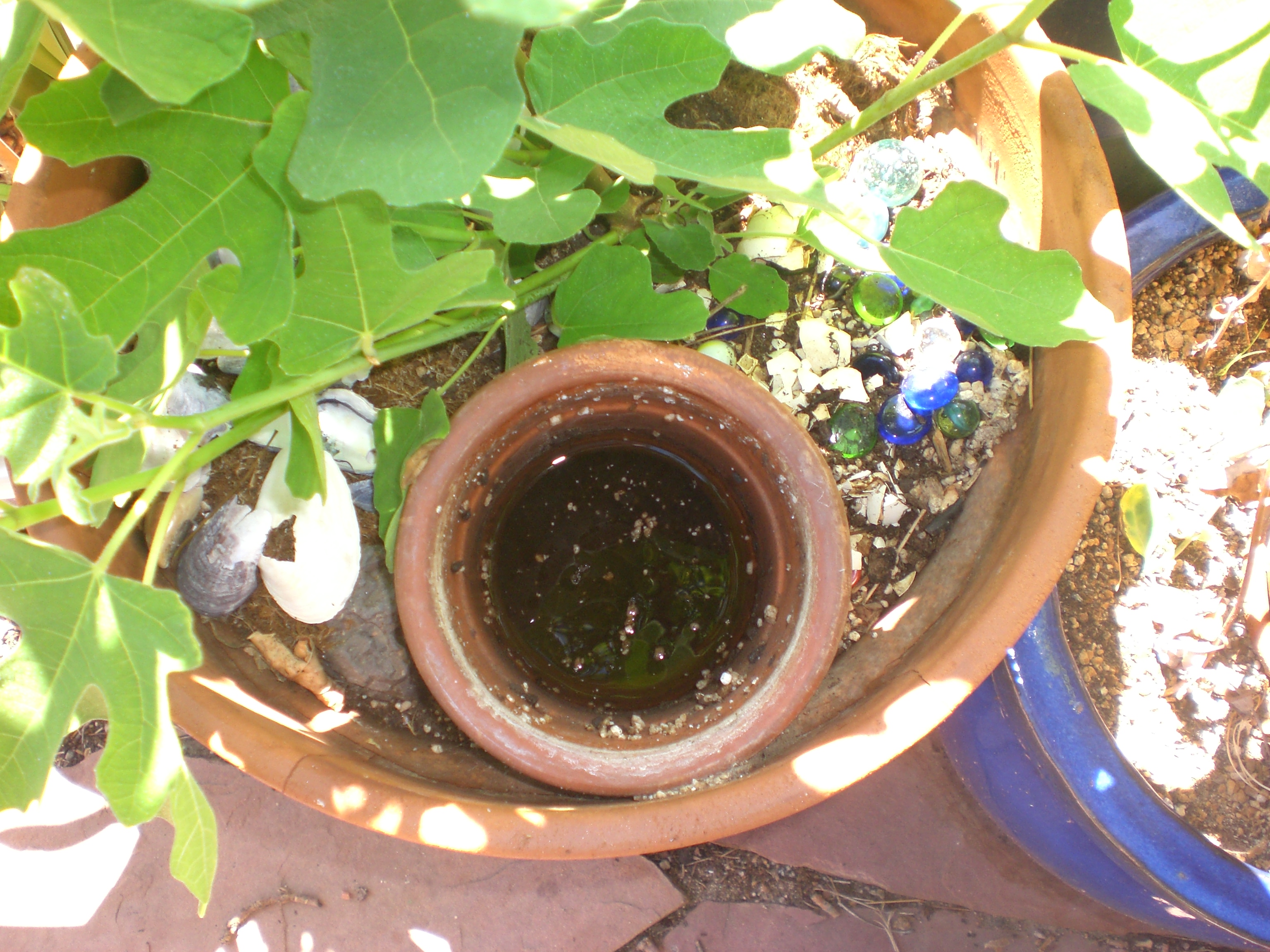
A porous clay vase turns any pot into a self watering container- it holds about 1/2 gallon, and seeps into the soil slowly.

I set up a large clay pot with a porous clay vase inside- the vase holds about ½ gallon of water and slowly seeps through to the soil. While it is outside I fill it every few days.  I kept it in our guest room in the basement last winter, with the twig under a flowerpot to keep it genuinely dark, and periodically filled the vase with water.  In April, I peeked at it, and saw that there were white buds popping, so I moved it to the back porch, ready to bring it inside when frost threatened.

It has grown beautifully all summer. I didn’t expect fruit for a few years, but there are 2 tiny figs on it. It is probably 18 inches tall, and sometime in October I’ll bring it down to the basement again, to start the process again.

Pomegranates might be next on my list of impossible fruits for Colorado- what else?

Next Newer Entries