Soil- you can grow that!


Hens and chicks in leaf litter.

Here on the front range of the Rocky Mountains, we have alkaline clay soil that ranges from tan to brown in color. I can jump up and down on the blade of a shovel and not make a dent. I use a thrift store knife to cut weeds off at the root, and I have broken two- snapped the blade clean off in the hard soil.
Except in places where I have mulched.
In shrub beds around the yard where I have been piling leaves and wood chips, I can slice into the soil like it was chocolate cake. Well, maybe brownies.
The best explanation for what happens when we add organic matter to soil that I have read is from Mel Bartholomew’s Square Foot Gardening. Imagine sandy soil is a jar of marbles, water just pours through, moistening the marbles, but not staying in the gaps. Organic matter works like little sponges in between the marbles, holding onto the water and nutrients. Imagine clay soil is like a pile pf playing cards. Water sits on top in a puddle, slowly sinking in. Organic matter works like little sponges in between the cards, creating space for water and air.
So, if you want to build soil, and believe me, you do, here are some ways to do it:
Compost– My favorite compost bin is one that has no bottom, and can be moved around the yard. Every six months or so, I put my bin under another tree, or next to a bush, and when I dump out coffee grounds and orange peels, I enrich the soil in that space. When the bin is full, I move it to a new location, spread out the pile, and have automatic mulch in that zone.
Leaves– I have two big ash trees- they drop copious leaves which I sweep off the patio and rake onto my asparagus, and raspberries, and strawberries, and veggie beds. You may not live in a neighborhood with big trees- some cities have leaf exchange sites where people who don’t want leaves can get rid of them. A few years ago, I participated, and a man brought over a flat bed trailer with a mix of leaves and fresh cut grass. It was heating up as we unloaded the trailer and I spread it around. It made lovely mulch.
Wood chips– I get a pick-up load of wood chips pretty much every year. The goal is mostly to keep weeds down and hold moisture in the soil, but they slowly break down to build soil as well.

A mix of autumn leaves and dead tomato plants, with some sticks on top so it won’t blow away. By spring, it will all boil down to the level of the top of the raised bed.

– I am lazy about “putting the garden to bed” because I know that the stems and leaves of the plants themselves will break down into soil. Weeds with seed heads I usually throw away, although I don’t get all of them. I intentionally leave some seed heads, like for coneflower or sunflowers, for the birds to eat. Tall stems also catch blowing snow and leaves around them so they act as tiny snow fences.

So, whether you have sandy soil or clay, your garden can benefit from adding organic matter to it. This is a great time of year to begin a garden- pile up leaves and let the worms and other critters turn them into soil for next spring.

Rabbit Hole Warning: See CL Fornari’s You Can Grow that site for more ideas of what you can do, no matter where you live.
Radical Apple Pruning


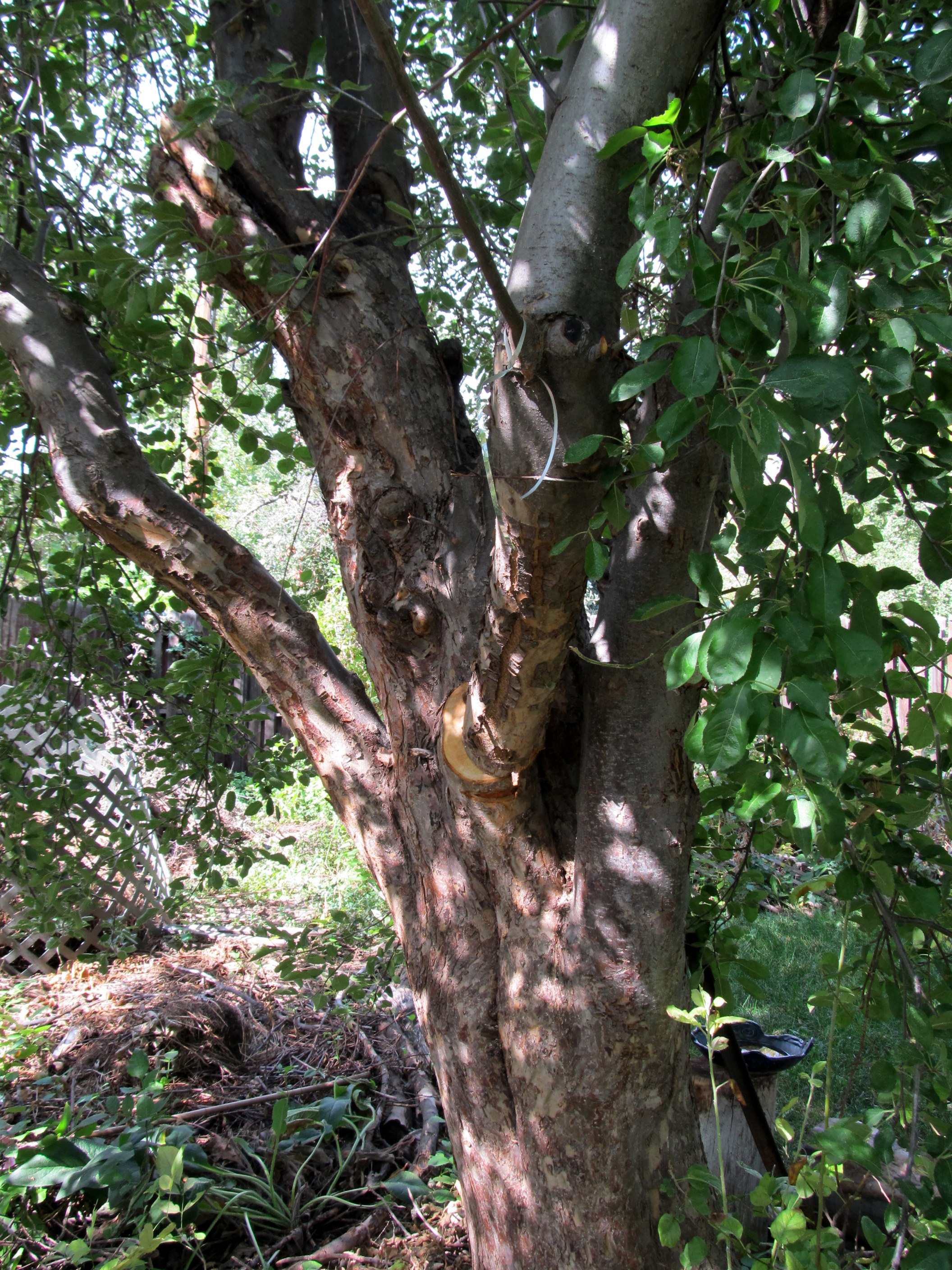
We have a giant apple tree that has been butchered in the past, then ignored, the butchered again, by the city tree trimming crew. It is probably about 50 years old, and most of the apples are developing way up high, because the major branches go up high, then bend over…after researching a lot, hemming and hawing and reading, online and in books, I have decided to renovate it. Slowly, over a few years, I’ll take off major limbs and train young branches to be the new major limbs, at a more convenient height. Convenient for me, not the squirrels.

Let me tell you about apical dominance… there is a chemical in plants that causes the  buds on the end of every branch to be dominant- it turns off the other buds back down the line. This chemical, auxin, is affected by gravity. If the end bud on a branch droops down, there aren’t many buds that will be activated. There will be buds on the tree up high, before the branch starts to droop. So we have very few apples down where we can reach them, and a bunch up high, which then fall down to be half-eaten by squirrels.


Another thing about apical dominance is that when the end bud is cut off,  other bud back down the line are activated. This is good when your pinch back flower chrysanthemums to make the plant bushier, so you get more flowers in fall, but not so good when the city crew whacks back your apple tree on a semiannual basis.

Since it is a standard tree, not a dwarf, it is really big. Branches are growing up into the power lines, and the city crews want to prevent that, but they don’t care much about the tree other than that. Every time the city comes to prune, they take out the center aggressively, which causes it to grow back aggressively. It’s pretty bad. There are seven major limbs, up to about 6 inches in diameter at the trunk, and they have kind of an umbrella effect, going up, then curving way down.
I have thought about it a lot, planning, and checking, and finally decided to take off one of the seven major limbs. Next year, I will take out another, never removing more than 25% of the leaf area at a time. Hopefully this will prevent major regrowth of water sprouts. I wanted to clean up the south side of the tree, since that is where I have recently sited a veggie bed and I wanted it to have more direct sun.

So, I chose my first limb, sawed it, then spent some quality time wondering how to get it down without seriously hurting myself. Seriously. It was tangled in so many other branches that even when it was cut all the way through, it just sat there.  I moved the ladder and made some more judicious cuts, then spent a pleasant afternoon cutting it into reasonable lengths for our chimenea.  Next year, I’ll select another limb from the North side of the tree, and work on that one.

The most helpful book for me in this project, which has mostly been a project about thinking, is Cass Turnbull’s Guide to Pruning. Tons of illustrations, tons of examples, written by a woman on a mission.

Organic Apples- you can grow that


I have a list of the “dirty dozen” on a post-it note over my desk- the fruits and vegetables that you should eat organically grown versions of, if you can get them, because of pesticide residues. Number 1 on the list, and in our hearts, is apples.
Celery, spinach, and bell peppers are on the list, but nobody around here eats enough of those to make a difference. Apples, though…we eat a lot of.
We have a giant old tree that produces sour apples, not our favorites, and about 7 years ago I planted a Golden Delicious tree. After falling down, but not being entirely uprooted, in an early fall storm last fall, it has produced prolifically this year. Prolifically enough that I thinned once in June, then again in July, taking off unripe fruit that I was worried would break off the branches.
Backyard Orchard (link) has helped figure out what to take off and what to leave, how to prune, and when.
Now the organic part… I didn’t do anything. Last year I stapled paper lunch bags to fruit I could reach, and that was effective, but this year, I was talking to a colleague, who said that since she had put up bird feeders, her apples were much cleaner. A few got wormy, but the birds came for appetizers, and stayed for dinner.
I didn’t put up feeders- the squirrels tend to get to those anyway, but I have a lot of plants that feed birds, like coneflowers, We have been building up the garden for about 12 years, making habitat for pollinators, and birds and snakes and us. Several years of building soil and habitat has made it so this summer, we didn’t have to do much- the apples kind of took care of themselves. After a summer of doing nothing, my apples look great. They are small, which tells me I need to thin more aggressively next year, and probably water more. However, they are bug-free, and pesticide free.
I am a few days late in posting this for the “You can grow that” meme, created by C.L. Fornari, a garden writer who wanted to get other writers involved in writing encouraging posts, letting people know that it isn’t that hard. It strikes me funny that Miracle Gro has a marketing plan called “you can gro that” that kind of tramples over the top of C.L. Fornari’s meme, which I have been participating in since March. I am not sure what the future holds for the meme http://wholelifegardening.com/blog/. But you should know, you can grow (yes, with a w) apples.

Dead Junipers- what next?


The new edge of the bed in the front yard- we’ll be adding some compost and lots of mulch.

Most people who know me would agree, that I don’t seem like the kind of person who would pound stakes into the ground, stretch out string between them, and then follow that string as a guide when making the edge of a  garden bed. I was a s surprised as anyone when I found myself doing just that this afternoon.

Yesterday evening, I was cleaning up the edge of the area where we took out the junipers (link) and I used the garden hose to kind of make a gently curving, voluptuous edge, nipping it in close to the faucet, easing it out near the corner of the house.

Then I thought about mowing that line. I thought about all the other curvy, sensual edges in the yard that have to be mowed, then edged. I decided it would be easier to make a straight edge, and let the plants be curvy.

The bed is about 20 feet long, and the outer line is 8 feet out from the house wall.  (when I said I was going to make the bed about 8 feet deep, DH had a moment where he thought I meant 8 feet from current ground level to top of bed.  No.) I bought 40 brick pavers, because I didn’t want to get out the measuring tape and then do math, so of course I have to pay for my laziness with another trip to the big box store.


So, the plan:

buy more bricks

when there’s grass inside the line, pop it out and transplant it outside the line, when possible

pile on 2-4 inches of shredded wood mulch

when the weather cools, start transplanting the plants I want to move from the backyard

order bulbs

snake soaker hose around the bed

Plant list

Hazel bush (transplanted from nursery bed)

Sedum Autumn Joy (thanks, Sharon!)

Purple coneflower (divided from back yard)

Bearded Iris (divided from back yard)

Yarrow (divided from back yard)

Lamb’s Ear (divided from back yard)

Thyme (divided from back yard)

Comfrey (divided from back yard)

larkspur (seeds)

columbine (seeds)

lily (ordering- probably dark reds and oranges)

tulips (ordering, probably red and yellow triumph)

daffodil (basic yellow)

Most of these plants I already have, so this is a very cheap design for me. I also know they do well here, so I am not taking much risk that everything will keel over and die. The exposure is a little different- the north end of the bed is pretty shaded from the ash tree and the house, and the south end gets morning sun. The coneflower and lilies will go that direction, because they need the light to flower.  My “largish” plant is a hazel nut bush, and I want it to form one corner of a triangle with the ash and the Korean dwarf lilac under my window.

The plan for the tuteur- the exact measurements will depend on the wood I find.

I am also planning some structure- as you can see in the picture, there is a big expanse of plain wall, so I will put in at least one trellis, and some containers,  and am thinking about building some tutuers, which are french teepees- using lumber,rather than round wood or sticks. And, you know my policy, it should be done with the wood that is already piled up, going to the lumberyard is cheating! There are still some 1×2’s sitting behind the garage left over from taking down the playhouse, so I will start with those.

Resilience- you can grow that!


Purple Coneflower and Yarrow, extremely drought tolerant herbs. They’re loving the heat.

It has been hot here. Crazy hot. Typically, in June we get nice moisture, soaking rains, heavy thunderstorms, nice misty days when it’s just cool and gloomy. Not this year. I realize it is hot pretty much everywhere right now.
We went LA on vacation last week, and it was cool and pleasant- too cool for the ocean almost. Then we ended the vacation in Las Vegas, and it was ridiculously hot. You expect that for Las Vegas, but we kept watching the weather for home, here on the front Range of Colorado, and it was ridiculously hot in Colorado, too.
The guy who mows our lawn was checking in on the cat, and a friend popped over to water the container plants and the tomatoes, but otherwise, we didn’t provide for sprinkling. I expected the worst when we got home, but I was pleasantly surprised.

The grass in the front looks awful, of course, but it almost always looks awful. It’s on the list for future projects.

The beds in back, though, look pretty good. They have plenty of mulch, to hold onto what moisture they get. They have plants that are drought tolerant, or native, or both. I designed them that way so they wouldn’t take much water, and would attract bees and birds and butterflies.

The golden currant is dripping with fruit, the lavender is blooming like crazy, the yarrow and coneflower and chamomile are standing tall.  They look better than I do, dripping and drooping, and praying for rain.

Plan for resilience- xeric doesn’t have to mean rocks and cow skulls, it can be dragonflies and birds and fruits and berries. It takes less water and other resources, and it bounces back from hard times. Resilience is a trait we all can use.

This is pretty much the same shot, from the same angle, as I took 3 weeks ago. It’s been watered once with a soaker hose.

Two books that influenced me tremendously are “Herbs in the Garden” by Rob Proctor, and “Gaia’s Garden” by Toby Hemenway.  Both books helped me learn to think beyond “vegetable garden here, lawn everywhere else.”

Fracking junipers*


I asked the tree trimmers who had worked for us before to come do an estimate of pruning the big old tree in back, the big old (slightly younger) tree in front, and ripping out the juniper bushes entirely. As I remember, when they came out last time, they pruned both ashes and the old apple, and removed an upright juniper, and the whole thing cost about $55o.

Umm… this estimate is higher. By a lot
$1600 for the ash in back, $600 for the ash in front. $450 to take out the junipers.
Seriously. $450 for the junipers?
I plan to get another estimate for the big trees, because this seems high. They did come highly recommended, and I was happy with the work they did before, and I am not going to climb up in my 50 year old ash tree and chop things up. But still. Cadillac prices.
I came to a conclusion in the shower, where I do my best thinking, and decided that for 450 I can rip out my own junipers.

Day 1  I started Saturday, tentatively at first, sitting in front with loppers, looking for the trunk, hoping I could just get in there and saw it down. Then I stood up and went around behind the northern-most bush, and saw that where the kids had tried to chop out a playhouse, it was pretty easy to access bigger branches. Lop lop lop, throw into a pile. After a while, I broke out the pruning saw, to get the branches that were too big to get with the lopper.
I discovered 3 wasp nests, unoccupied, and a bird nest, also unoccupied.

Little bird nest.

On the first afternoon, I got most of two shrubs cut up, waiting for the main trunk to be cut as close to the ground as possible. The temperature was about 75 degrees, not too bad for working outside, but my arms got scratched up, and I got dust and stuff in my eyes, even with safety glasses, and there were little pieces of prickly stuff everywhere. I kept thinking, “$450… $450”

DH suggested buying a chain saw when I was halfway into it. I may have growled at him.

.

Day 2 had record breaking temperatures. High temperatures, in case you are wondering. I loaded the pick-up, then discovered the waste yard was closed on Mondays. D’oh. Then I crawled into the house, and waited for it to cool off, investing the time in looking at wholesale bulb catalogs and drawing plans for the new bed. I also took a nap.

Day 3, the weather was cooler, but not by much. I drove the pick-up to the city waste yard, dumped the trimmings, then reloaded twice. The third time I stopped for iced coffee and a brownie, then stocked up on epsom salts.

Day 4: We sawed up the last of the shrubs, loaded up the truck, this time with help from DH, who didn’t have to go into work until late.

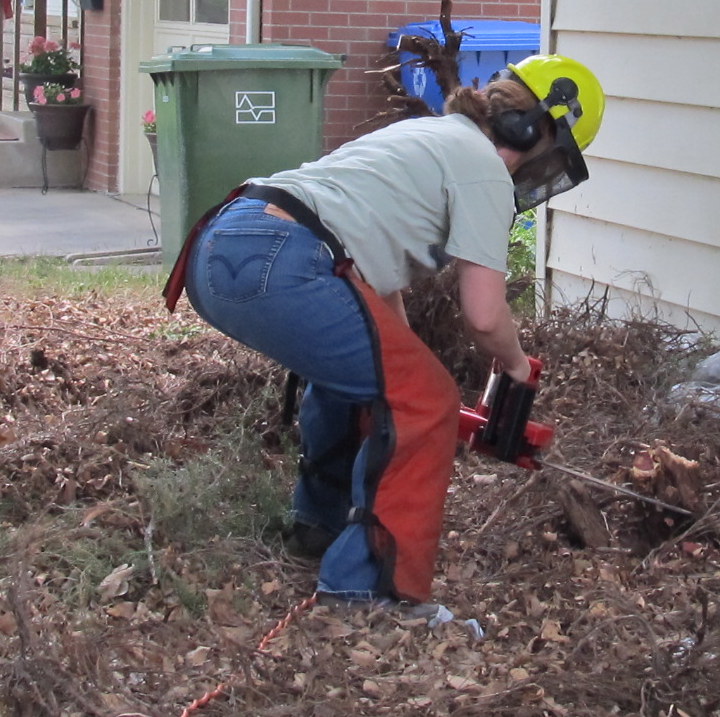
We also rented a small electric chainsaw. The stumps are just too big for the pruning saw. It cost about $40, and made the stumps go much more quickly.

Thank you Kate, for taking pictures…maybe we’ll have a conversation sometime about flattering angles.

I’m glad we rented, because safety equipment came with it. If we had bought a saw, I know we would have half-assed the safety part. Sure, I would have worn safety goggles, but the kit from the rental place had chaps, and goggles, and a hard hat with hearing protection.

I’m coming after you, stumpy!

At the end of day 4, the only thing left is clean up- the remaining stumps and branches, and sweeping.  The next time I get mulch, a thick layer will go onto this area, and when the weather cools in fall, I’ll transplant things into it.

My thought throughout this project was “We’re saving $450” every time I cussed, and complained, and found little tiny prickly juniper needles in my bra (in my bra!) I would think about the money I was saving. What is a project you could have hired out, but didn’t, or you did it yourself, but would never do it again? What would you do with $450?

*my original working title for this post was a different F word, which expressed how I was feeling toward the bushes. The boy saw it when I was working on it, and attempted to cover my eyes, to protect me. He thought someone bad on the internet had written that word, and he wanted to protect me, bless his heart.

A little birdhouse for your soul


Last year, I wrote about my half-assed attempt to mount birdhouses in my garden, on posts from the thrift store, with rebar and duct tape.
Today, I have a more fully-assed attempt, where I actually used wood and a drill, and screws to build a kind of trellis structure. No duct tape at all.

I have drilled 1/2 inch holes in the bottoms of the posts, and driven 1 foot rebar stakes into the ground, at the right distance apart from the holes. Trust me, I measured! I stepped on some plants in the meantime, but I did measure.

I laid out the pieces on the ground before screwing them together- here you can see where the hole is drilled for the rebar. Having a 2×4 on both sides of the base makes the whole structure sturdier.

I had some wood left from taking apart the playhouse (no worries- there will be a new and better shed playhouse in the future) so I used it to brace the posts. Screwing it onto both sides makes the structure stable by triangulating it. I let the length of the wood determine the size of the structure- the posts are roughly 42 inches tall, the leftover wood was roughly 50 inches long, I used three of the posts for the structure. The fourth might become  a bottle tree. Too tacky?
I painted the top cross bar and the posts bright blue, but not the base- the weathered gray wood will become kind of invisible against the ground.

I used “Surebonder Clear 9001” glue to attach the birdhouses, which we painted 5 years ago? A really long time ago, and they have been sitting around. I realize the glue won’t be permanent, but I am not too worried about it.

Larkspur, yarrow and chamomile blooming, silver buffalo berry bush and lilac in background.

I decided this space needed a structure because it is so green- shrubs, self seeded annuals, weeds, perennials. I like having a frame to make it more formal, but not in a “pinkie-up while you drink your tea” kind of way. Formal like having a frame around a picture- any structure works for this, a flowerpot, a trellis, a headboard.

There has been a forest fire to the northwest of here- we are not at any risk, other than from the smoke. The smoke has made it really unpleasant to get out and garden. It is better today, so I hope to get some stuff done.

Strawberries- you can grow that


One of my peak experiences in gardening was not in my own garden, and in fact, I didn’t do any of the cultivation. Friends of mine in college lived in a house with a strawberry bed, next to a flagstone path. One beautiful June, I would go to their house, sit in the sun on those red sandstone pavers, and eat perfect, ripe strawberries.

Of course, I had to have strawberries and a flagstone path at our house, when we finally bought one.

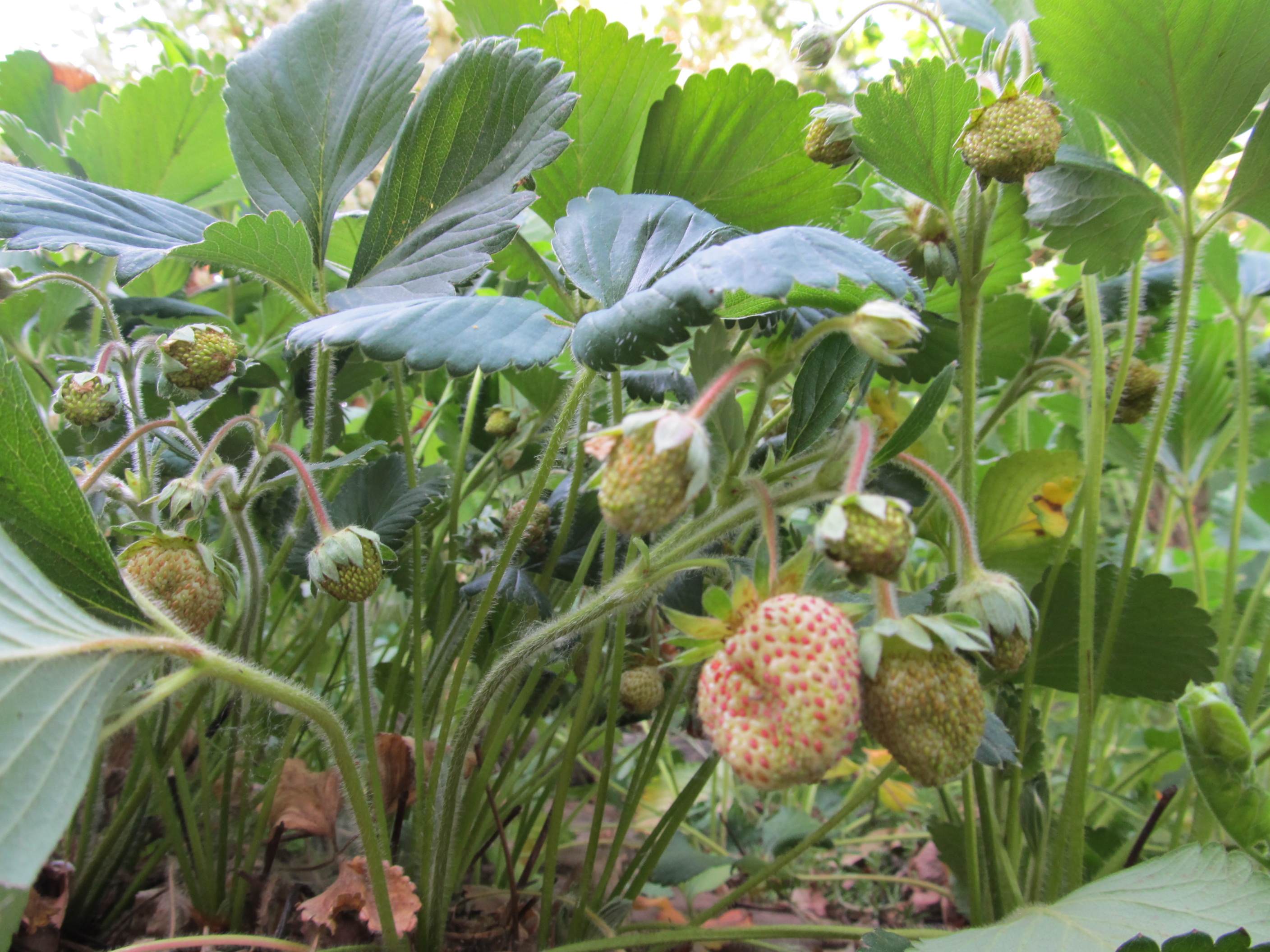
just a few more days…just a few more days…

I actually have planted strawberries in many locations- before I got married, and moved every year or so, after I got married, and …moved every year or so. It may seem ridiculous- planting a fruit that takes several years before it produces in house and apartments that I knew I would be moving out of. Maybe it is ridiculous, but it seemed like a good investment in karma.

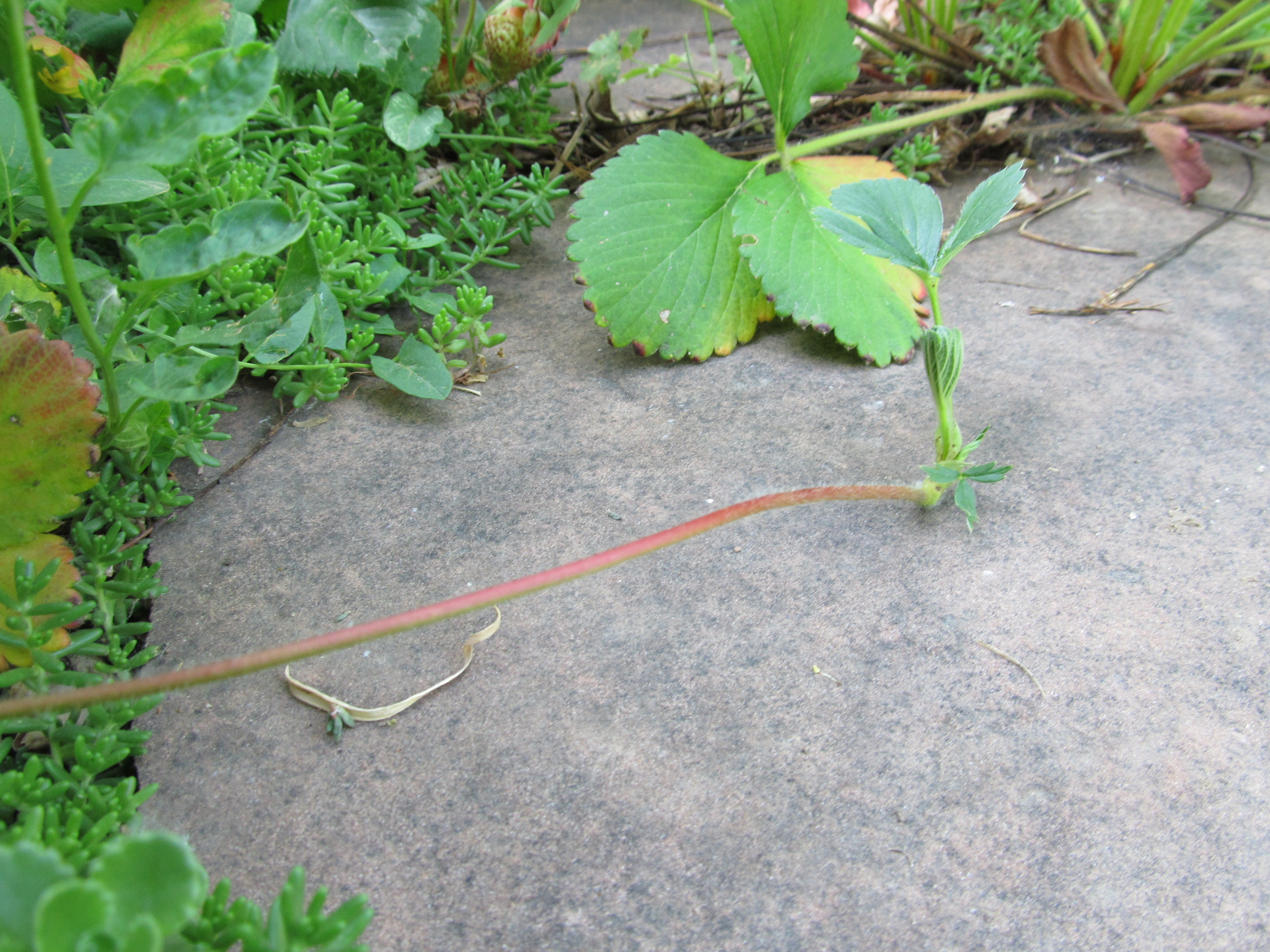
Strawberries do produce sparingly the first year, but after that, they spread and produce more. They reproduce by sending out stolons, or runners, with baby plants on the end.  I let the “daughter plants” take root and grow, so I always have some plants that are 3 or 4 years old, and about to peter out, some 2 year old plants that produce well, and some baby plants that are getting established. Most gardening books recommend cutting off the stolons the first year so you get more fruit.

New vocabulary word for the day- stolon.

A few years ago, I was at my sister-in-law’s house, and she was transplanting strawberry plants out from under a huge pine tree. Apparently, the birds that stole her berries perched on the tree, and ummm…seeds grew…in perfect packets of fertilizer. Yeah, you know what I mean, bird poo. They didn’t get enough sun under the tree to produce very well, but it made a perfect nursery for baby plants.

Strawberries are heavy feeders, so I give them compost, and mulch them pretty heavily, except where they have grown into the gaps in the path, where I can’t get mulch to go.

I plan to transplant these guys out of the gaps in the path, and may try them in containers.

Here in zone 5, the front range of Colorado, they ripen in early to mid June, this is later than you can get them in the grocery store, but oh so much tastier. And organic. And with a very small carbon footprint. Here’s where I get preachy and link you to a story about strawberries from California.

If you order plants in winter, you can get a bundle of 25 for around 25 dollars. They go a foot apart, so that is a lot of space to devote to  strawberries, but you can tuck them around other things- for example, there is a giant rosebush in the same bed with my strawberries, as well as iris and a mock orange. They are also available this time of year in nurseries. In fact, at the grocery this weekend, they had hanging baskets of them in the doorway.

I have had slug issues in the past, but this year has been so dry, I don’t expect them. I’ll put out saucers of cheap beer just in case.

Tree Killer


There are 2 types of people, tree planters, and tree murderers. No. Not really. Sometimes people who plant trees also kill them. Me, for example.
I have killed trees through benign neglect, bad cultural practices, and laisse faire policies. And occasionally, I have hired hit men to practice premeditated tree murder. (We’ve been watching a lot of Monk lately- I think it’s rubbing off.)

It’s like Justin Beiber’s bangs, in shrub form…

We have juniper bushes that were probably planted when the house was built, almost 50 years ago.They are hideous and over-mature- we have trimmed them in past years, but not the past couple of years. They half block the windows, making the front bedroom cavelike all year round. They have to go.
What has been holding me back?

  • Possible insulation value
  • Prickliness
  • Snake habitat

Does anyone know how to figure out the R value of 50 year-old juniper bushes? Me neither. Actually, there are places on the web where you can figure it out, but as far as I have been able to determine, the most value comes from bushes stopping the wind in winter. These uglies are on the east side of the house, and winter wind hits us from the north. I am not convinced they make much difference in gas bills in the winter. They do make a comfort difference in summer, I suspect, since, as I said, they make the front bedroom cave-like.
Prickliness- I don’t want to take these out myself. They poke, and make my skin rashy, and whaa whaa whaa. Plus they smell like cat pee. That is why I am hiring hit men to do the job- tree guys to get the junipers as well as clean out some dead wood on the ash trees. Since it is family policy to spend as little money as possible on anything, it has taken me a while to come around to this decision (and I am not bad mouthing DH here- the crazy penny-pinching mostly comes from me…unless we’re talking about lattes…)
Snake habitat- animal habitat in general, actually. Dense, prickly bushes make great protective homes for wildlife, not just the cute cuddly birds and butterflies that people want to attract, but also the garter snakes and rodents who are part of the environment but who don’t get the kind of  press that butterflies do. By taking out shrubs that are close to 7 feet tall and 4 feet wide, I am affecting beings other than myself.
Sigh.
I’m doing it anyway. I’ll let you know how it goes.

Bloom Day- Patience


Three years ago (or was it four?), my wonderful Mother-in-law gave me an envelope of seeds from her yellow columbine, which was spilling over the sides of the flowerbed (the flowers, not the envelope). I scratched them into the soil next to my brass headboard, near the dark red lilies, and stella d’oro daylilies…and this week for bloom day….they are about to bloom. Still waiting.

The waiting is the hardest part.

Oh sure, they have pretty ruffly leaves, and a bright green color, but none of us got into this for the foliage! Give us flowers!

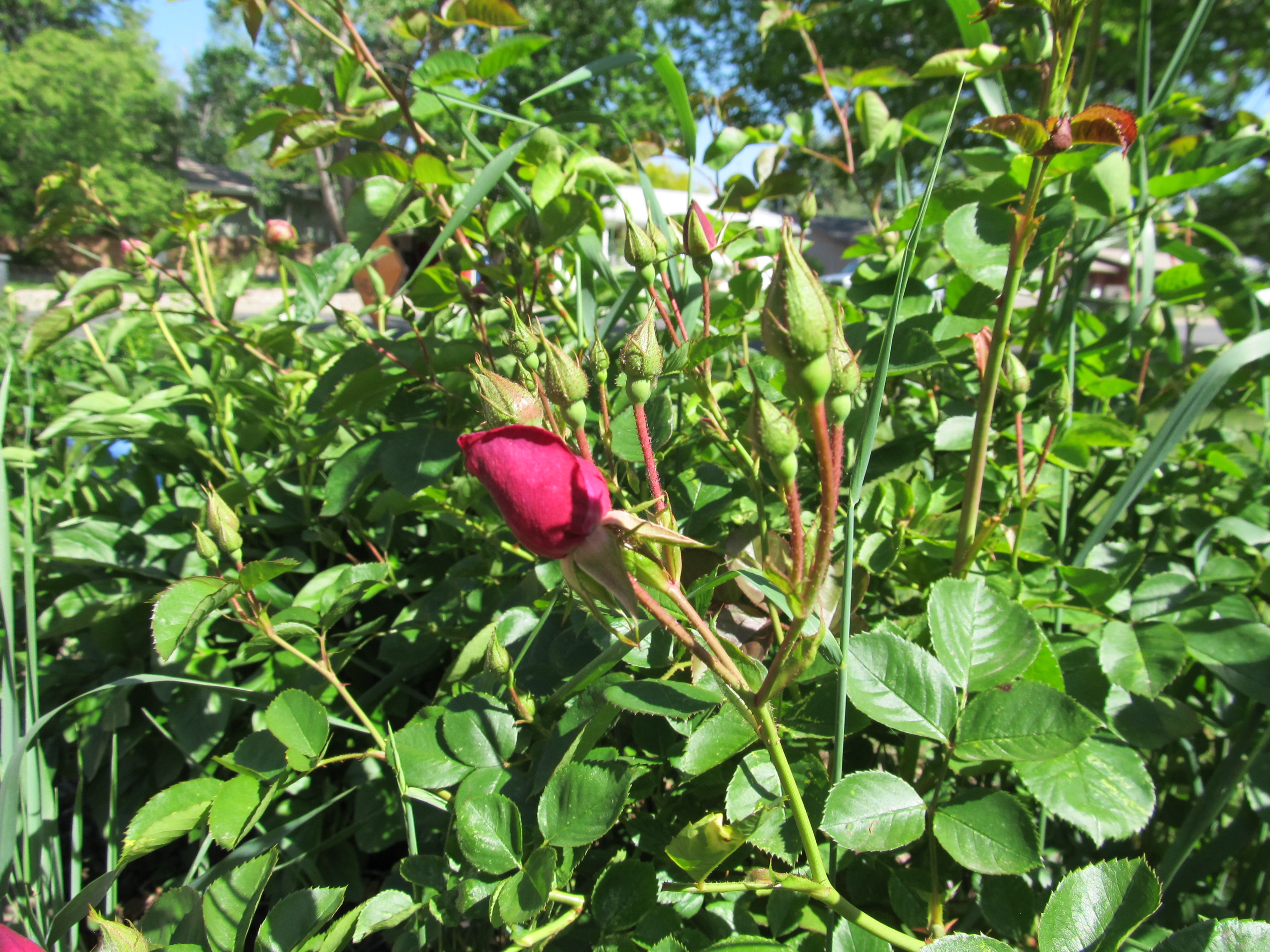
Also about to bloom, roses and peonies.

Planted before we moved in- unknown variety.

As big as a dinner plate when it opens…did I say dinner plate? I meant coffee cup. Which is still pretty darn big. For a flower.

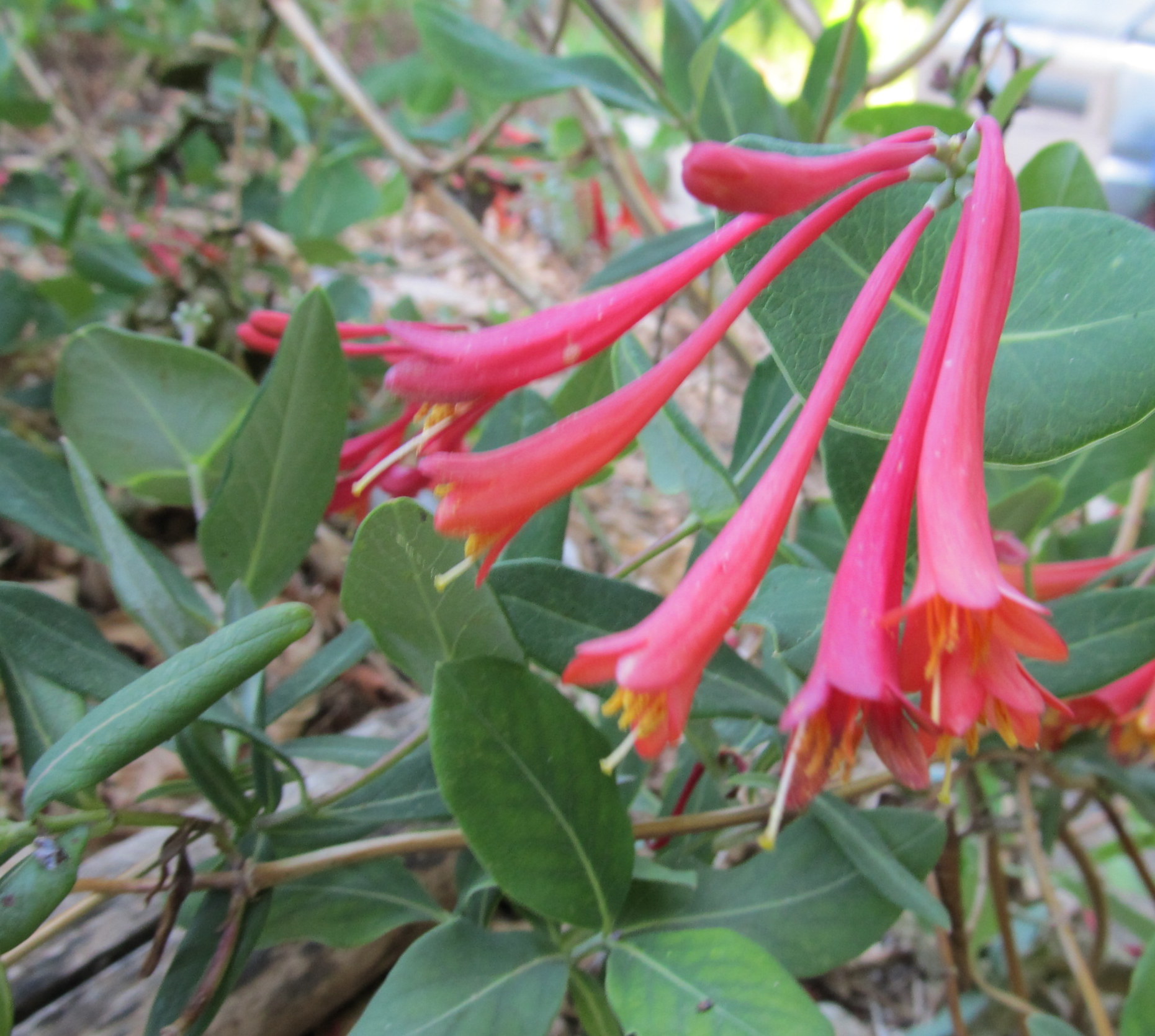
Actually in bloom, we have Honeysuckle Blanche Sandman, well-loved by pollinators and in continual bloom from May through August.

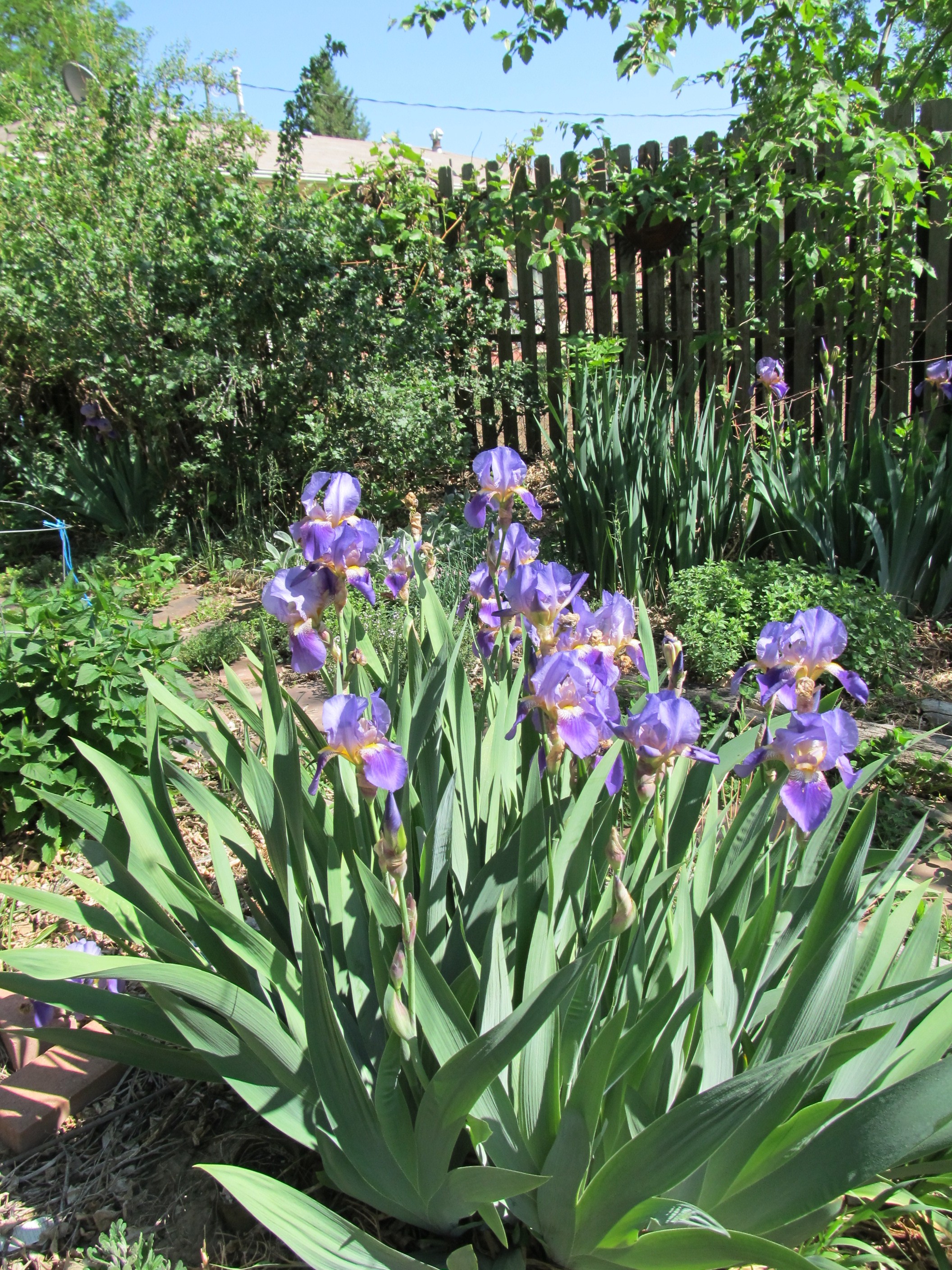
Bearded iris is still blooming.

Clover is  in the paths and lawn. Clover fixes nitrogen, and the flowers attract bees and butterflies, so I have it even though it doesn’t make my heart pound.

And, of course, we have strawberries. Blossoms now mean fruit in June- all mine! Mine, I tell you!

In June, I’ll eat strawberries…

Previous Older Entries Next Newer Entries