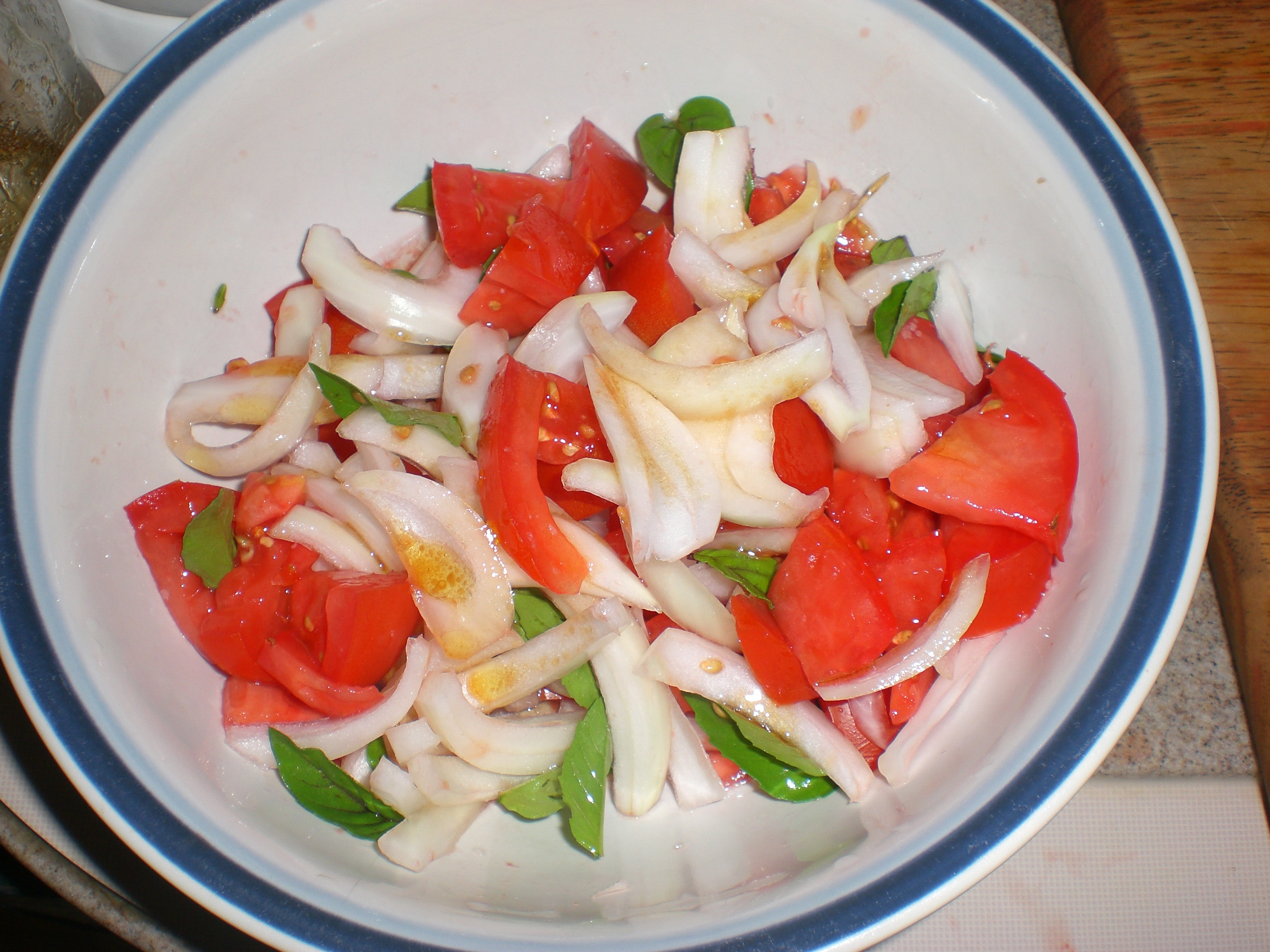
Beware- onion and tomato salad


This would also be great on a pizza, or over pasta.

My kids wanted frozen pizza for dinner tonight. I was happy to make it for them, but didn’t really want to eat it myself. Tomato season is coming on, and I had a Walla Walla onion left from a party a few weeks ago.

I had marinated the onions in basalmic vinegar, olive oil and Vietnamese fish sauce, then I grilled them. My friend Grif came to the party early, and he kept snitching raw onions out of the bowl they were marinating in. I couldn’t believe he was eating raw onions, then I tried one. It was really good.

Tonight, I sliced the onion into wedges- cutting pole to pole instead of around the equator. I soaked it in cool water for a few minutes, to take away some of the bite. I learned this trick from Andrew Weil’s book 8 Weeks to Optimum Health http://www.drweil.com I love the book, although I have never made it through all 8 weeks. That may be why I am not in optimum health.

While the onions were soaking, I zipped outside to get some tomatoes and basil. I chopped the tomatoes, drained the onion, and ripped up the basil, and tossed them all together with some vinaigrette and salt. Paradise in a bowl.

Sneaking Nutrients into kids’ food


Today I thawed some stock I had made a while ago, and put a cup of brown rice and about a quarter cup of lentils into the rice cooker with about 3 cups of the stock. They should all cook in about the same amount of time, and The Boy has already commented that it smells good, so that is a good sign. The Boy doesn’t eat meat, hasn’t for about two years without serious manipulation, and this spring he declared himself a vegetarian. Which would be fine if he would eat vegetables, but he mostly eats rice. He’s a rice-a-tarian. So, today I am sneaking some iron into the rice, with lentils, also some protein.
At his recent check-up, the doctor threatened to do a blood test to see if he had enough iron stores, and actually ordered the test, but said we don’t have to get it right away. It has been a powerful manipulation tool, I can say, “try the beans, they are on the list of high iron foods. If you don’t eat enough iron, we’ll have to get that blood test”
In doing some research, I think he is getting enough iron- from fortified cereal and bread, from raisins, beans and broccoli. I recognize that he does need to eat a bigger variety of food. I have decided not to fight with him about meat, but I will fight about sweet potatoes, and spinach and other nutritious food.
So, what does anyone out there do to sneak nutrition into kids’ diets? And a related question, is it right to manipulate people into eating healthfully? What about freedom of choice?

the best thing about cooking rice in stock? The brown bits on the bottom of the pan- crunchy goodness.

what yoga is teaching me about pulling weeds


Every summer, it would be the same thing- I would spend an evening plling the weeds out of the garden, then limp into the house, stretch out on the living room floor, and moan about tweaking my back. There would be a sore spot, always on the right hand side, and I would feel it for a few days, then go right back to pulling weeds, re-injuring myself over and over.
This summer, I have been doing yoga, taking a class about twice a week, and doing a little practice on my own on the in-between days. Here’s what I’ve learned:
1. “Halfway lift and lengthen” there’s a move we do, hanging like a rag doll, bent at the waist, where we lift up halfway, to get a flat back, and lengthen the spine conciously. This has helped so much while I’m out getting at the bindweed under the burr oak. I’ll stretch and pull, then conciously, “halfway lift and lengthen.” It strengthens my back, takes the curve out of my spine and prevents the tweaks.
2. Sweat is good for you- I’ve been doing Vinyasa yoga, where the studio is heated to at least 80 degrees. Easy in the summer- it’s been cooler inside the yoga studio than out, but I come out of class wringing with sweat, and it feels so good. Gross, but good. Same with weeding. Pulling up the thistles before they go to seed, lugging buckets to the compost pile- it isn’t exhausting. It shows me how strong I am and how much stronger I’m getting.
3. Gardening is a practice. There won’t be a time when I’ll “know yoga” and be finished. It is something I can continue to do and get better at my whole life, if I’m lucky. “Landscaping” is something that can be installed and finished, but a garden is a process- I pull up the weeds between the flagstones knowing they’ll come back. Mother nature bats last- there will always be more seeds coming along, and the roots of the perennial mallow stretch way down. I can look at it as a never ending battle, or I can look at it as a practice, something I’ll be able to do the rest of my life, if I’m lucky. The plants are collecting sunlight, protecting the soil from erosion, and once I pull them, providing me with material for compost. So, breathe, stretch, pull, halfway lift and lengthen, and get that bindweed before it goes to seed.

Surprising Cilantro


I’ve been planting cilantro for years, enjoying the young, lower leaves in salsa, pad thai, and other yummy international dishes. I’ve always cursed when it would flower and go to seed, I’d pull it up and plant something else in its space. I even bought “large leaf” cilatnro seed, with promises from the seed catalog (oh, seed catalog writers, let me believe your sweet, sweet, lies…) that it was “slow to bolt.” Bolting means flowering and going to seed.
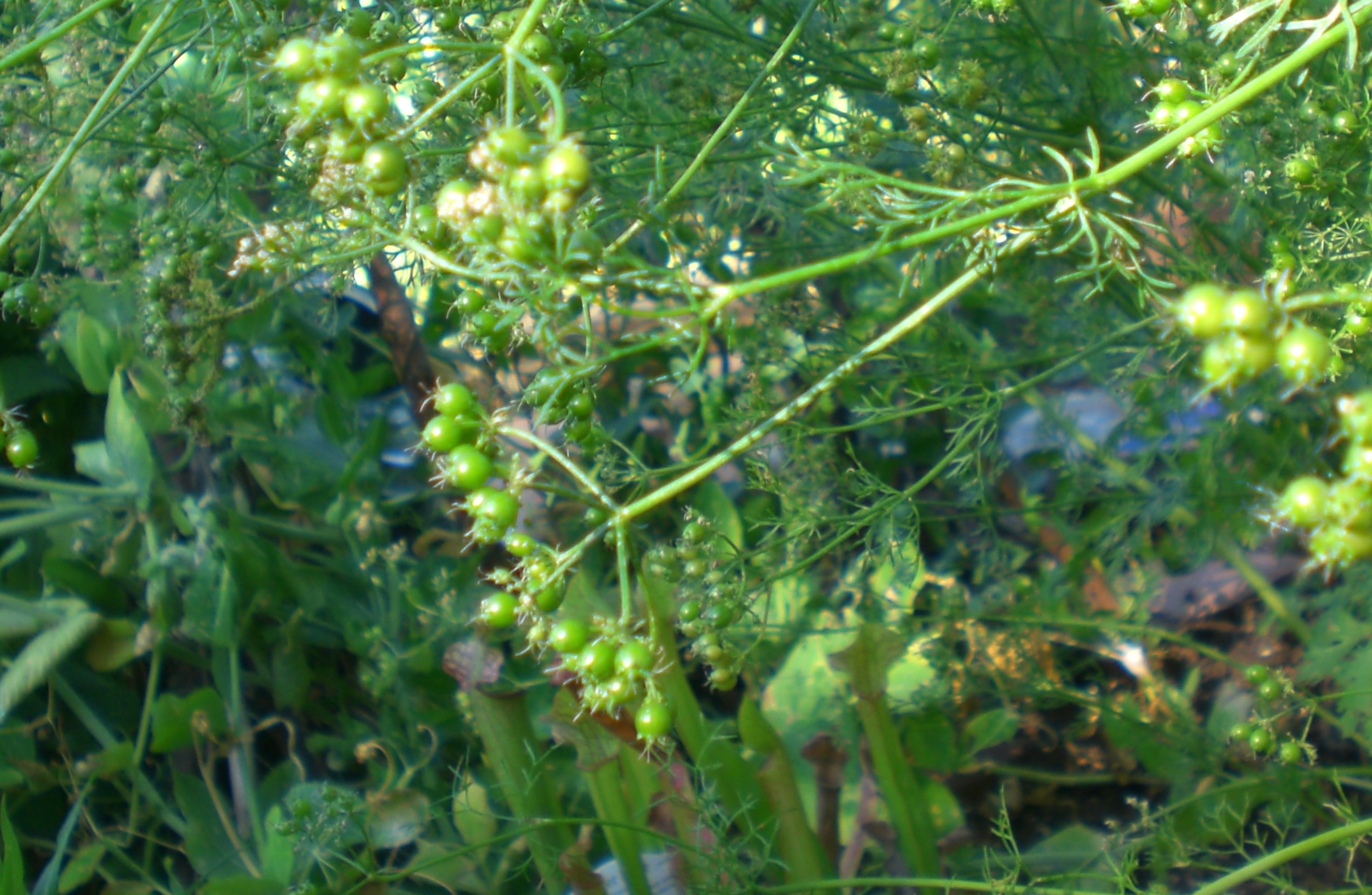
But this year, I let the cilantro in the boy’s garden flower, and it is lovely- cilantro is umbelliferous, cousin to carrots, queen anne’s lace and yarrow- beautiful white flowers that dance on the wind. Now, the seeds are forming, and once they turn brown, I’ll harvest the them. At this point, they’re called coriander, for some reason. I’ll plant some next spring, and use the seeds this winter to put in dry rubs, stir fries and maybe bread…I wonder if they’ll sprout, like alfalfa sprouts….that might be weird, actually,on a sandwich. Anyone tried sprouting coriander?

The leaves are called cilantro, and used in ethnic cooking

You can see why the type of plant is called "umbelliferae" the flowers come out of the stem in a shape like an umbrella.

A Radical suggestion


            I would like to make a radical suggestion: buy your Christmas tree now.

            In garden centers and big box stores, there are evergreen trees, spruces, pines, firs, beautiful future Christmas trees.  You could pay 20 dollars for a decent sized evergreen  Add another twenty or thirty dollars for a pretty pot, and you have a great specimen  that will add structure to your yard or patio, and next Christmas, a tree for inside.

            Now, wait, you say to yourself, you read all those articles back in December about choosing between a cut tree and a fake tree, and there was always a brief mention of the third road, the live tree.  However, there is the implication that it is a lot of work: you have to dig a hole before the soil freezes, you have to special-order a ball-and-burlap tree, only bring it into the house for a few days lest it break dormancy, and put it in the ground a soon after Christmas as possible.  I am here to say it simply isn’t true. 

Maybe I should have said this before Christmas, and I did, to anyone who would listen, but let me tell you now, in July, it is not only possible, but pleasant to have a living holiday tree in your house.   I have bought three Christmas trees in the last eight years.  The first was an Alberta Spruce, purchased for five dollars, and plunked in a pot.  I know I paid more for the pot than for the tree. It was only about 15 inches high, and was a great tree for two Christmases.  When we bought our house, I planted it in the garden, and it is still only about 30 inches tall. It is a dwarf, after all.  

The first year, we left it outside in its pot, watering often in the summer, and whenever I remembered in the winter.  We brought it inside the weekend before Christmas, and watered it with ice cubes, to keep the root ball cold. We always undecorate for Christmas on January 6, 12th night, and that year, as I recall, it was warm, so we just put it outside. A few branches had broken dormancy, and sprouted, so they froze when the weather got cold, but it did no lasting harm to the tree.  Tell me there was no lasting harm to the tree you bought at the tree lot.  The following year, we did the same, My daughter was toddling, and I thought it was nice to be able to put it on the table, out of reach, but my husband expressed a desire for a bigger tree.

So, the next spring I chose a three foot tall Colorado Blue Spruce, and bought a 20” terra cotta pot to go with it.   I honestly can’t remember whether I paid more for the pot or the tree, but it probably doesn’t matter, because I still have them both, five years later.    We have it down to a science now: bring the tree inside just before Christmas,  water with ice cubes, put it back out two or three weeks later, and take care of the tree as a large potted specimen the rest of the year. It is a nice anchor for one of my flower beds, adding height and structure. 

Are there any disadvantages? Well, you have to water the tree during the summer, and it might die.  I could point out that you have to water petunias, or geraniums, or any other plant you might have in a container, so why not a tree?  As far as the risk of killing the tree, the one you buy from the Lion’s club is already dead, and the artificial one was never alive, and they were both probably shipped from somewhere very far away.  A little live tree is much easier on the environment.

  Another disadvantage is the small size. In our house it doesn’t matter. We have a ranch house built in the ‘60’s with low-slung ceilings- it has a very horizontal feel. The pot for our current tree is about 20 inches high, and the tree is 40 inches, so the whole thing, including the angel on top, is shorter than I am. If I had a huge entry way, with a grand staircase, the tree might feel… puny.  However, I suspect there are more people in the world with little houses than big, anyway. In our house, our tree feels just right, it might feel just right in your house, too.   

So, go out and get yourself an evergreen.    In order to keep your tree in the same pot for a few years, find a pot that is 20 inches in diameter or bigger.   Use good quality, well draining potting soil, and mix in slow release fertilizer. Place the pot in full sun, and water regularly. Then next winter, when the question of “real or artificial” comes up, you can sniff and say, “we don’t have a tree carcass in our house, we have a live tree.”
Next Newer Entries