Bag Those Apples


We have an old standard apple tree that came with the house- don’t know the variety, but it is sour, a pie apple, rather than a sweet one. I have also planted a yellow delicious, which is my favorite.

Most years, the big apple tree produces more than we could ever eat- we give away bags of them, and I made apple sauce last year, but many, many go on the ground, and in the compost pile. I don’t spray for worms, and because I don’t kill the worms, there are more worms every year.

I’ve been researching what to do, because even though we don’t love the pie apples, the golden delicious, which is my favorite, is just getting big enough to produce- we had two apples from it last year, but this year it bloomed well, and there are a bunch (get the number) I still don’t want to spray poison, so I researched what to do to get organic apples. Organic apples with no worms, I mean; mine have been organic for years, with a nice shot of protein…

Most websites I found suggested sprays and traps and pheromones, which I don’t really want to mess with. Expensive and time consuming.  Then I came across this guy (http://www.finegardening.com/pages/g00062.asp)at Fine Gardening magazine, and got a paradigm shift- instead of trying to kill all the bugs, why not just prevent the bugs from getting to the apples?
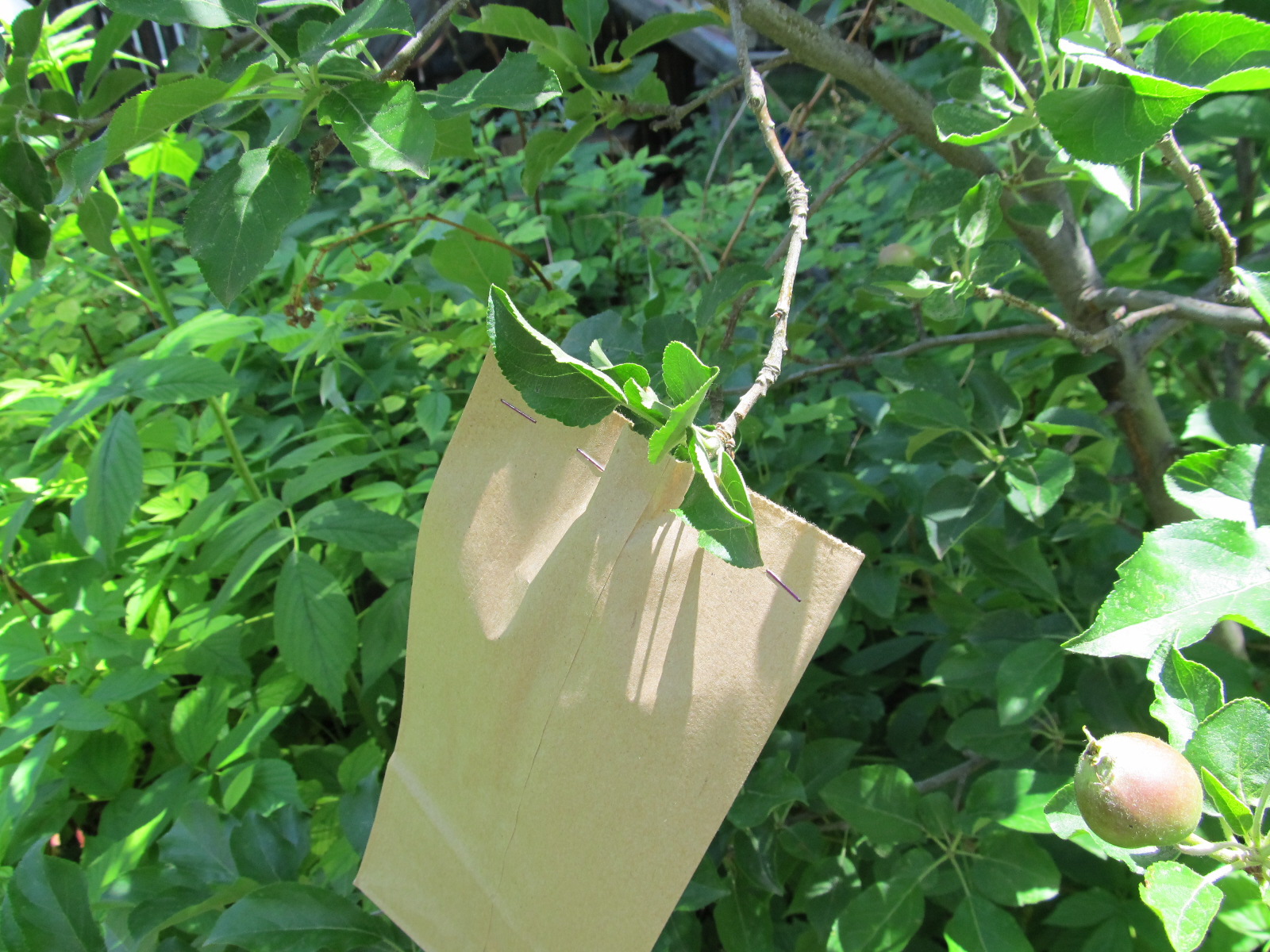
 

Put staples in the edges of the bags while sitting in the shade, then slip the bag on the apple and do the last staple.

So, it’s late June, 4-5 weeks after my apples bloomed. I go through, select the biggest apple in each cluster that I can reach, and staple a paper lunch bag around it. The apple will grow inside the bag, moths won’t get to it to lay their eggs, and by picking off the smaller apples in the cluster, the chosen one will get bigger. The paper bags are kind of ugly, but I am hoping they will fade into the background- I’m not hosting a garden tour or anything.

I will start with the golden delicious-(it’s my favorite, did I mention that?) and then put bags on the big tree for as long as my patience (and my stapler) holds out. I bought a package of 100 bags, but I don’t think I’ll get that far. This fall, I’ll update how it goes.

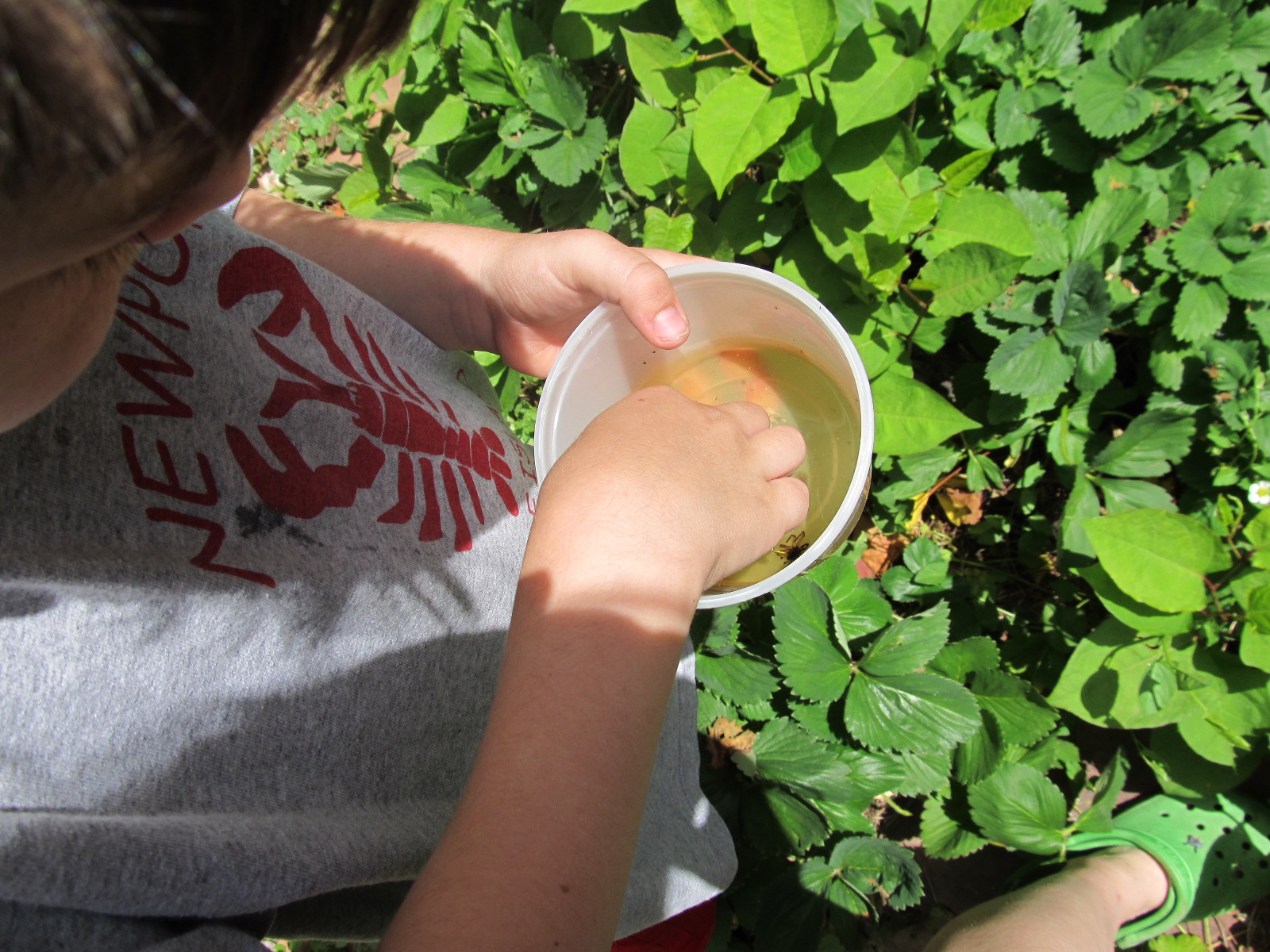
I’m not killing the slugs, I’m inviting them for a beer, then they die.


Homegrown, organic beautiful, and eaten by me, not by neighborhood gastropods.

We have been having such a wet June (global weirding, or is this normal?) that the slugs are having a field day. My strawberries are getting ripe, and the slugs have been eating half of them. Now, I’m a generous soul, if the slugs would eat some berries, I wouldn’t mind so much, but they seem to eat half of each one.
My MIL has taught me the solution- cheap, grocery-store-type beer in a saucer at ground level. She saves her margarine tubs for this, but I’m too snobby for margarine, so I use salsa containers. You have to bury them so the rim is just at ground level- the slugs are attracted to the carbon dioxide coming off the beer, then they drown in it.

The Boy checks the trap the next day- "EEW! there's beer on my hand!" Our take, a couple of slugs and a spider. Collateral damage- sorry spidey.

I will also set out board traps- pieces of scrap wood on the ground- the slugs hide under them during the day, so I can scrape them off into the compost pile. My friend Schnied’s mom feeds slugs to her goldfish, but I think these slugs are too big for my fish.

There’s been a radio ad recently that just curls my hair- a major pesticide company telling me I need to kill the bugs that are eating my precious garden crops. It just makes me mad- they want me to dust poison on the food I want to eat. Grrrrr. With beer, they die, but it is their choice. And not all of them die…maybe I’m still conflicted.

I’ll add new beer to my traps before we leave for the weekend. Last year, we barely had slug damage, I think, because the garter snakes stepped up to the plate. I realize that for some people, snakes are worse than slugs, but garter snakes are slug eating machines. And you hardly see them- we’ve got great ground cover, which is good snake habitat.

Lazy Granola with Chinese 5 Spice


I’ve been cleaning out the freezer in the garage, not cleaning cleaning, you know, just sorting out what’s in there and eating it if possible. I came across a quart of peaches in vanilla sugar that I had sliced and frozen last summer. Since we are only a month away from new peaches, I figured I should do something with them.
Last year I made a peach crisp and instead of using cinnamon, I used some Chinese 5 spice powder. I had gotten it at our co-op, where you can buy bulk spices and herbs. I like being able to buy a tiny bit of things I’ve never tried before. I open the jar, smell it, scoop a little in a bag- it winds up being like 25 cents for a recipe’s worth. (It drives DH crazy, though, because I never label the bags, so there are all these bags of green herbage in the cabinet)
I had first used the 5 spice in a dry rub for steak, which got a thumbs- down from DH, and a thumbs up from me. So, then I tried it in peach crisp, and loved it, but it got a thumbs down from basically everyone else that I made taste it. We are picky around here, I tell you.
According to the Spice House website, which is a supplier of herbs and spices, their 5 spice mix is: “Gently hand mixed from China Tung Hing cassia cinnamon, powdered cassia buds, powdered star anise and anise seed, China No. 1 ginger and ground cloves. http://www.thespicehouse.com/spices/chinese-five-spice-powder By my count, that’s only 3 spices, unless the seeds of anise taste way different from the pods…and the cassia buds taste different from the bark… which I guess it could, but that still only makes 4. It’s a mystery.
Frontier is the distributor of the bulk spices at my co-op, and their website doesn’t list any ingredients at all- their listing reads like the J. Peterman catalog: “Chinese Five Spice Five Spice Seasoning includes all five tastes: sweet, sour, bitter, salty, and hot or spicy. Thought to create a balance of yin and yang, this spicy blend makes for a great twist on American dishes too. And it’s salt free!
Maybe I should sell it harder with my kids, “C’mon, try it, you know how you’ve been needing to balance your yin and yang!”

I loved the 5 spice, but I am virtually the only one in my house who does. So, then, I figured the streusel topping stuff was essentially granola, and wouldn’t life be easier if I could just slice some peaches, put yogurt on top and sprinkle it with granola. I could cook up a big batch on a cool day, and have it ready for peaches any time I wanted.
Lazy Granola
2 cups rolled oats
1/3 cup oil
1/3 cup brown sugar
2 teaspoons 5 spice powder, or cinnamon, or whatever spice floats your boat
½ cup almonds
Dump everything into a bowl and mix with a wooden spoon- all of the oatmeal flakes should be pretty evenly coated with the sugar/oil mixture. Preheat oven to 250, pour the granola mix into a sheet pan and toast for an hour. Shake and stir it every 15 minutes so it browns evenly. When it cools, store in an airtight container.

No photos- beautiful arty pictures of year-old frozen peaches, or uniformly brown granola are beyond my food stylist skill level right now.

Asparagus Update


The shoots of Asparagus in the new, horseshoe-shaped bed are up- thinner than pencils, but they show me the plants are alive. I’ll carefully layer more compost on top (carefully, because I don’t want to knock anything over). I’ve had to grub out some thistles that like the compost and moisture, too. Once the trench is up to ground level, I will put on a thick layer of mulch to keep down the weeds.

Little asparagus shoots, before I dug out the grass and thistles.

A visit to my local nursery


Mother’s day seems to be the official day around here to buy plants, even though the average last frost date isn’t until the 15th. We went hiking on the actual holiday, but I stopped at my favorite local nursery after work today. I have ordered a bunch of plants from a friend who has started seeds for a school fundraiser, but I had to fill in the gaps, and pick up the floating water plants that I can’t overwinter, but Gulley’s can.

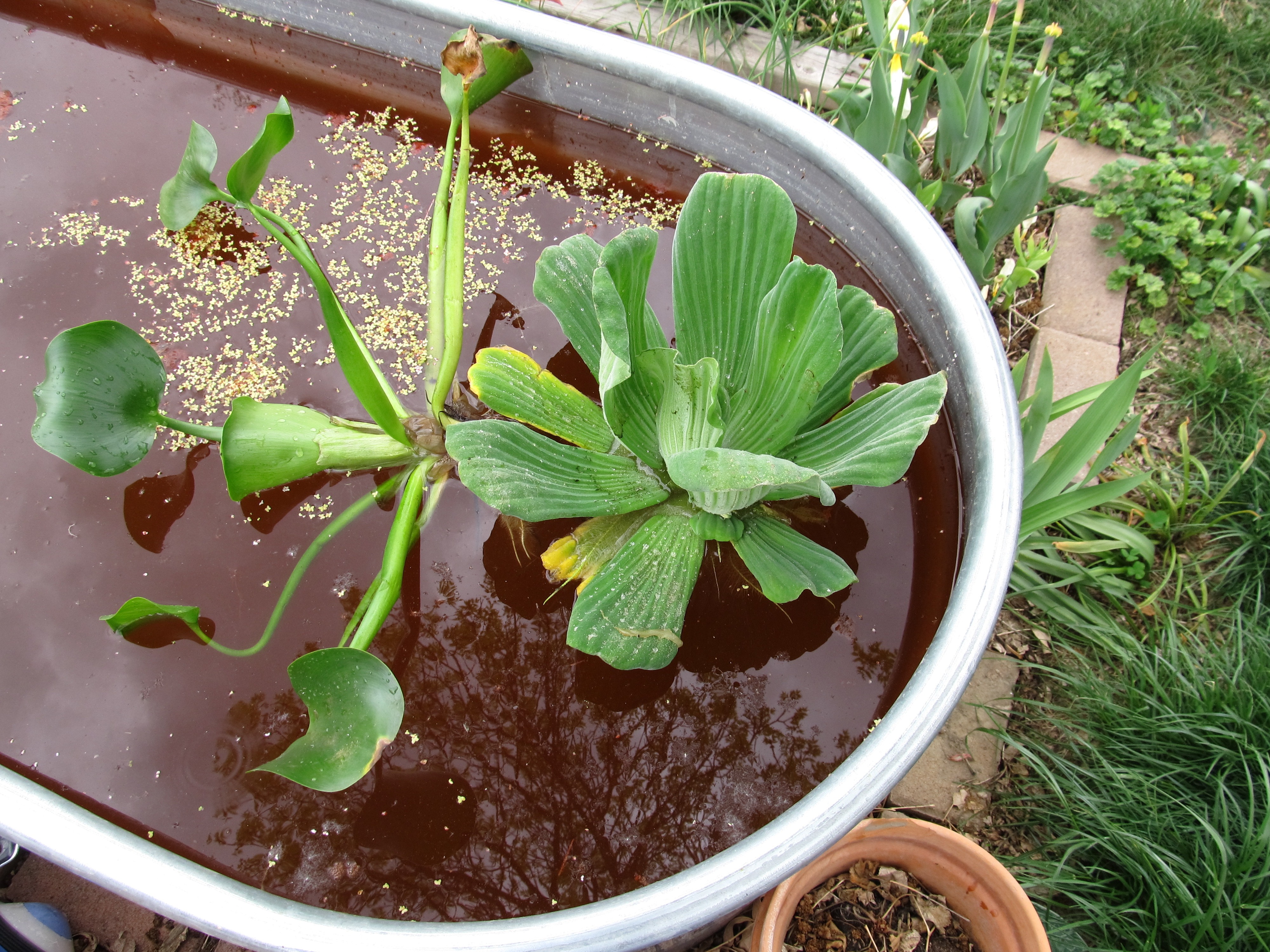
Water lettuce and water hyacinth- I picked the biggest ones they had in the bucket. The lettuce is more than a foot across.

When the girl was a baby, we would go to Gulley’s once a week in the winter, just to enjoy the greenhouse- they actually had a Koi pond inside, with a bridge overlooking the water, and turtles basking…they have removed it, because it really doesn’t make sense to have several hundred square feet of retail space devoted to goldfish. Especially when they didn’t even sell goldfish.
So, on Monday afternoon, I got 2 kinds of tomato, a kohlrabi plant,(because my kids keep insisting that they only like the broccoli stems, not the florettes, and kohlrabi is basically broccoli stem) a “Wee be little” pumpkin, and a jalapeno and a sweet pepper.

Just a box of plants- pond plants in the bag, everything else in 2"pots.

I have always hated green peppers, but if I am trying to get my kids to try new things, I should also…and notice how much better home-grown tomatoes taste than grocery store ones? Maybe it’s the same with peppers.
I resisted the huge selection of herbs- especially the scented geraniums, which they had several varieties of, but I have one already, a rose-scented, and no space to overwinter any more than that.

I went ahead and planted everything when the temperature was 80- then looked at the weather forecast- rain/snow mixture predicted for last night. Curses!

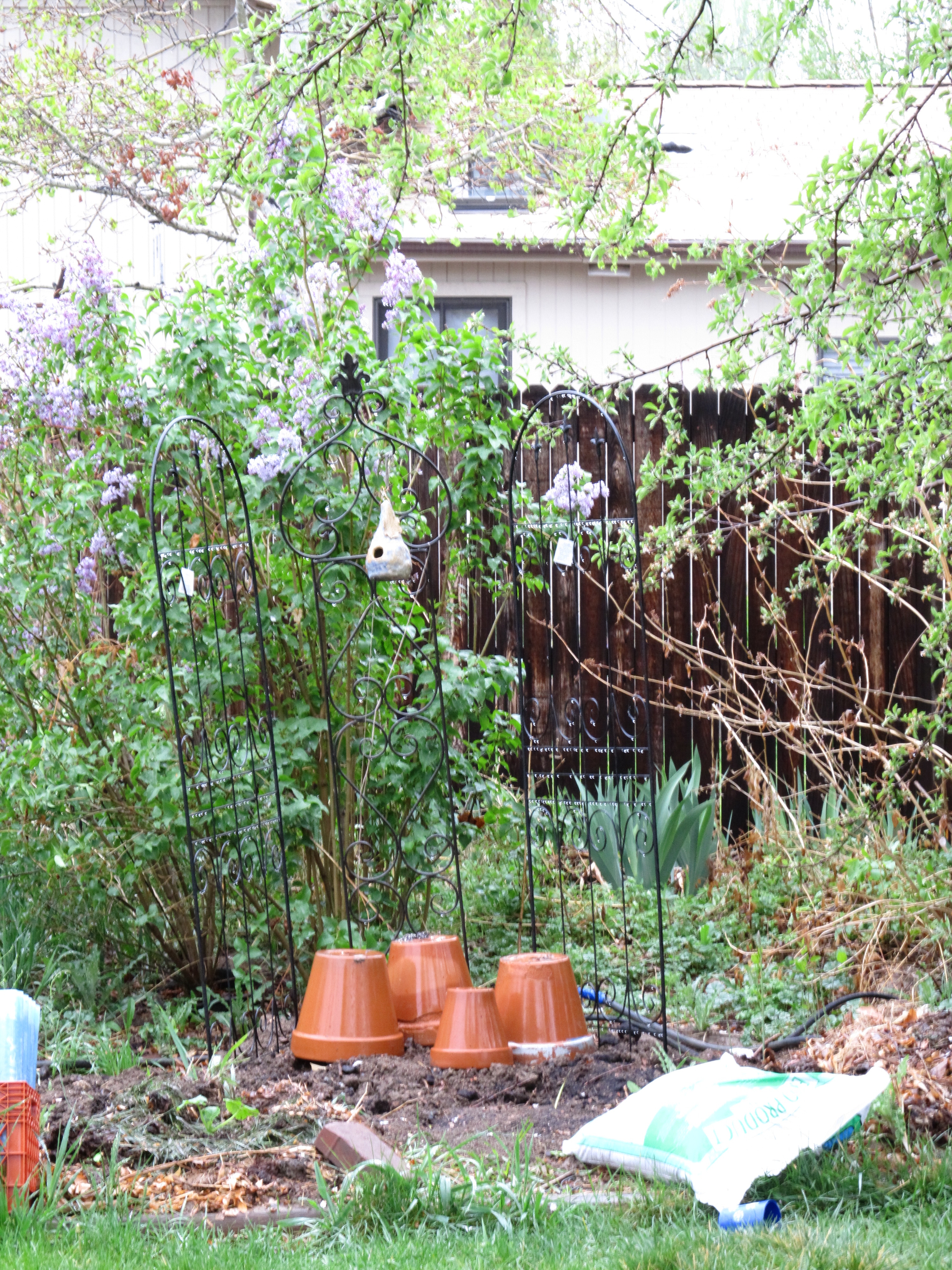
When I went to bed the thermometer was at 40, and it was sprinkling. I covered the plants with big clay pots, just in case it did freeze. When I woke up today, it was cool and rainy, but no snow on the ground.

Come on, weather, warm up so the tomatoes can be happy...

Asparagus Bed- do it right once…


I got 25 asparagus plants in the mail a couple of weeks ago. Actually 50, because I split an order, but 25 were mine. I knew they were coming, but kind of put them out of my mind, because they are a lot of work. Planting asparagus is the kind of thing that if you do it right, you only have to do once… it’s a lot of pressure.

I put in 10 purple asparagus plants about 4 years ago, and did them in a raised bed. My thinking was that all the directions say to dig a trench, then as the plants grow, add soil to them. I thought, why not put them on the ground, then add soil as the plants grow? I had excavated for our flagstone patio, and had a lot of topsoil, so I thought it would work…I thought wrong.

It is dry here in Northern Colorado, and one of the benefits of the trench method is that the plants get more water. Out of the 10 that I planted, only about 3 are still alive, and I have never gotten a meal out of the planting. Last year, I was able to pick about 20 spears, but not on the same day, of course. I just ate them raw out in the garden.

So, this year, I am working harder on it.  Last Spring I put some horse bedding down in an area near the apple tree (I planted some perennials, but they didn’t work out (moment of silence for dead lady’s mantle)) so I had an area about 10 feet across with some pretty decent soil. It was also the area I had hop-scotched my compost bin around, so there would be some pretty nice compost there, too.

My poor little poin-and-shoot camera- it's like, "what did you want me to focus on here? the shovel? the dirt? what am I looking at here?"

 I figured instead of digging a long trench, I would do it in a horseshoe shape, and use the space in the middle as a vegetable bed this summer. This is where my tomatoes and peppers will go, so they can benefit from the water and compost, too.  In Permaculture books, they call this a keyhole bed, because you access it from stepping stones in the center- it minimizes the amount of path you need to get to plants.

The weekend the plants arrived, it had rained lightly, so the soil was actually digable- the end that hadn’t gotten as much horse bedding was clumpy and hard to get through, but the side that had been mulched was like slicing chocolate cake.  Well, maybe not like cake, but it was certainly easier.  We have clay soil, so the more organic matter, the better.  I dug down about the depth of my shovel blade, and put the loose dirt in the center of the horseshoe.

The following day, I placed the plants- about a foot apart in the trench. I then mixed the loose soil with a few bags of coffee grounds I had gotten at Starbucks, and covered up the plants. All of them already have shoots on them, and in the last week, I have scooped more of the soil from the center on top, slowly filling in the trench. God has been helping out with the rain- (Thank you, God) making up for a very dry winter with a nice wet spring. As they grow, I’ll continue to add more soil on top, and compost. I won’t eat any spears from this year, but by next year I should be able to harvest for a week or so, then more and more. I hope not to have to do this job again. Unless we move…

Citrus in containers


 When the girl was just a twinkle in her dad’s eye, I bought 3 citrus trees from a catalog- tangerine, lemon and lime, all for around 10 bucks. When they arrived, they were tiny- the largest was the lemon, and it was about the size of a pencil, the others were stems with roots. I put them in 8 inch pots, and put them on our west facing porch for the summer. When it got cold in the fall I brought them in, put them in a south window, took care of them through the winter, waited for them to bloom.
And waited…
The girl was a kindergartner when the tangerine tree bloomed, and produced tiny sour fruits… it blooms every other year, or so, and the lemon more regularly. The lime only has bloomed once.
The best winter for them was a year when I took them to school with me- my classroom at the time had a wall of north facing windows, and the heat was turned off at night. Perfect conditions. Indirect sun and cool nights are what everyone recommends for citrus in pots, and that room was perfect for it.

One of my favorite memories of the tangerine is from that year I brought it to school- I had a student who was hungry all the time- all teenage boys are, to a degree, but this guy- hungry all the time. The tangerines were hanging from the branches, still green, still wickedly sour. I was on hall duty, the bell rang and I came inside. The air was fragrant- I could tell someone had picked and eaten a tangerine- “Who?” all the boys tried to look innocent, especially Miguel, whose lips were in a permanent pucker.

Unfortunately, I only had that classroom for a year, and now the trees have to suffer through winter at my house.We have a low-slung ranch house, and there are no north windows, the west ones are shaded. The citrus live in the boy’s room, which therefore has a jungle aura to it. He doesn’t mind, at this point…

I underplanted the lemon with a jade plant- neither seems to suffer, although I can’t say either is benefitting. I have wondered if I should try to separate them, but I think I’d wind up killing both. It’s in a 14 inch pot, near a west window that is shaded. I move it outside in May, and watch the low temperature predictions.
The tangerine is the giant of the bunch, and it bloomed tremendously this winter. Because it bloomed inside, there weren’t any pollinators around, so I had to play bee. I took a paint brush out of the boy’s watercolor set and went around transferring pollen from one blossom to another. There are tiny green marbles on the plant now- although not as many fruits as there were flowers…not an exact science.
The lime is still the tiniest of the three, I may move it to a different pot, with new soil, this spring to see if that will jump start it.

So, at 11 years old,, are these plants thriving? Not really. If I lived in a place where citrus could grow in the ground, and these were ten year old trees, I think I would have more fruit than I could give away. In containers, they are much more like pet houseplants than anything that contributes to my food pantry. The Logee’ s book I reviewed the other day has some helpful tips, that I mostly already learned the hard way, in keeping them alive for 11 years.

 Someday, when I get my conservatory (dreams can come true) maybe they’ll produce more, but right now, I’m kind of disappointed.
 But, hope springs eternal, I’ve ordered a Meyer lemon, also cheap and tiny, and I’ll nurse it to adulthood as well, fighting for window space in my kids’ rooms. It arrived the other day, and I’ll now count down the years until I can make lemon curd. We’ll have a party, with vanilla ice cream, too.

Artichokes, an excuse to eat melted butter


Bubble, bubble...

When I was a kid and my mom would go out of town, my dad would make special dinners- the kind of thing that either she didn’t like, or that she considered too messy. Artichokes were sometimes on the menu for these meals. And, funnily, I don’t remember anything else on the menu those nights, that was the whole meal- just artichokes, dipped in melted butter.
Daddy would cook them in the pressure cooker, spread out newspapers on the top of the portable dishwasher in the middle of the kitchen, melt butter in a tiny pan on the stove top (it wasn’t before microwaves were invented, but it was before we had one) and we’d all stand around, ripping leaves off, dunking them in butter and scraping the flesh off with our teeth.
Once we got down to the chokes, the feathery tiny leaves that stick in your throat, my dad would trim them with a paring knife and distribute the pieces of heart fairly. Fairness in heart distribution was a big issue.
It’s the kind of thing that if you don’t have a childhood memory of it, you probably don’t eat. They are a bit of a pain to make, and eat, and dispose of, as well as looking intimidating in the produce section.  However, they are so good- rich in their own right plus extra good with the butter….  Can I suggest that you create a good memory of it? right now?
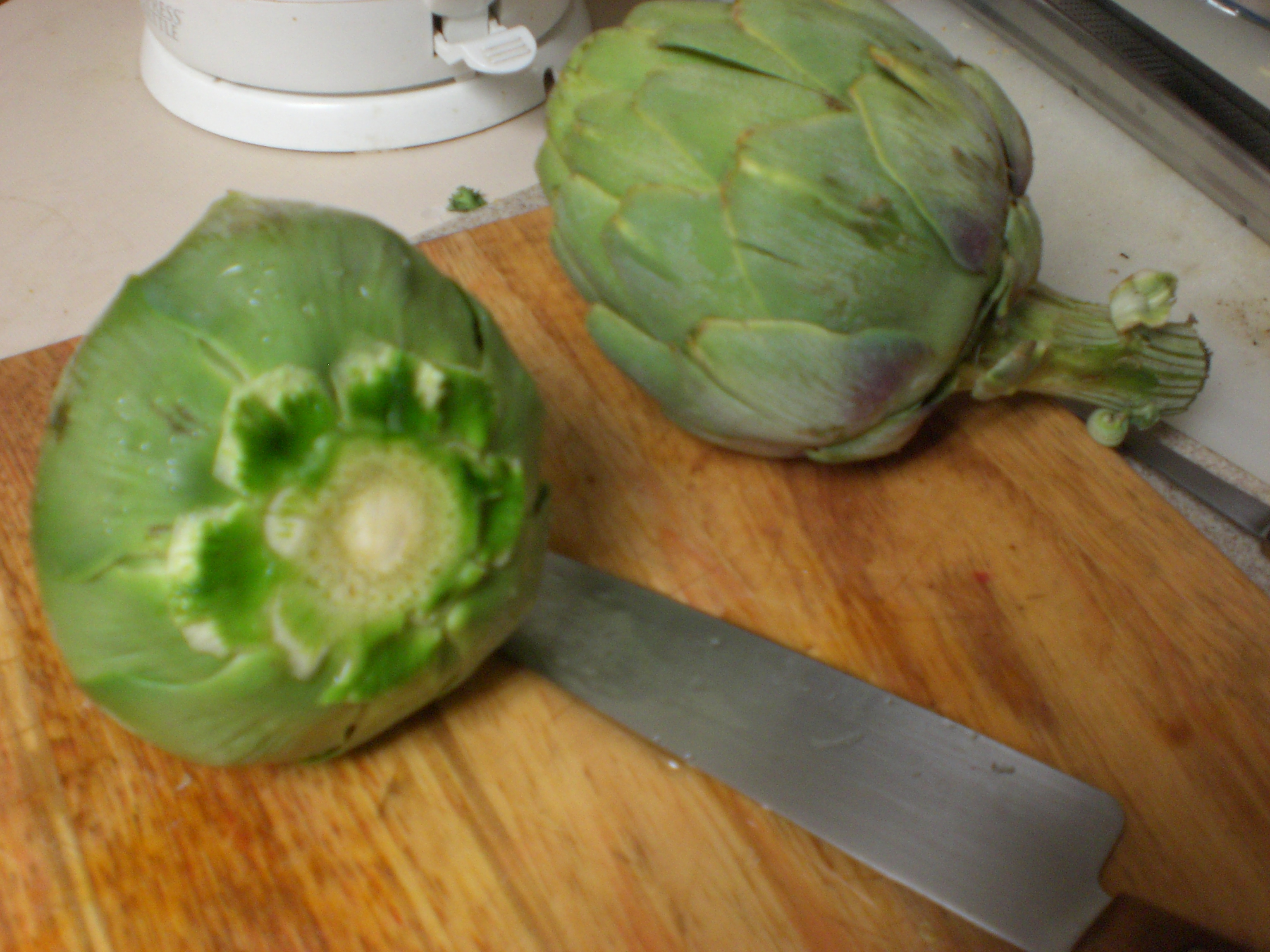
To cook- trim off the bottom stem, and the bottom row of leaves- these are tough anyway, and take forever to cook.

At our house, 3 of us like artichokes, and cooking 2 is enough.

Place in boiling water. I sometimes throw in a garlic clove, but not always. Boil until a knife goes into the stem end easily, about 20 minutes. Meanwhile, melt some butter (aren’t those some of the most beautiful words in the English language? right up there with “you look so much prettier without make-up” and “I’ve folded all the laundry”)
To eat, you pluck off the leaves, dunk in butter, then scrape off the soft stuff from the insides of the leaves with your teeth.

Turn the leaves upside down and scrape with your bottom teeth.

 The closer you get to the center, the more “soft stuff”  there is- once the tops of the leaves turn purplish, you can bite off the bottom 1/3rd of the leaf. 

Once you get to the stuff that looks like chick feathers, trim that off, and you have the heart- distribute it fairly. Sop it in the rest of the butter and enjoy.

I have tried to grow artichokes here in zone 5, and it is possible, although they don’t overwinter here. In warmer places, they are perennial, and produce more buds every year. I have read directions on the interwebs about pulling the roots at the end of the season, and storing them in the basement, the way people do with dahlias. I’ll try that this fall with the plant I have growing in the basement under lights.

Lemon Syrup and First-ever Giveaway


Brighten up late winter (yes, it's late winter, not spring, yet) with citrus.

Last summer I started making a lemon simple syrup to put in my iced tea- it adds sweetness and zing, without having to cut up lemons every time. Easy to make, and keeps a long time in the fridge. This winter I did it with Meyer lemons  and it had an amazing fragrance to it. However, Meyer lemon season is over, and my pint of syrup is gone, so it’s time for another batch. This could conceivably be used on desserts or pancakes as well, but around here, we just use it for tea.

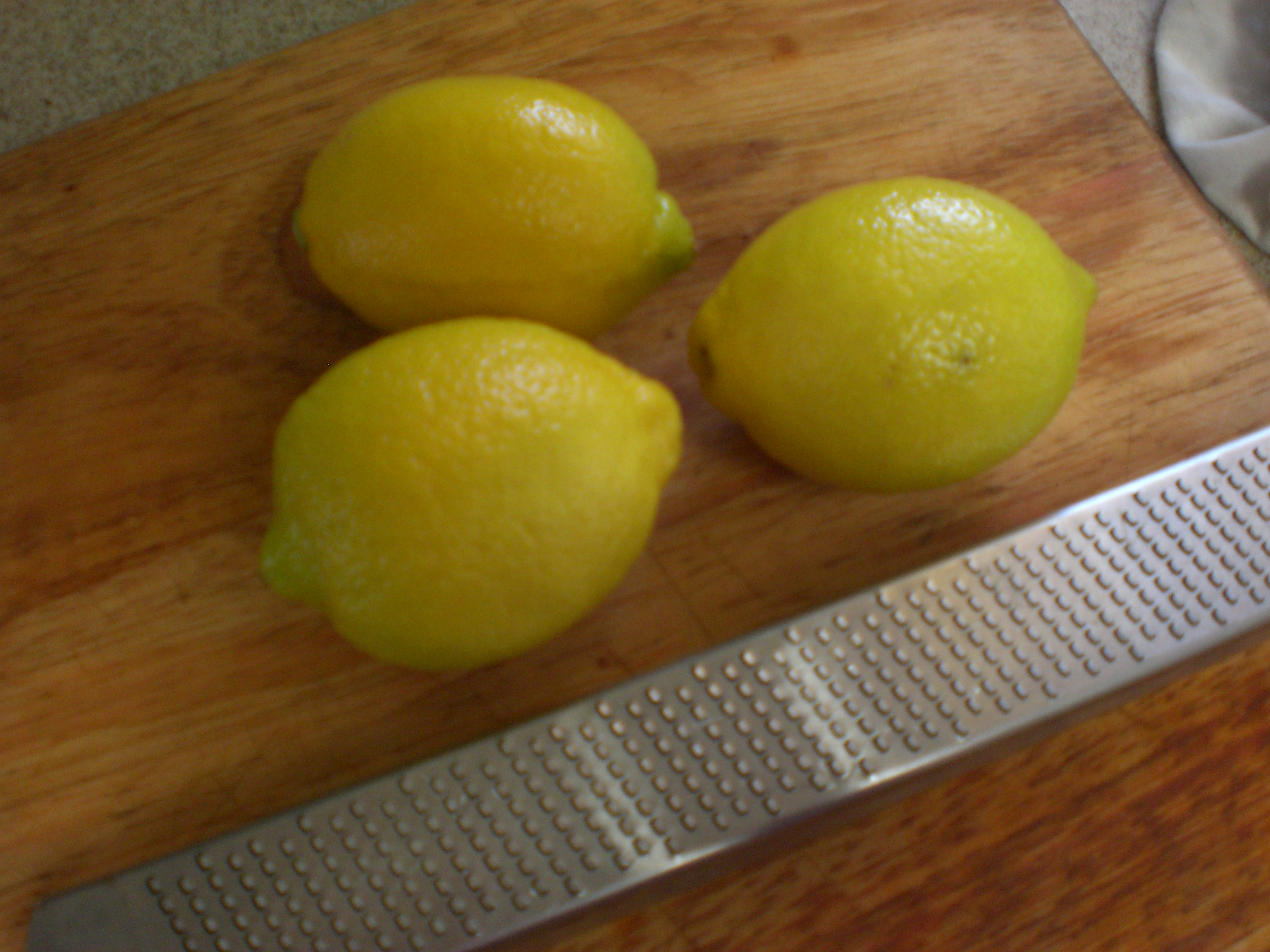
I use a microplane grater to get the zest, which is just the yellow part, of the lemon. I love this tool- it was originally designed for woodworking, but it works great as a very fine, very sharp grater. I use it for parmesan cheese, raw ginger and zest. When I was cleaning off the top of the fridge, I discovered one that I got a few years ago as a premium for subscribing to Cook’s Illustrated.  The best comment on this post before Wednesday 3/9 will receive it as a prize. Tell me why you need a microplane grater, why you deserve it, why you want one… Remember, I’m an English teacher – answers written in poetry might get bonus points.

Lemon Simple Syrup
zest from 3 lemons
juice from 3 lemons, plus enough water to make 1 cup
1 cup granulated sugar.

The most onerous task is zesting the lemons. I have a microplane zester, which I highly recommend,  but I can’t stand it when recipes require some tool which hardly anyone has. If you don’t win the zester, use a grater, or even a potato peeler. Be careful not to get the white part of the peel, it will make it bitter.

The girl was helping out, and the boy was giving unneeded advice.

Mix the juice, water, zest and sugar in a pan and boil, stirring until sugar is dissolved.

eyeew, maybe I need to clean the stovetop...don't simmer too long, you just want to flavor it, not reduce it.

Allow to simmer a few minutes, cool for a few minutes, then pour through a fine mesh strainer. I pour it into a pyrex measuring cup, then into a bottle with a pourer.  I store it in the fridge, although I don’t know how fast it would go bad on the counter…I wonder about doing this with other flavors- what about chai? or raspberry? The simple part means that it is an equal ratio- 1 part sugar and 1 part liquid, so it could theoretically be any flavorful liquid…I may have to experiment.

Book Review- Ratio


My only objection to the book is that the cover is yellow, but the spine is pink, so it is hard to find on the shelf. A small quibble.

I’ve mentioned this book before, and as I break it out to use to make cream puffs for my friend’s Oscar party on Sunday, I figured I’d write a full-blown review.
This isn’t like other cookbooks: it explains the why of cooking as much as the how. It does have recipes in it, but they are very simple ones, almost foundation recipes, and then you can vary them from there.

The chapter on roux has transformed (transformed, I say!) my relationship to gravy. And soup. The chapter on cakes has finally taught me the difference between sponge cake and pound cake, and the girl and I are now able to whip together a perfect little 2-layer-easy-bake-oven cake. It still takes forever to bake, because of the whole “cooking with a lightbulb” thing, but we can whip it up pretty fast.
There is a whole chapter on sausage making, which I can’t see myself ever delving into. Also, it’s fairly Eurocentric- no salsa, no rice, no stir-fries.  On the other hand, the 5 pages on making mayonaise is one of the reasons I asked for a stick blender for Christmas.

Michael Ruhlman is the author, I haven’t read his previous books, but this one is readable- he is a journalist who wanted to learn how to cook, rather than a chef who was hired to write a cookbook. One kooky detail is the blurb on the back,  by Alton Brown. It identifies him as author of “I’m Just Here for the Food.”  I didn’t realize he was an author, I thought he was a TV personality.

So, the recipes I’ll be using for Sunday are the pate a choux, which is a cream puff dough, and creme patisserie, from the chapter entitled “The Custard Continuum.” I love this book.http://www.amazon.com/Ratio-Simple-Behind-Everyday-Cooking/dp/1416571728/ref=sr_1_1?s=books&ie=UTF8&qid=1298677515&sr=1-1

edited to add: the cream puffs were amazing- we brought about 30 to the Oscar party, and they disappeared instantly.

Previous Older Entries Next Newer Entries