I have a list of the “dirty dozen” on a post-it note over my desk- the fruits and vegetables that you should eat organically grown versions of, if you can get them, because of pesticide residues. Number 1 on the list, and in our hearts, is apples.
Celery, spinach, and bell peppers are on the list, but nobody around here eats enough of those to make a difference. Apples, though…we eat a lot of.
We have a giant old tree that produces sour apples, not our favorites, and about 7 years ago I planted a Golden Delicious tree. After falling down, but not being entirely uprooted, in an early fall storm last fall, it has produced prolifically this year. Prolifically enough that I thinned once in June, then again in July, taking off unripe fruit that I was worried would break off the branches.
Backyard Orchard (link) has helped figure out what to take off and what to leave, how to prune, and when.
Now the organic part… I didn’t do anything. Last year I stapled paper lunch bags to fruit I could reach, and that was effective, but this year, I was talking to a colleague, who said that since she had put up bird feeders, her apples were much cleaner. A few got wormy, but the birds came for appetizers, and stayed for dinner.
I didn’t put up feeders- the squirrels tend to get to those anyway, but I have a lot of plants that feed birds, like coneflowers, We have been building up the garden for about 12 years, making habitat for pollinators, and birds and snakes and us. Several years of building soil and habitat has made it so this summer, we didn’t have to do much- the apples kind of took care of themselves. After a summer of doing nothing, my apples look great. They are small, which tells me I need to thin more aggressively next year, and probably water more. However, they are bug-free, and pesticide free.
I am a few days late in posting this for the “You can grow that” meme, created by C.L. Fornari, a garden writer who wanted to get other writers involved in writing encouraging posts, letting people know that it isn’t that hard. It strikes me funny that Miracle Gro has a marketing plan called “you can gro that” that kind of tramples over the top of C.L. Fornari’s meme, which I have been participating in since March. I am not sure what the future holds for the meme http://wholelifegardening.com/blog/. But you should know, you can grow (yes, with a w) apples.
Organic Apples- you can grow that
07 Sep 2012 Leave a comment
in environmentalism, food, gardening, you can grow that Tags: apples, organic, you can grow that
The Ubiquitous Mason Jar
27 Jul 2012 2 Comments
in containers, environmentalism, learning Tags: being green, learning, Loveland Sculpture Park, parenting, permaculture, science

lots of duckweed, little bit of water
We went to the river park this week. There are steps down to the Big Thompson river, where you can float or splash, or put in your tubes and drift down the river. We didn’t bring tubes, but ran into friends who shared with Kate. There are sprayers where the little kids can shriek and splash and get soaked in relative safety, and there is a bridge under which the water slows down a little, spreads out into shallows, where you can look for crawdads. This is where we spent the bulk of our time. The boy discovered that when crawdads are really little, they just tickle when they pinch.
In Gaia’a Garden (I know, terrible title, great book) there is a description of a project where you take water samples from several different places, with plants and muck and life, mix them in a mason jar, put the lid on and then watch. The idea is that you are mixing elements and creating an ecosystem that is not quite pond, not quite river, not quite lake, but a blend of the three.
I told the boy about the mason jar project at bedtime, and he was fired up- he couldn’t think about anything else. Right after breakfast he asked for a jar, and kept asking when we could go. Obviously, I needed coffee first. And there was that pesky dental appointment…
We went out in the afternoon, after a wonderful thunderstorm. There is a wetland by Kate’s school, but no way to get to open water, so we wound up going to the Sculpture park near our house. This park has a chain of wetlands, culverts and open water, so we were able to find swampy still water, fast running aerated water, and duckweed covered water.

This lake is usually deeper than this…
The final piece of the puzzle was mud, from the reservoir. They have been lowering the water level alarmingly, and we had to walk out quite a ways in the mud. It was pretty gross.
The water is clearing, and the mud has settled, and we can see stuff swimming around. The boy had high hopes for a minnow, but I don’t think we caught one.

Yes, I am aware of what 3 cups of pond water would smell like if it spilled on top of legos. We would probably have to move. But, we are also trying not to spill.
Dead Junipers- what next?
13 Jul 2012 2 Comments
in design, environmentalism, gardening, gardening in containers, herbs, home projects, lawn Tags: being green, gardening, home improvement, insane frugality

The new edge of the bed in the front yard- we’ll be adding some compost and lots of mulch.
Most people who know me would agree, that I don’t seem like the kind of person who would pound stakes into the ground, stretch out string between them, and then follow that string as a guide when making the edge of a garden bed. I was a s surprised as anyone when I found myself doing just that this afternoon.
Yesterday evening, I was cleaning up the edge of the area where we took out the junipers (link) and I used the garden hose to kind of make a gently curving, voluptuous edge, nipping it in close to the faucet, easing it out near the corner of the house.
Then I thought about mowing that line. I thought about all the other curvy, sensual edges in the yard that have to be mowed, then edged. I decided it would be easier to make a straight edge, and let the plants be curvy.
The bed is about 20 feet long, and the outer line is 8 feet out from the house wall. (when I said I was going to make the bed about 8 feet deep, DH had a moment where he thought I meant 8 feet from current ground level to top of bed. No.) I bought 40 brick pavers, because I didn’t want to get out the measuring tape and then do math, so of course I have to pay for my laziness with another trip to the big box store.
So, the plan:
buy more bricks
when there’s grass inside the line, pop it out and transplant it outside the line, when possible
pile on 2-4 inches of shredded wood mulch
when the weather cools, start transplanting the plants I want to move from the backyard
order bulbs
snake soaker hose around the bed
Plant list
Hazel bush (transplanted from nursery bed)
Sedum Autumn Joy (thanks, Sharon!)
Purple coneflower (divided from back yard)
Bearded Iris (divided from back yard)
Yarrow (divided from back yard)
Lamb’s Ear (divided from back yard)
Thyme (divided from back yard)
Comfrey (divided from back yard)
larkspur (seeds)
columbine (seeds)
lily (ordering- probably dark reds and oranges)
tulips (ordering, probably red and yellow triumph)
daffodil (basic yellow)
Most of these plants I already have, so this is a very cheap design for me. I also know they do well here, so I am not taking much risk that everything will keel over and die. The exposure is a little different- the north end of the bed is pretty shaded from the ash tree and the house, and the south end gets morning sun. The coneflower and lilies will go that direction, because they need the light to flower. My “largish” plant is a hazel nut bush, and I want it to form one corner of a triangle with the ash and the Korean dwarf lilac under my window.

The plan for the tuteur- the exact measurements will depend on the wood I find.
I am also planning some structure- as you can see in the picture, there is a big expanse of plain wall, so I will put in at least one trellis, and some containers, and am thinking about building some tutuers, which are french teepees- using lumber,rather than round wood or sticks. And, you know my policy, it should be done with the wood that is already piled up, going to the lumberyard is cheating! There are still some 1×2’s sitting behind the garage left over from taking down the playhouse, so I will start with those.
Resilience- you can grow that!
05 Jul 2012 12 Comments
in design, environmentalism, gardening, herbs, lawn, you can grow that Tags: gardening, herbs, learning, permaculture, resilience, weather, you can grow this

Purple Coneflower and Yarrow, extremely drought tolerant herbs. They’re loving the heat.
It has been hot here. Crazy hot. Typically, in June we get nice moisture, soaking rains, heavy thunderstorms, nice misty days when it’s just cool and gloomy. Not this year. I realize it is hot pretty much everywhere right now.
We went LA on vacation last week, and it was cool and pleasant- too cool for the ocean almost. Then we ended the vacation in Las Vegas, and it was ridiculously hot. You expect that for Las Vegas, but we kept watching the weather for home, here on the front Range of Colorado, and it was ridiculously hot in Colorado, too.
The guy who mows our lawn was checking in on the cat, and a friend popped over to water the container plants and the tomatoes, but otherwise, we didn’t provide for sprinkling. I expected the worst when we got home, but I was pleasantly surprised.
The grass in the front looks awful, of course, but it almost always looks awful. It’s on the list for future projects.
The beds in back, though, look pretty good. They have plenty of mulch, to hold onto what moisture they get. They have plants that are drought tolerant, or native, or both. I designed them that way so they wouldn’t take much water, and would attract bees and birds and butterflies.
The golden currant is dripping with fruit, the lavender is blooming like crazy, the yarrow and coneflower and chamomile are standing tall. They look better than I do, dripping and drooping, and praying for rain.
Plan for resilience- xeric doesn’t have to mean rocks and cow skulls, it can be dragonflies and birds and fruits and berries. It takes less water and other resources, and it bounces back from hard times. Resilience is a trait we all can use.

This is pretty much the same shot, from the same angle, as I took 3 weeks ago. It’s been watered once with a soaker hose.
Two books that influenced me tremendously are “Herbs in the Garden” by Rob Proctor, and “Gaia’s Garden” by Toby Hemenway. Both books helped me learn to think beyond “vegetable garden here, lawn everywhere else.”
Strawberries- you can grow that
04 Jun 2012 3 Comments
in design, environmentalism, food, gardening, you can grow that Tags: food, organic, strawberries, use the harvest, you can grow that, zone 5
One of my peak experiences in gardening was not in my own garden, and in fact, I didn’t do any of the cultivation. Friends of mine in college lived in a house with a strawberry bed, next to a flagstone path. One beautiful June, I would go to their house, sit in the sun on those red sandstone pavers, and eat perfect, ripe strawberries.
Of course, I had to have strawberries and a flagstone path at our house, when we finally bought one.
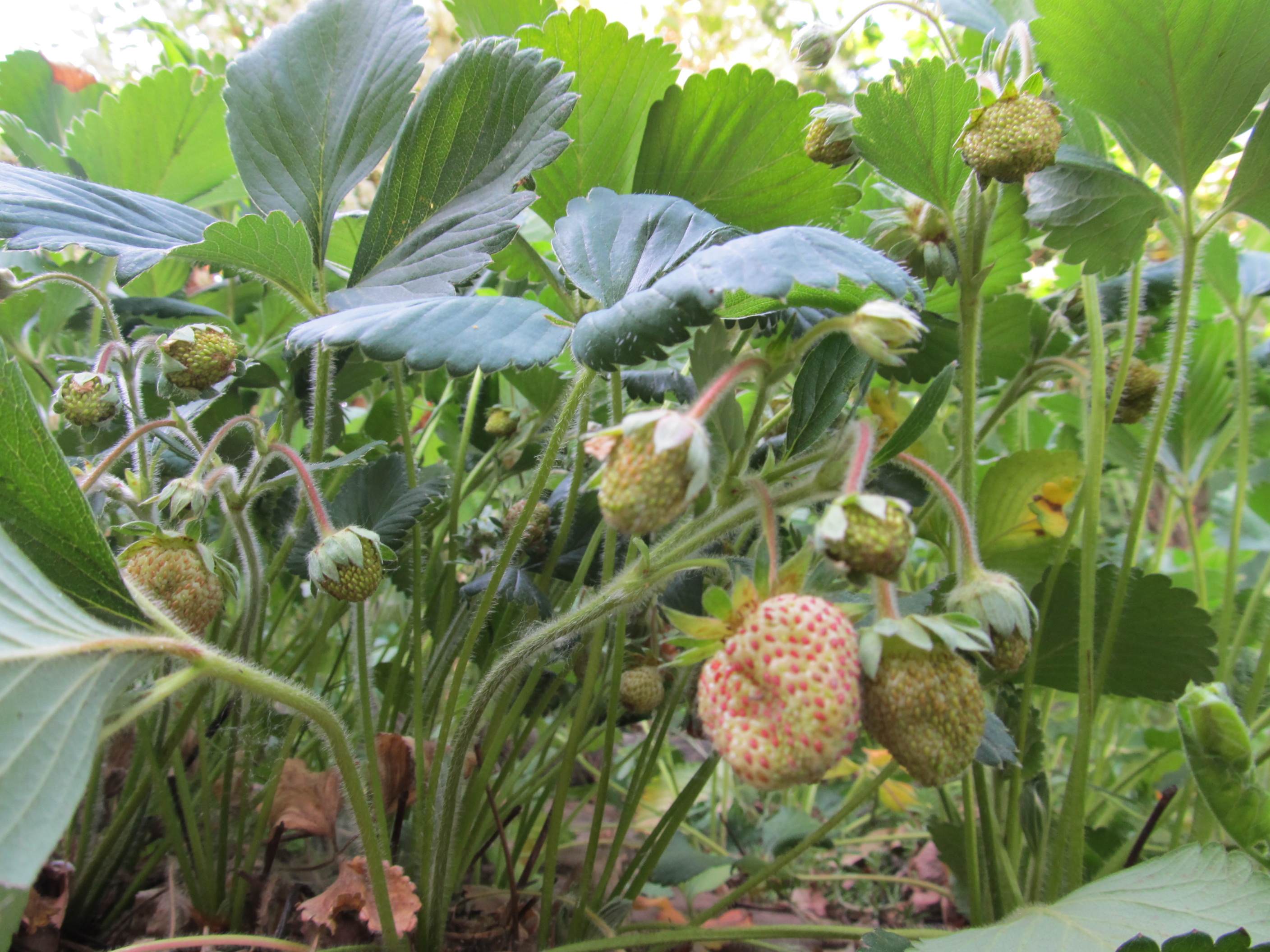
just a few more days…just a few more days…
I actually have planted strawberries in many locations- before I got married, and moved every year or so, after I got married, and …moved every year or so. It may seem ridiculous- planting a fruit that takes several years before it produces in house and apartments that I knew I would be moving out of. Maybe it is ridiculous, but it seemed like a good investment in karma.
Strawberries do produce sparingly the first year, but after that, they spread and produce more. They reproduce by sending out stolons, or runners, with baby plants on the end. I let the “daughter plants” take root and grow, so I always have some plants that are 3 or 4 years old, and about to peter out, some 2 year old plants that produce well, and some baby plants that are getting established. Most gardening books recommend cutting off the stolons the first year so you get more fruit.
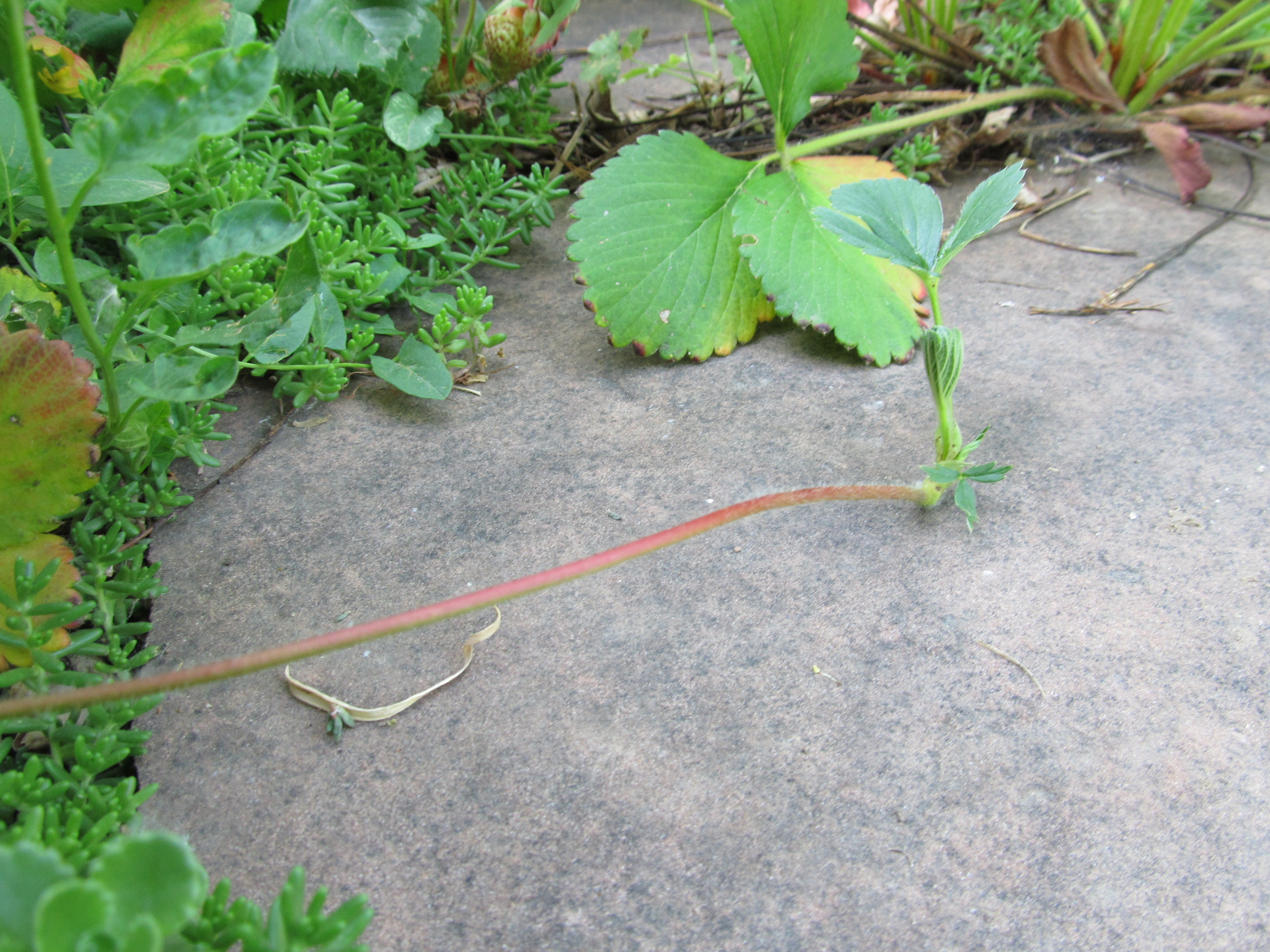
New vocabulary word for the day- stolon.
A few years ago, I was at my sister-in-law’s house, and she was transplanting strawberry plants out from under a huge pine tree. Apparently, the birds that stole her berries perched on the tree, and ummm…seeds grew…in perfect packets of fertilizer. Yeah, you know what I mean, bird poo. They didn’t get enough sun under the tree to produce very well, but it made a perfect nursery for baby plants.
Strawberries are heavy feeders, so I give them compost, and mulch them pretty heavily, except where they have grown into the gaps in the path, where I can’t get mulch to go.
I plan to transplant these guys out of the gaps in the path, and may try them in containers.
Here in zone 5, the front range of Colorado, they ripen in early to mid June, this is later than you can get them in the grocery store, but oh so much tastier. And organic. And with a very small carbon footprint. Here’s where I get preachy and link you to a story about strawberries from California.
If you order plants in winter, you can get a bundle of 25 for around 25 dollars. They go a foot apart, so that is a lot of space to devote to strawberries, but you can tuck them around other things- for example, there is a giant rosebush in the same bed with my strawberries, as well as iris and a mock orange. They are also available this time of year in nurseries. In fact, at the grocery this weekend, they had hanging baskets of them in the doorway.
I have had slug issues in the past, but this year has been so dry, I don’t expect them. I’ll put out saucers of cheap beer just in case.
Tree Killer
25 May 2012 1 Comment
in design, environmentalism, gardening, home improvement Tags: environmentalism, foundation planting, insulation value of plants, juniper, tree removal, wildlife gardening
There are 2 types of people, tree planters, and tree murderers. No. Not really. Sometimes people who plant trees also kill them. Me, for example.
I have killed trees through benign neglect, bad cultural practices, and laisse faire policies. And occasionally, I have hired hit men to practice premeditated tree murder. (We’ve been watching a lot of Monk lately- I think it’s rubbing off.)

It’s like Justin Beiber’s bangs, in shrub form…
We have juniper bushes that were probably planted when the house was built, almost 50 years ago.They are hideous and over-mature- we have trimmed them in past years, but not the past couple of years. They half block the windows, making the front bedroom cavelike all year round. They have to go.
What has been holding me back?
- Possible insulation value
- Prickliness
- Snake habitat
Does anyone know how to figure out the R value of 50 year-old juniper bushes? Me neither. Actually, there are places on the web where you can figure it out, but as far as I have been able to determine, the most value comes from bushes stopping the wind in winter. These uglies are on the east side of the house, and winter wind hits us from the north. I am not convinced they make much difference in gas bills in the winter. They do make a comfort difference in summer, I suspect, since, as I said, they make the front bedroom cave-like.
Prickliness- I don’t want to take these out myself. They poke, and make my skin rashy, and whaa whaa whaa. Plus they smell like cat pee. That is why I am hiring hit men to do the job- tree guys to get the junipers as well as clean out some dead wood on the ash trees. Since it is family policy to spend as little money as possible on anything, it has taken me a while to come around to this decision (and I am not bad mouthing DH here- the crazy penny-pinching mostly comes from me…unless we’re talking about lattes…)
Snake habitat- animal habitat in general, actually. Dense, prickly bushes make great protective homes for wildlife, not just the cute cuddly birds and butterflies that people want to attract, but also the garter snakes and rodents who are part of the environment but who don’t get the kind of press that butterflies do. By taking out shrubs that are close to 7 feet tall and 4 feet wide, I am affecting beings other than myself.
Sigh.
I’m doing it anyway. I’ll let you know how it goes.
Bloom Day- Apple Blossoms
16 Apr 2012 Leave a comment
in environmentalism, gardening, Uncategorized Tags: apple, bloom day, dandelions, golden currant, late storms, lilac, mock orange, tulips

A wall of flower petals.
I have an elderly apple tree which continually grows into the power lines and every year city crews come by to whack it back. The apples are sour, and numerous (overly numerous most years). This is the best year for blossoms I can remember- the tree is a shower and curtain of blooms. And, they are predicting a snow tonight, and a low of 28 degrees. Sigh. I guess we won’t have to worry about numerous apples this year.

"Ooh-leee-oool" I think that's how you say it, anyway. The French don't spell things like they say them.
Also in bloom- species tulips, white,purple and yellow hybrid tulips ones whose variety I can’t remember. There is one blooming “oullioules” tulip, out of 50 I planted several years ago. It is my absolute favorite pink tulip- it is kind of on the orchid-colored range of pink, with white stripes. It makes me realize I should buy a bunch more. I also have siberian squill and grape hyacinth, which are both naturalizing nicely.
Golden currant, lilac and mock orange shrubs are blossoming as well, and a goumi shrub. Goumi is related to russian olive and is a nitrogen fixer. It is supposed to have delicious fruit, but this one has never produced any, to my knowledge. It is windy enough that the flowers on shrubs are coming out ridiculously blurry. It is the storm coming in.
And, of course, the dandelions are in full bloom. hooray! I know, I should have picked them before they bloomed and eaten them…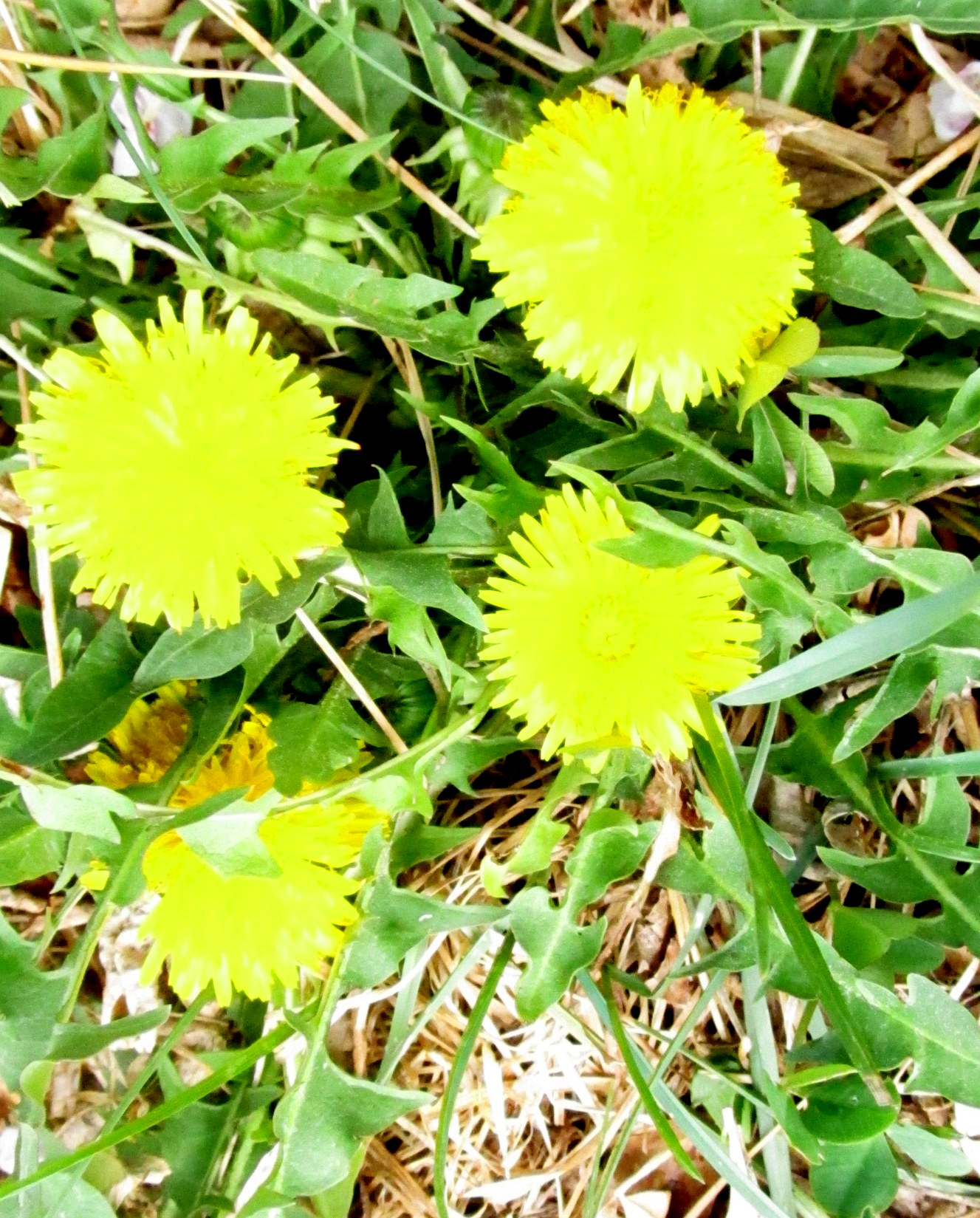
A Year’s Worth of Garlic, part deux
29 Mar 2012 7 Comments
in environmentalism, gardening Tags: drought, garden, garlic, hardneck, herbs, organic, softneck
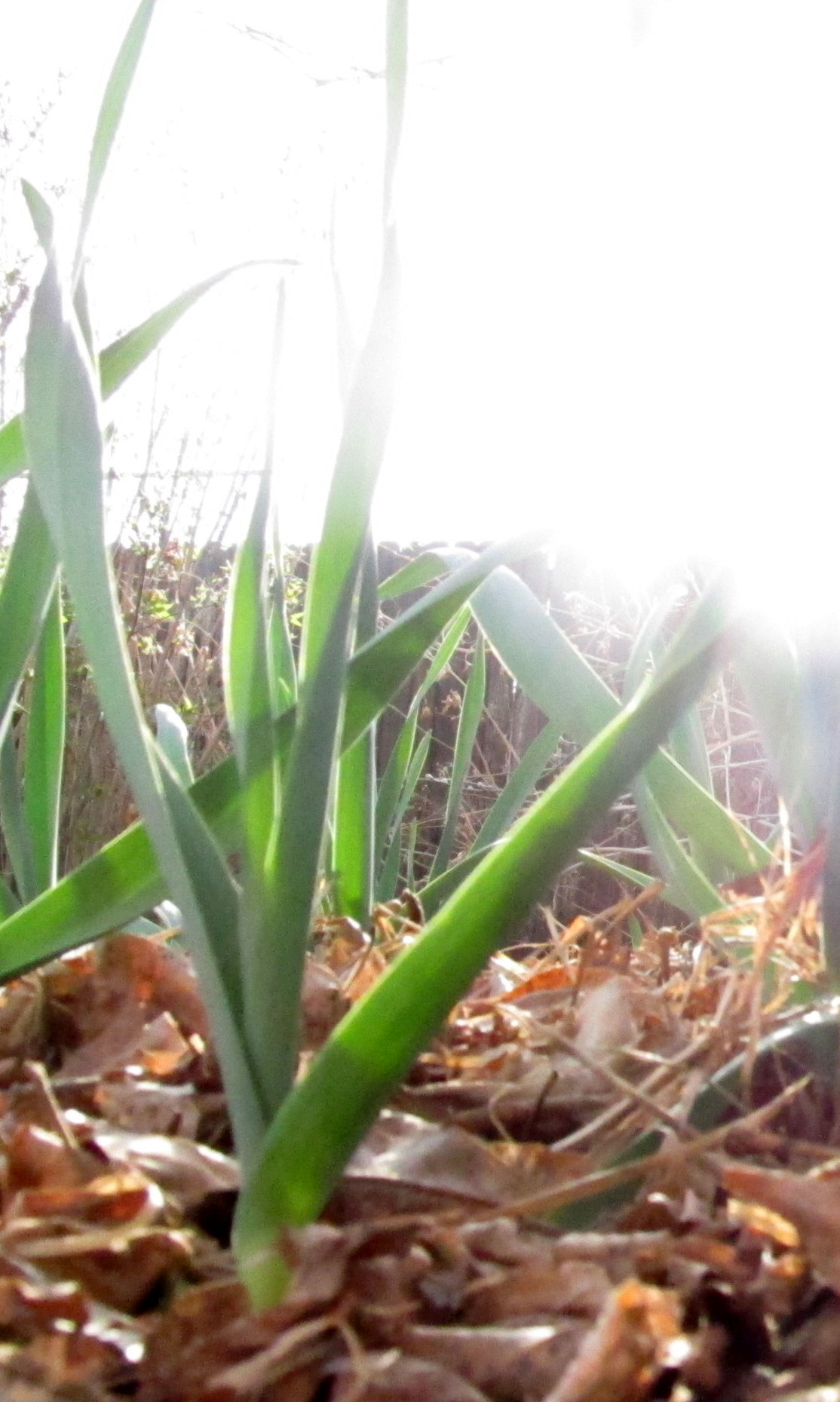 Last summer, I harvested some lovely garlic from my garden, and we have been eating it pretty much all winter. We have not had to buy it at all, and we still have several heads- it may not get us all the way to July, but it will be darn close.
We also planted more- I saved out the best cloves to plant, and also bought some hardneck garlic to try. I would link to that post, but can’t figure out how...can someone please teach me how to use link within in WordPress? ooh, somebody did- thank you!
Hardneck garlic has a bonus- it sends up a flowering stem called a scape, and they can be thrown into soup, or sliced for stir fries. Or smoothies…nah, maybe not smoothies. The scapes will fill a gap with garlic flavor after all the heads of garlic from last year will have sprouted and gotten mushy.
I planted it last fall when the soil was still warm, and lo and behold, it has come up. It has been pretty much the only part of the garden I have watered this spring. It has been super dry, and I probably should be watering my young trees right now…
You do have a compost pile, right?
05 Feb 2012 Leave a comment
in environmentalism, food, gardening, herbs Tags: being green, compost, gardening, herbs, soil preparation, zone five
I have a little raised veggie bed right outside my back door- it is only 2×3 feet, but super convenient. Last summer, I would go out, pull up a green onion or two for a salad and go right back in. Next year, I plan to put in tomatoes, which are a heavy feeder- they like a lot of moisture, and a lot of nutrients. I put tomatoes in a different place every year, so disease organisms don’t build up.
Solution- make this veggie bed the winter home of the compost bin, then spread it out in spring.

Luke, I am your father...
I’ve written before about our bin(link to own post)- a Darth Vader head- very ugly, but pretty effective for boiling down organic waste into compost. I move it every few months, spread out the finished compost where it is, and put whatever is not broken down back in the bin in its new location. The partially broken-down stuff is seeded with the compost organisms that will help break down new material.
Because I want the soil to be super rich, the first layer of stuff I put in the bin was comfrey leaves. Comfrey is an amazing plant- it has deep roots that take minerals out of the subsoil and concentrate them in the leaves. When the leaves break down, in compost or mulch, the minerals are deposited in the topsoil. The plants can be whacked back several times a summer and keep coming back on just natural rainfall.
I add kitchen stuff as it fills up the cup on the edge of the sink, and layers of leaves, too. Kitchen waste is usually high in nitrogen, and can be smelly if there isn’t high carbon material added at the same time. Compost breaks down all winter, although it is slower when the weather is colder.
In about March, I’ll lift the bin off and hopscotch it to another location. I’ll take off what hasn’t broken down, and spread out the finished compost- moving some to other beds that need it, but saving a lot for the bed. My tomatoes will have a deep bed of good soil to feed on.
You don’t need a Darth Vader head, or any kind of container- compost will break down anywhere. I like my bin, but I recognize it isn’t necessary.
Bagged Apples, update
22 Nov 2011 2 Comments
in environmentalism, food, gardening Tags: being green, food, gardening, insane frugality, zone five
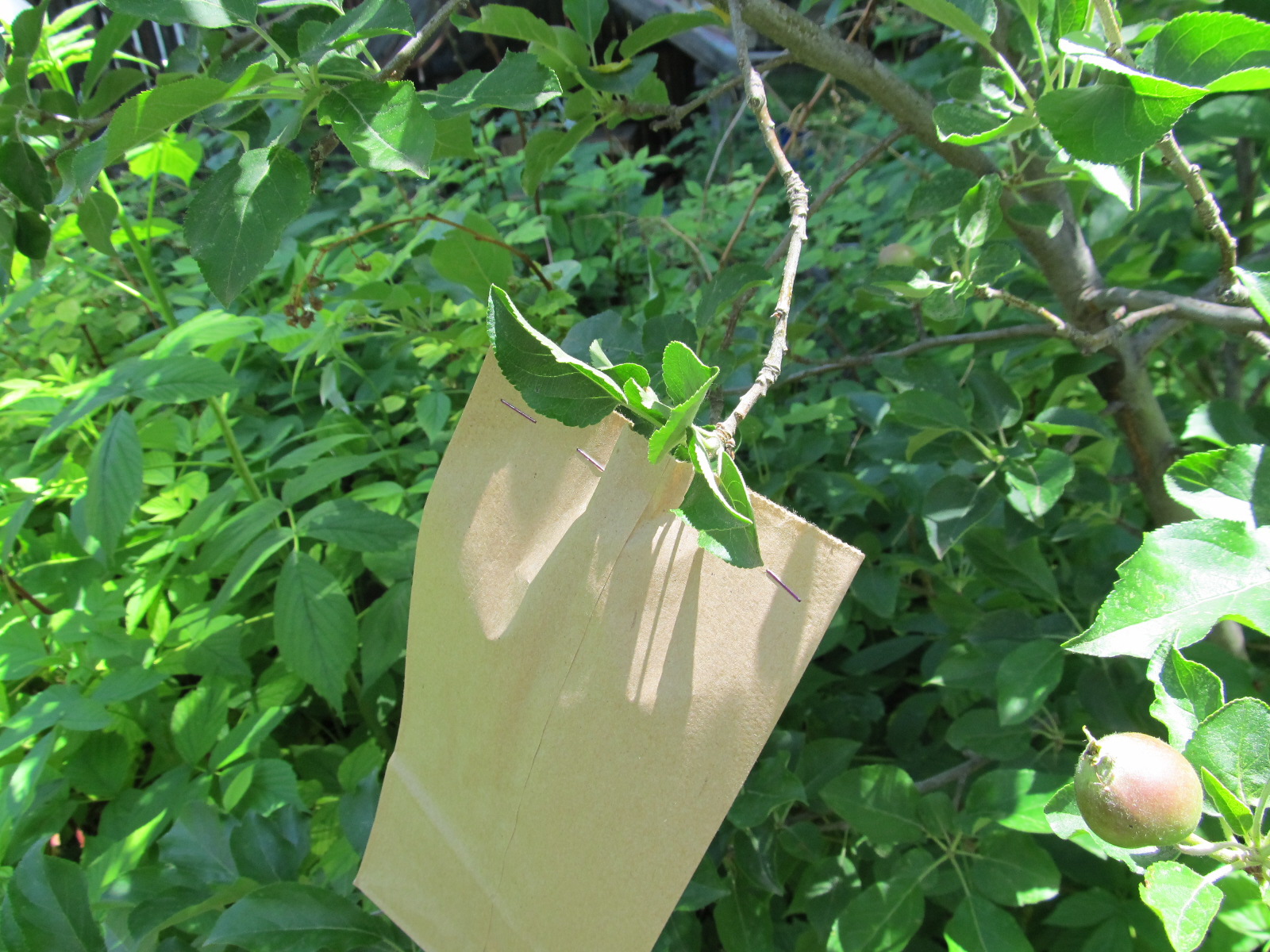
It isn't beautiful, but it isn't as visually intrusive as I thought it would be. That is, I never looked at the tree and thought, "dang, that's ugly!"
Back in June, I wrote a post about growing apples organically by using paper lunch bags to form a barrier against the critters that might want to lay eggs in my apples. I just picked the apples a few weeks ago, and it worked pretty well.
Some of the bagged Golden Delicious fell off in July or so. My total “harvest” from the Golden Delicious tree is only 7 apples. Sigh.
My other tree (name unknown) had a zillion apples on it, and I only wound up bagging a dozen or so before my stapler died. The bags have to be removed before I pick them so they have a chance to redden. I did pick one, to test for ripeness, and it did need more time.
I will definitely do this again next year, with two differences.
I will put the bags on earlier, and thin the fruit at the same time. I’ll get bigger individual apples, without spraying poisons.
I will pay better attention to when to harvest. The sour apples, from the tree that was here when we bought the house, need time in the sun to ripen. I’ll have to pull the bags off well before the first frost date, which on average is mid September here on the Front Range of Colorado although we didn’t freeze in my yard until October, which is crazy.
Actually, one more difference- I’ll get a better stapler.
 Strawberry Fields for Breakfast