Peonies- you can grow that


So many buds about to pop!

So many buds about to pop!

When we moved into this house, like 11 years ago, there were plants here already. Some that I have gotten rid of, like junipers that smelled like cat pee, and russian sage, which was plotting to take over the world, starting with my mailbox.
The plants that have given me the least trouble and the most joy, though, are the peonies in the front of the house along the driveway. I don’t know the variety name- I suspect they are the cheapest, most common type, rather than the rare, special-order-from-a-catalog-with-a-fancy-French-name-variety. They bloom profusely in June, then are simply green the rest of the summer.
The reason I say “you can grow that” is that these are the least troublesome plant in the world. They are old-fashioned, cottage-y looking, but they take very little water (how do I know? because I give them very little water) No fertilizer or compost or any special treatment- for this abuse, they reward me with teacup sized blossoms every June.

If you decide to plant them, prep your soil with some compost, follow the directions on the bareroot package, or if it is in a container, place the root ball so the top is even with the soil. Water well, mulch, and wait.

Our cool spring this year means they have not quite popped yet, but you can see they are about to. I can’t wait.

“You can grow that” is a project started by C.L. Fornari, whose goal is to get people growing. Not a bad goal…

I can’t believe I am spending money on grass!


Gaze at the majestic grass in the sunset, said no one...ever.

Gaze at the majestic grass in the sunset, said no one…ever.

For years, my secret plot has been to rid myself of as much lawn as possible (oops, not so secret anymore, huh?) I have mulched, and created shrub beds, and laid out veggie beds, and perennials, and even sneakily scooted the edging bricks out, expanding the width of every bed by 4 inches each year.
I hate grass- hate mowing, hate fertilizing, hate the amount of water it takes, hate the judgement of people driving by who see my dandelions and shake their heads.
And yet, I just spent 30 bucks on “Revive” an organic, Colorado made fertilizer/soil amendment/wetting agent. Wetting agent sounds gross- it has chelated iron in it, and “pure chicken-shit” as my brother says. (The label actually calls it DPW, which stands for dehydrated poultry waste, which means my brother is right.) The idea is that water will be able to soak in more deeply, and we will be able to water less frequently, but the grass will grow better.
It won’t kill dandelions, but maybe the grass will be able to out compete them? Those judgey people driving by will just have to find something else to judge me on….What will that turn out to be?

(Sorry to anyone who has missed me- the day job plus gardening has left me less time to write…no disasters on the home front, just normal busy-ness.)

Beet Greens- you can grow that!


When C.L. Fornari, the genius garden blogger behind “You Can Grow That” suggested that for the month of February, we pick a plant related to the theme of love, I had to think about it.  I considered the plants I love, or the plants that symbolize romance, and I was kind of stumped.  February is a tough month for planting, around here anyway.  So, I decided to be contrarian, and write about beets.

We heart beet greens! Well, I do. Well, maybe I don't heart them, but I like them.

We heart beet greens! Well, I do. Well, maybe I don’t heart them, but I like them.

I have to confess that we don’t love beets at our house.  When we had a CSA membership, I tried to like them. I roasted them, which is my favorite with most veggies, and I threw them in stir-fry (which made everything weirdly pink) and I marinated them…not popular. I did learn that I liked beet greens, though. A friend insists that beet greens taste just like beets, but I disagree. Or maybe it’s the texture. Anyway, when I saw directions for forcing root crops in a pot, I thought to myself, that’s a good way to get greens without having to actually eat beets.

The directions come from Eliot Coleman’s Four Season Harvest, which is a funky combination of a book- part how-to garden tome, part we-went-to-the-south-of-France-and-drove-around-looking-at-gardens-in-winter travelogue. My kind of book, in other words.

Coleman describes  taking beets, or turnips, or celeriac, putting the roots in damp sand in a sunny window, and eating the greens that sprout.

I decided to start the experiment with beets. I bought a cute bunch, and cut off the leaves that they came with to sautee, then eat in garlic soup (really tasty- follow this link!)

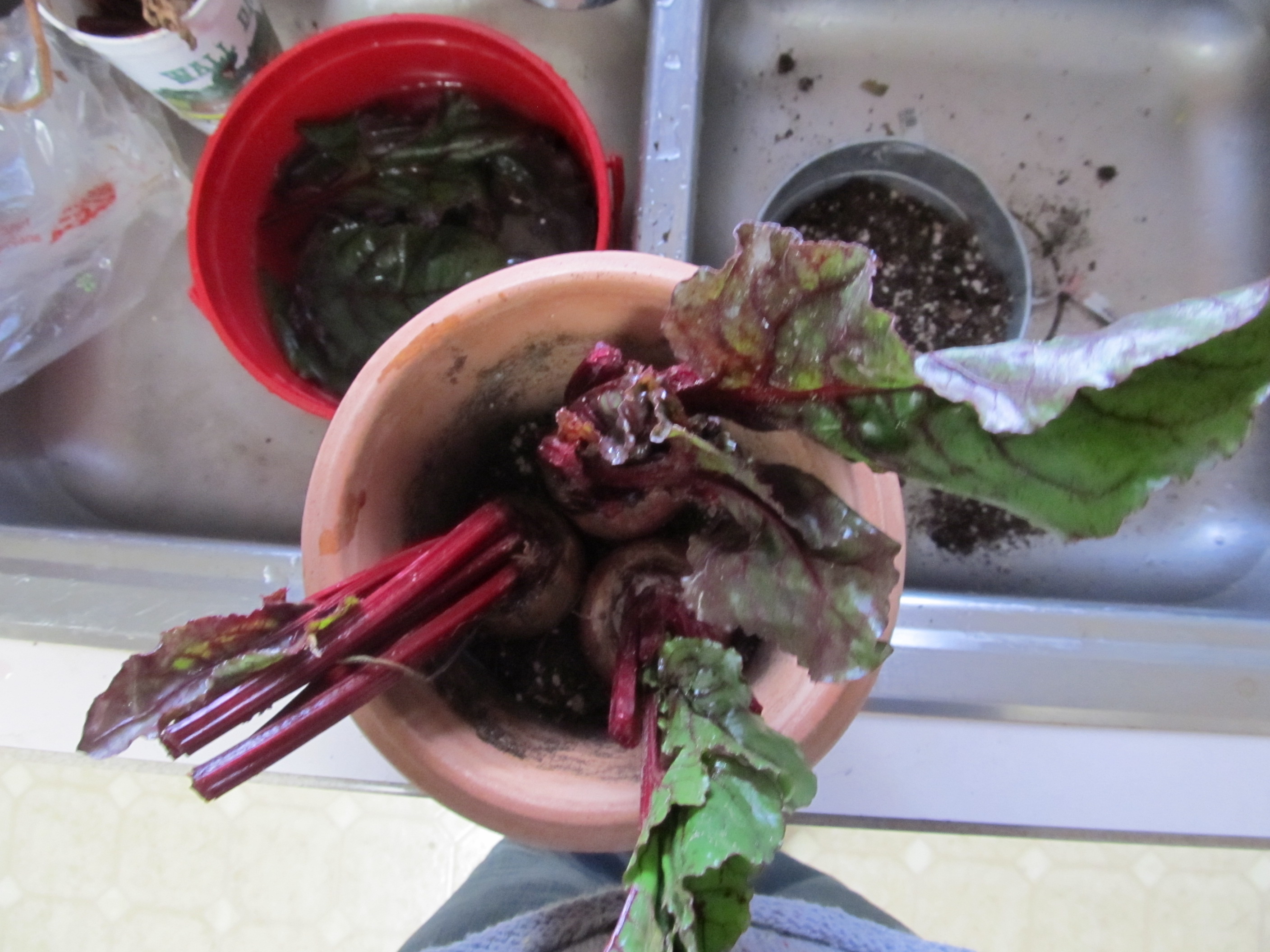
I then filled a 6 inch pot 1/3 of the way with potting soil, then put in the roots, then covered with soil and watered.

BIrd's eye view of 3 beets in a pot, before another layer of soil is added.

Bird’s eye view of 3 beets in a pot, before another layer of soil is added.

The roots won’t get any bigger- storage crops are biennial. During the first summer, they put energy into the root. When they send up leaves again, they use the energy store in the root to prepare for blooming. This means you don’t have to worry about leaving room in the pot for root growth.IMG_0056

We haven’t gotten enough for a big salad, but there should be leaves to add to stir-fry or soup or whatever.  I’m adding some to Quinoa salad tonight.  I hope it doesn’t turn weirdly pink.


Bottle Tree- you can grow that


IMG_0022In the bleak midwinter,

frosty wind made moan

The earth stood hard as iron

Water like a stone…-Christina Rosetti

Nothing like being an English major- these words came to mind when I started thinking of what to write for a “You Can Grow That” post- what can you grow this time of year? yes, the houseplants, the Christmas cactus, the amaryllis and the paperwhites. But outside? Sigh.

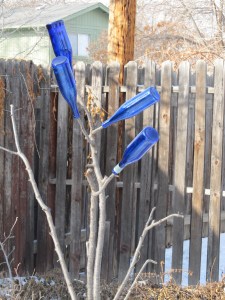
I could flip through my seed catalogs, place post-it notes, sketch diagrams of my new bed in the front of the house where the junipers used to be, but I am mostly just sitting and looking out the windows, these days.  And the view from my desk is a happy little bottle tree.

I got the idea from a craptastic garden we visited in Idaho- I guess you could say a bottle tree seed was planted there.

It used to be an unhappy cherry tree, that died. Alas. (another benefit to being an English major, I get to use words like alas, and nobody is surprised)  I trimmed it back to stubs, and placed blue wine bottles on it.

It won’t last forever- the roots are decomposing underground, and at some point it will tip over. That’s fine. Until then, I have something to catch my eye when I look out my window this winter. And an excuse to buy blue bottles of wine.

Family meeting


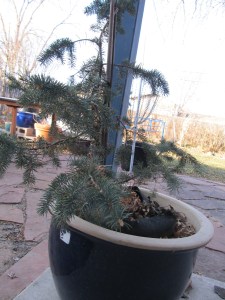
For many years, I have turned up my nose at the debate so many people have this time of year about real christmas trees versus artificial. We have used a small blue spruce in a pot, which we bring inside a few days before the holiday, and then taken back out again. I rolled my eyes at people with tree carcasses in their living rooms, or tree mannequins. I even wrote about having a live tree in my very first blog post.
It turns out, that separately, we have all been thinking about changing our tree situation. The Boy mentioned the other day that his grandma had teased that our tree looked like the tree from the Charlie Brown special. He felt sad. I felt defensive. She’s right, of course. It does.

This drought has made it hard to make sure this little guy got enough water.

This drought has made it hard to make sure this little guy got enough water.

I found myself rubbernecking the tree lots on the highway, and sniffing at the trees outside the grocery as I ran in to get milk, and as I was putting out our Christmas village, I looked at the box of all the cool ornaments we have collected over the years, but that we don’t have space for on our tiny Charlie Brown tree.

DH mentioned today that he missed the pine smell.
Kate has been lobbying for a big tree for a while- since before Halloween….
So today, we had a family meeting, and discussed pros and cons of live tree versus artificial versus dead tree.
Kate said she would feel guilty about having a tree murdered for her,The Boy just wanted something big and from what I understand, real versus artificial kind of balance out over the years. The carbon footprint of an artificial is huge- made of plastic, shipped from China, but it “amortizes” for a long time.

And, confession, some of the choice boils down to convenience- no stepping on pine needles, no crawling under the tree with a watering can.

We are crazy frugal here, and the tree we get will last us a long time. The interwebs tell me that the expected life of an artificial tree is 6 years- if we are buying a new one in 2018, then I will admit that we made a mistake. My prediction is, though, that we will keep this thing for-freakin’-ever.
DH went on the mission, and chose a 6 foot pre-lit tree.When it first came out of the box, I was nonplussed. It was all mashed together, unfluffy. I had a sad.

Then Kate and DH worked on spreading out the branches and making it lovely.

What is your choice? Fake, dead, live, stained glass? I’m interested in the thoughts behind your choices.

Radical Apple Pruning


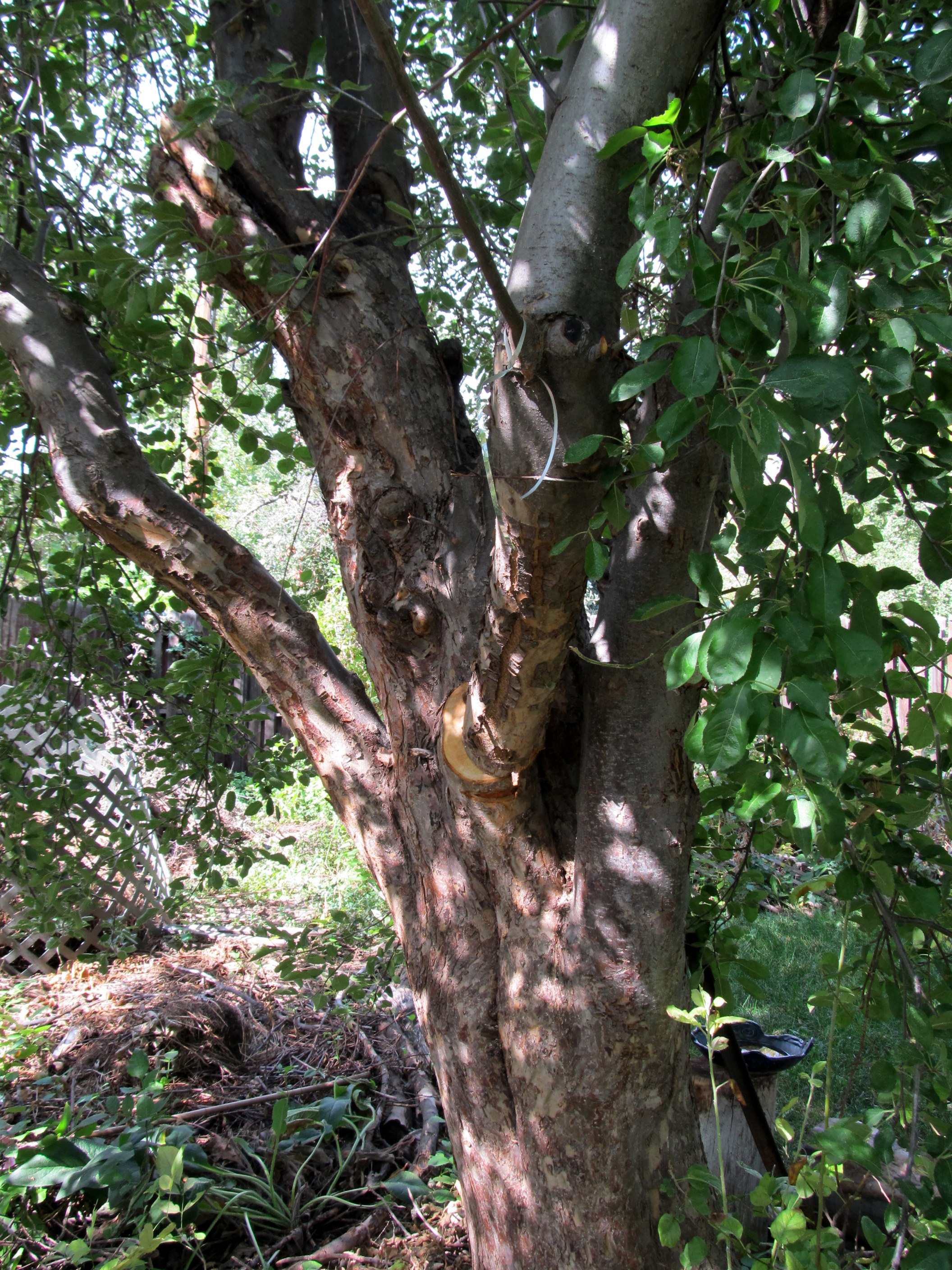
We have a giant apple tree that has been butchered in the past, then ignored, the butchered again, by the city tree trimming crew. It is probably about 50 years old, and most of the apples are developing way up high, because the major branches go up high, then bend over…after researching a lot, hemming and hawing and reading, online and in books, I have decided to renovate it. Slowly, over a few years, I’ll take off major limbs and train young branches to be the new major limbs, at a more convenient height. Convenient for me, not the squirrels.

Let me tell you about apical dominance… there is a chemical in plants that causes the  buds on the end of every branch to be dominant- it turns off the other buds back down the line. This chemical, auxin, is affected by gravity. If the end bud on a branch droops down, there aren’t many buds that will be activated. There will be buds on the tree up high, before the branch starts to droop. So we have very few apples down where we can reach them, and a bunch up high, which then fall down to be half-eaten by squirrels.


Another thing about apical dominance is that when the end bud is cut off,  other bud back down the line are activated. This is good when your pinch back flower chrysanthemums to make the plant bushier, so you get more flowers in fall, but not so good when the city crew whacks back your apple tree on a semiannual basis.

Since it is a standard tree, not a dwarf, it is really big. Branches are growing up into the power lines, and the city crews want to prevent that, but they don’t care much about the tree other than that. Every time the city comes to prune, they take out the center aggressively, which causes it to grow back aggressively. It’s pretty bad. There are seven major limbs, up to about 6 inches in diameter at the trunk, and they have kind of an umbrella effect, going up, then curving way down.
I have thought about it a lot, planning, and checking, and finally decided to take off one of the seven major limbs. Next year, I will take out another, never removing more than 25% of the leaf area at a time. Hopefully this will prevent major regrowth of water sprouts. I wanted to clean up the south side of the tree, since that is where I have recently sited a veggie bed and I wanted it to have more direct sun.

So, I chose my first limb, sawed it, then spent some quality time wondering how to get it down without seriously hurting myself. Seriously. It was tangled in so many other branches that even when it was cut all the way through, it just sat there.  I moved the ladder and made some more judicious cuts, then spent a pleasant afternoon cutting it into reasonable lengths for our chimenea.  Next year, I’ll select another limb from the North side of the tree, and work on that one.

The most helpful book for me in this project, which has mostly been a project about thinking, is Cass Turnbull’s Guide to Pruning. Tons of illustrations, tons of examples, written by a woman on a mission.

Citrus- you can grow that


The leaves are falling, must be time to cover the tomatoes and bring in the houseplants.

Freeze predicted tonight-the radio people keep saying “temperatures in the 30’s” which seems unfairly vague. It is  time to move my pots of citrus inside for the zone 5 fall and winter. and much of spring, if we are honest.
When I was pregnant with my daughter, now 12, I bought a lemon, a lime and an “orange” tree for about 10 bucks, for all 3 from a catalog- don’t remember which one. I thought I was getting a huge bargain- when they arrived, they were twigs.
The biggest was the lemon, which had a trunk as big around as a pencil, and about 4 leaves. The other two were like q-tips. So I planted them and waited.
I didn’t just wait- I had a baby, and watched the baby grow, and taught middle school, and then had another baby and watched that baby grow, and when that baby was walking, the orange tree bloomed.
Heavenly smell, tiny bb sized fruit, that grew to marble sized, then…what’s smaller than a ping pong ball? A big marble? Yeah, big marble-sized. They ripened to orange, but remained small and sour.
Since then, the lemon has produced actual real sized lemons, but not very many, and the lime has produced actual real sized limes, but, again, not very many.
Why bother, then?
They are pretty plants. I have other house plants that don’t do much of anything other than purify the air. When these bloom, they smell amazing, even on the patio. In the Boy’s room, which has the best light, they fill the air with fragrance when they bloom in the winter. The novelty is another reason- one year I brought them to school for the winter, when I had a classroom with windows, and students would bring their friends in and dare them to eat the oranges.
Order them, or if you have a good local nursery with citrus, buy there. Once they are big, they take a big pot- mine are about 12 years old now, and are in 14 inch pots. I use a dolly to move them outside in the spring and back inside in October.
When they come in, spray with the hose attachment of the kitchen sink, under the leaves especially to get rid of any hitchhikers. Looking at this, I realize it might make more sense to spray them outside, instead of in the kitchen, especially if by “hitchhikers” I mean “tiny bugs.”  Which I do.
Citrus like bright indirect light, and humidity. Much like myself. Not too much humidity, though. Dry air can make them drop leaves. It hasn’t been cold enough for the heat to come on very much yet, so there isn’t too much difference in humidity bringing them inside. The Boy’s room has a fish tank which evaporates enough that the plants do okay.
You don’t have to buy a plant, if you are in it to experiment. A neighbor of my mom’s planted a grapefruit seed, or her toddler did, probably close to 50 years ago. It grew big enough that they couldn’t fit it in their house, so they donated it to the public library, where it brushed the ceiling in the children’s section when I was a kid. Don’t know if it is still there.

The Big Yellow Monster


I have been a member of the National Geographic Society for many years. The primary benefit of the membership in this prestigious society is the receipt of a magazine every month. Depending on the amount of spare time, and the topics, we either devour the magazines, or they pile up on the end table. The recent issue with the story about how dogs were domesticated, fascinating, and hit all the right notes on the Boy’s interest in dogs and evolution and selective breeding.

The thing is, I can’t get rid of these magazines- we hold on to them as reference material, in case we want to look back at the maps, re-read the articles. Cutting them up for collages? Never! People do, I know, but not us.
The reality is, though, we don’t look back at old issues, or at least we haven’t, so far. So we hold on to them. I have a vivid memory of going out to the icy cold garage one February, to find an issue with Olmecs in it, to do a school report when I was in Junior High.

Why the garage? I don’t know the origin of the decision, but there were so many issues of the magazine, and so little storage space inside, that somehow it seemed logical to keep them in the garage.
Get rid of them? Never!
Ours, almost 20 years worth, have been fitting well in a lovely built-in shelf in our entrance way. That is, they were fitting in well, when they were only occupying the bottom shelf, then they encroached on the second from the bottom, displacing my cookbooks, and craft books. The front hall is terrribly lighted as well, so even when you want to look for a map, or a story on the Mongols, it is hard to do.
Long story short…I’m not getting rid of them. Never! But I am moving them to the basement, where with some clever re-arrangement, they can have their own bookshelf, with a lamp nearby.
Philosophically, what is this hold that National Geographics have on me? I can recycle or give away other magazines and books, but not these. What do you have that you can’t get rid of?

These Seven Pieces? Really?


At the bookstore the other day I flipped through Good Bones, a book about the seven essential pieces of furniture that you should buy and keep for a lifetime.

I was pleased to see a demilune table- I have one in teak, that I paid too much for, probably, but that I really love.

But the rest of the stuff threw me off. A dresser, obviously.

Wait…You have to write a book to tell people to buy a chest of drawers?

Slipper chairs…really?

A loveseat? ummm…I want a big couch that several people can flop on, especially as two of my favorite people to flop with get bigger and taller.

Bookshelves, a necesity for me, don’t get a mention in the book. Entertainment center… likewise not in the book. Coffee table? No. Rocker/recliner? Not in there.

So, what are your 7 essential pieces of furniture- if you were starting over, what would be the 7 first things you would get?

Demolition


Need some elbow grease to finish scraping off that mastic.

If  remodeling all starts with a throw pillow, or a pretty Martha Stewart towel rack,or paint colors, or choosing tile, there’s still a lot of stuff in the middle to get through, before any of the fun pretty stuff can get accomplished.

Our basement bathroom remodel started with a sluggish drain, and it is turning into a big deal. And we have kind of a deadline- I go back to school soon, and I will be teaching full time, rather than half, as I have been for the past several years. More money=nice, less time= not so nice.
The clock is ticking.
So, I ripped off the ceramic tile from the walls. At first I was dainty, sliding the scraper under the edge, prying gently, removing it with my other hand and placing it gently into the trash barrel.
Then it got fun. It was loose enough in most places that it would just pop off- whoever applied my tile so many years ago did it the same way they constructed the shower. That is, they did it  half-assedly. There was no grout, and I think it was mastic, rather than thin-set mortar. The mastic comes off the concrete foundation wall pretty easily, but not so much on the drywall. It’s pretty sloppy.

I used the gentlest tool first, and it worked really well- I read a lot of advice on the web that advocated crowbars and stuff, and implied that the best case scenario for most people was replacing the sheet rock. In our case, it popped off pretty easily.
The main tool I used was a scraper- it has removable 4 inch blades, and I found it in the tile section of the home improvement store.
If you are looking at this as a how-to, rather than just an opportunity to laugh at my hapless DIY skills, make sure you wear shoes, and gloves, and probably long pants, and definitely DEFINITELY DEFINITELY EYE PROTECTION. Seriously. There are tiny chips of ceramic flying around. Your eyes are what you see with. Protect them.

The next step was yanking out the dry wall from behind the shower wall. Rotten drywall. Pretty gross. I used a claw hammer to pull it up and break off pieces. About an hour by myself. I’m not complaining about doing it by myself- it is a 5×8 bathroom- I don’t think anyone else could get in there with a hammer without either taking longer, or someone getting hurt.

The next step is mental- the reason the drain was so sluggish was because the hole in the shower pan didn’t line up with the hole in the floor. I need to figure out how to “fur out” the wall so that the backer board can line up with the shower pan.

The book that has been super helpful is Stanley’s Complete Baths– I read it when we were up in the mountains last weekend.  My niece would say, “what are you reading?” and I would say, “shhh, I’m learning how to tile.”

So, we are working through the messy part, and soon will get through to the fun parts, expect more photos!

Previous Older Entries Next Newer Entries