Garlic Scape Pesto


I grow hardneck garlic , and one of the benefits of it is that you can eat the unopened flower buds, called scapes, in the early summer. I have put them in stir-fries before, and they are really tasty, greener, milder chunks of garlic.
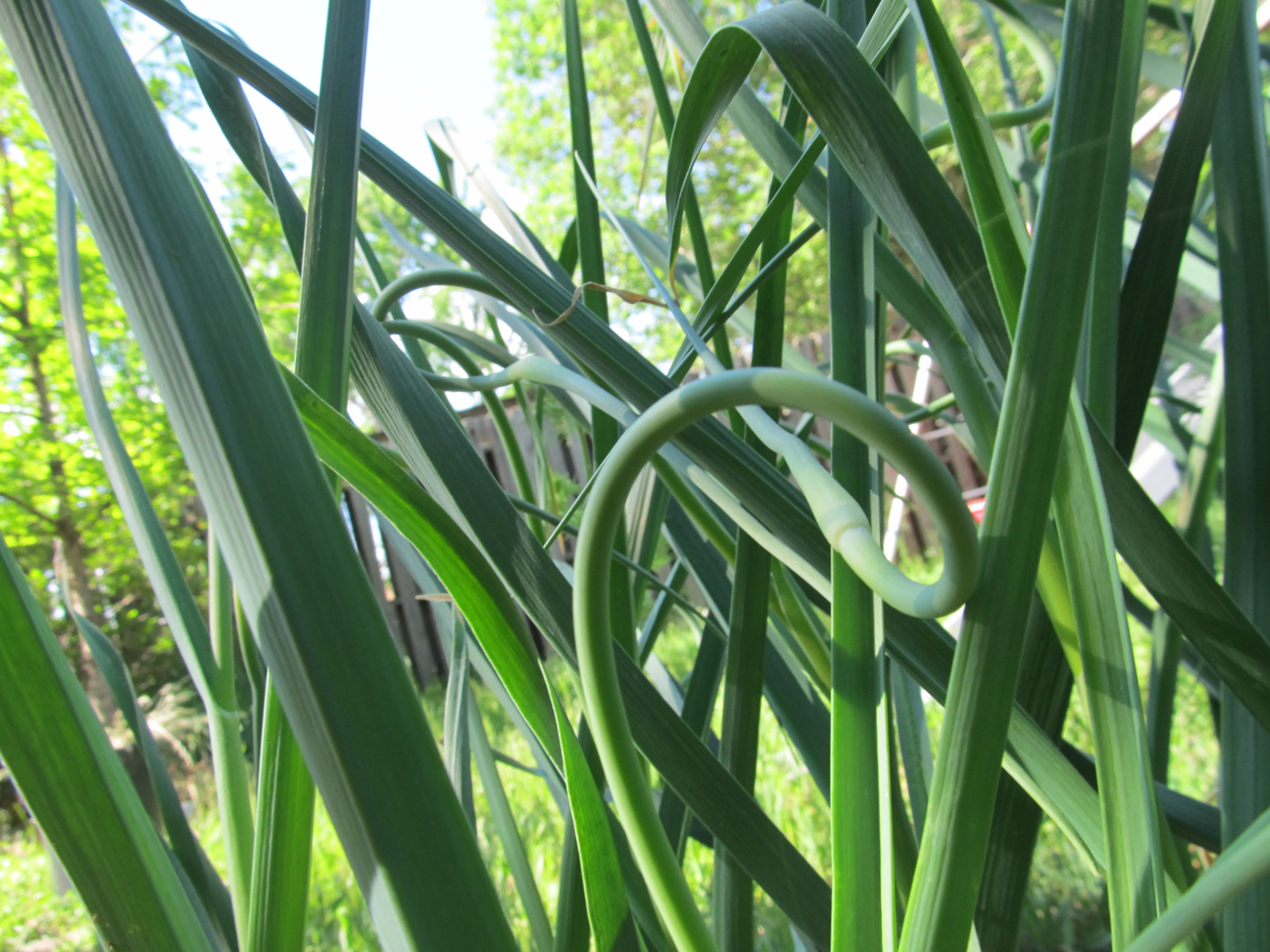
My subsistence garlic farm- a year's worth in about 2 square feet.

My subsistence garlic farm- a year’s worth in about 2 square feet.

Then on Pinterest (Pinterest gets me into more trouble- are you supposed to do the stuff you pin, or just pin it, and let your social network believe you do it- like all those ab workouts I see pinned, I mean really? We’re supposed to do how many crunches? (all those not on Pinterest, disregard previous rant)) I saw a pin of garlic scape pesto recipe. Now, here’s where I get in trouble, because I saw it, I don’t think I even pinned it, and I certainly didn’t click through to see the recipe, I just let the idea sink to the bottom of my mind like a pebble in a pond, and then weeks later when I saw the scapes forming on my garlic, I was like, “yeah, so it is probably just like when you make it with basil, maybe I’ll put in a little parsley, so it won’t be too…sharp.” After all, one of the things I don’t really like about basil pesto is that it is kind of bland, so really garlicky pesto would be a good thing, right?

So then I picked all my scapes (picking them is supposed to help the bulbs become bigger, also, rather than sending energy into forming seeds, it adds mass to the roots) and I got out the food processor and started to puree stuff.  It smelled amazing.  I planted roughly 20 garlic cloves last year, which has turned into 20 plants, with 20 scapes.  Which is a lot, for the half cup or so of leaves I snipped off my parsley plant, and the corner of a  chunk of parmesan, and the little baggie of pine nuts and the quarter cup of olive oil.

I have since done some research on official scape pesto recipes, and let’s just say my proportions are off. Here’s one from Dorie Greenspan- calling for about twice as much cheese and nuts as I used, and half as much garlic. Well.

Let’s have some pasta. It will keep the vampires away. If you are making some, can I recommend that you use Dorie’s recipe?

Early tomato update (spoiler- no tomatoes yet!)


A commenter, who I know from real life to be an actual horticulturalist, suggested I put upside down tomato cages in my walls of water to prevent them from tipping over. It has worked beautifully! I put dollar store finials on the wires not just for pretty, but also so I don’t poke my eye out.

Small tomato cages, put in upside down, support the sides of the wall of water.

Small tomato cages, put in upside down, support the sides of the wall of water.

The tomatoes are staying nice and warm at night, they are flowering, especially the 4th of July plant. I am super hopeful that I will be slicing up tomatoes in just a couple of weeks.

Tomatoes grow the most once nighttime temperatures are above 60- since these have been protected on the nights it has gotten down into the 40’s, they have really grown a lot.  I guess if I were a true scientist, I would have a control tomato plant, with no protection, and see what the difference was.

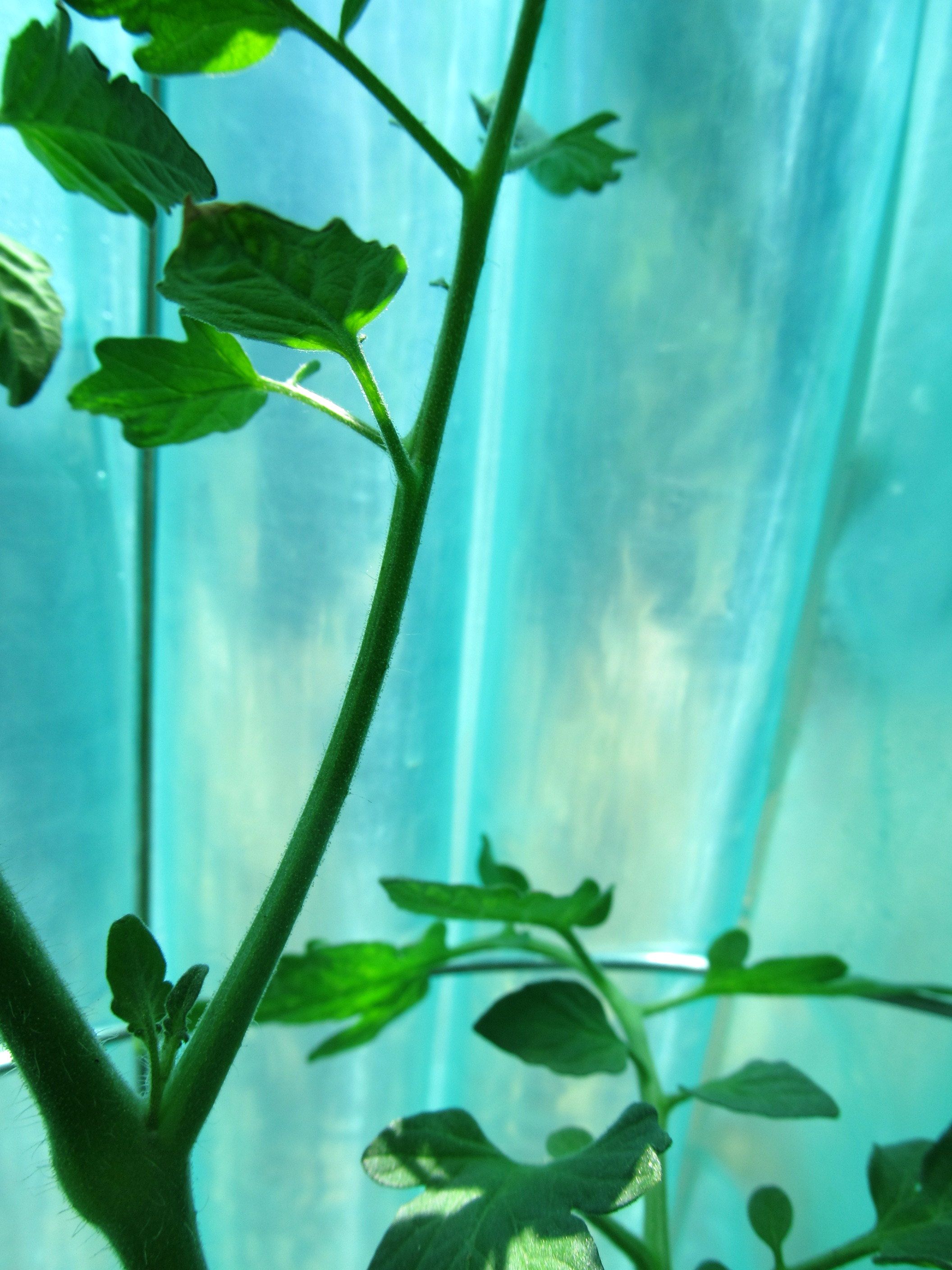
Instead, I held my camera inside the wall of water and took a bunch of pictures.  What would it be like to live in a water teepee?  Very green.

The view from inside.

The view from inside.

Martial Arts belt display


White through Green, with room for more.

White through Green, with room for more.

My kids have been doing Tai Kwan Do for about a year and a half, and our policy for dealing with old belts has pretty much been just leaving them on the floor, or whipping them around occasionally for the cat to play with. Maybe not the best plan, but it has worked so far, and has the benefit of being really easy.

Our Dojang has a display on the wall with the belts of our school’s founder, W.T. Alexander, and it is a big board, with the belts tied on. I wanted some middle ground between the pile of belts on the floor, and the enormous wall display, but I had no ideas.
Until I saw a sample display of a lucite tube, with a dark wood base and cap, with the belts rolled into disks and stacked in the order they had been earned. The display was for sale for 50 bucks.
Being the insanely frugal person I am, I thought to myself that I could do that for nothing. And I did try- I have a clear glass cylindrical vase, that has been laying around for years. I usually put lilacs in it. I rolled up Kate’s white belt, it fit perfectly. Excellent. Then I attempted her yellow striped belt, which I couldn’t make fit at all, It is just slightly thicker, so the disk as it is rolled up is just too big. I tried forcing it, and then visualized slicing my hand open and bleeding all over.  A trip to the emergency room isn’t frugal at all, so I changed plans.
Now, glassware happened to be 50% off at Hobby Lobby, so I scouted it out while on a trip for thread.
Since I was only buying thread, I had ridden my bike over- one of my goals this spring and summer is to bike for short errands where I won’t be carrying much stuff. So, of course, I found the vases I was looking for. I considered very carefully. Hmmm…2 glass vases, 6 inches in diameter and 18 inches tall, in my panniers, over the railroad tracks… I decided to come back later.
I went back later and brought them home, rounded up both kids’ belts, rolled them up and inserted them. I’m pretty psyched. Total cost of the two vases was $32, and I still have my big vase for lilacs. Every body wins.

Peonies- you can grow that


So many buds about to pop!

So many buds about to pop!

When we moved into this house, like 11 years ago, there were plants here already. Some that I have gotten rid of, like junipers that smelled like cat pee, and russian sage, which was plotting to take over the world, starting with my mailbox.
The plants that have given me the least trouble and the most joy, though, are the peonies in the front of the house along the driveway. I don’t know the variety name- I suspect they are the cheapest, most common type, rather than the rare, special-order-from-a-catalog-with-a-fancy-French-name-variety. They bloom profusely in June, then are simply green the rest of the summer.
The reason I say “you can grow that” is that these are the least troublesome plant in the world. They are old-fashioned, cottage-y looking, but they take very little water (how do I know? because I give them very little water) No fertilizer or compost or any special treatment- for this abuse, they reward me with teacup sized blossoms every June.

If you decide to plant them, prep your soil with some compost, follow the directions on the bareroot package, or if it is in a container, place the root ball so the top is even with the soil. Water well, mulch, and wait.

Our cool spring this year means they have not quite popped yet, but you can see they are about to. I can’t wait.

“You can grow that” is a project started by C.L. Fornari, whose goal is to get people growing. Not a bad goal…

Early tomatoes


We can all agree that home grown tomatoes are what make life worth living, right. (Oh be quiet- you like them in salsa and stuff, though, right? okay, then.) So, we can probably all agree that we want those tomatoes as early as possible, right?
Around here (zone 5, Northern front range of Colorado) the traditional date for safely planting out things that won’t survive frost is Mother’s day- mid May. There is no guarantee it won’t freeze after that date, but that is the average annual last frost date. This year we had a snowy April, and an actual cancel-school- snow day on May first.
That meant that the ground was cold- it was very wet, which is a good thing, but the soil was cold. I made the decision to delay tomato-planting until it warmed up a bit.
Tomatoes need warm air temperature as well as warm soil temperature- it isn’t just a matter of “not freezing” they actually need to be warm. (Interestingly, tomatoes are kind of the Goldilocks of plants, when it gets too hot, over 90, they stop blooming)
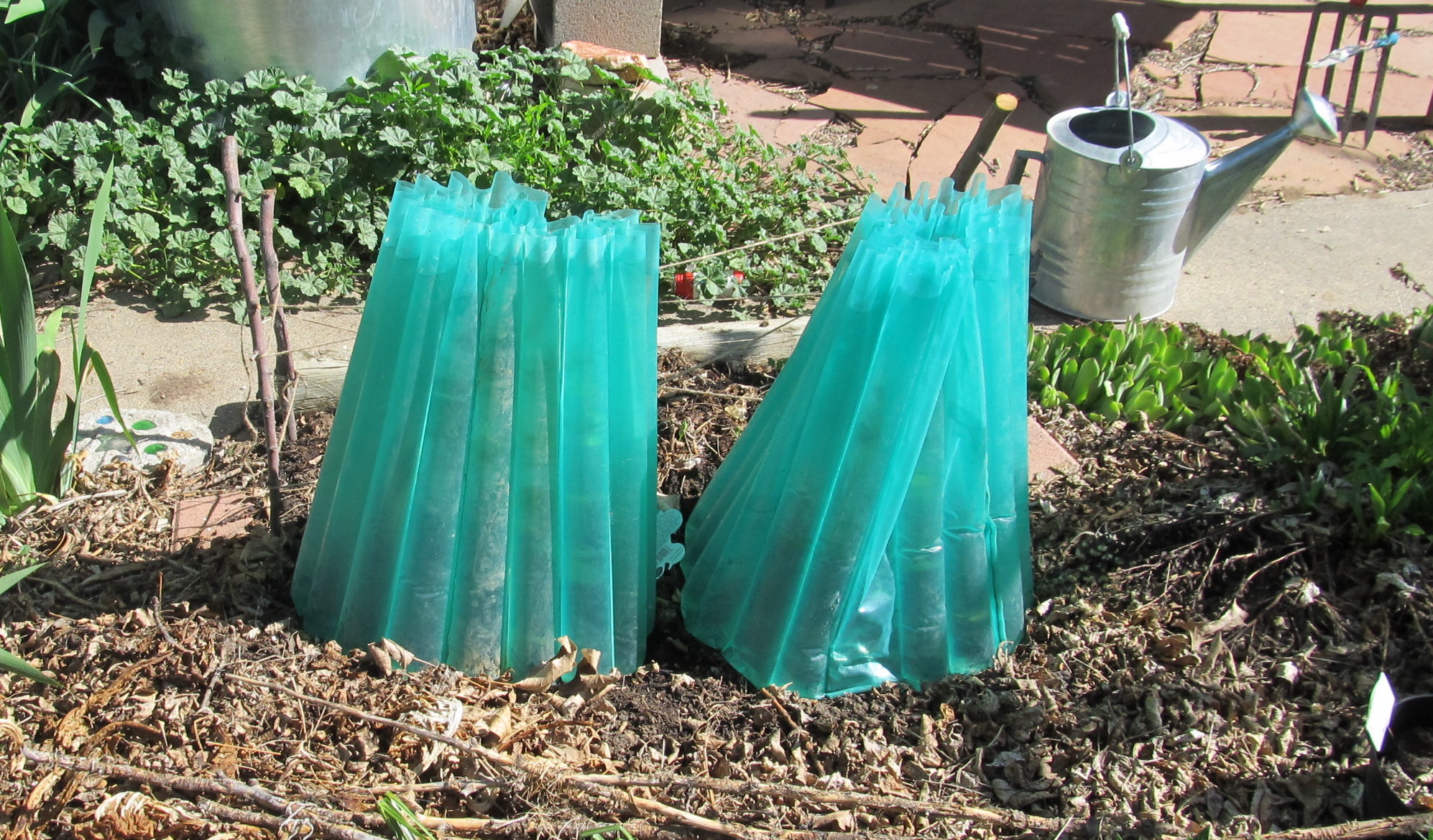
I checked the soil temp with my trusty meat thermometer, and it was 43 degrees. I had some walls of water in the garage. For those of you who don’t know, a Wall of Water is a plastic cylinder made of connected tubes which can be filled with water.  It creates a mini greenhouse, and the water absorbs heat during the day and releases it at night. They are supposed to be self supporting. I set them up, (and then reset them up- they kept falling over- I don’t know if the cat kept messing with them or what the deal is, but that is why I don’t ordinarily use them- any one have any tips?)

Look how slouchy that one on the right is- if that falls over on the chocolate cherry plant I am going to be so ticked off.

Look how slouchy that one on the right is- if that falls over on the chocolate cherry plant I am going to be so ticked off.

Anyway, I set them up, then took the soil temperature again. It was 63 degrees after just a couple of days.
Now, variety choices. In the past I have gotten “Early Girl” because the fruits are, you know, early. 60 days to maturity, which means mid July, roughly. One year I was swayed by some garden porn, and bought Radiator Charlie’s Mortgage Lifter, which has a great name, and an heirloom provenence, and is supposed to be heart-meltingly delicious, which didn’t ripen until late September, so I didn’t get to eat any. Mid- September is our average last frost date, so we have about 4 months to get as many tomatoes as we can.
This year I went to the garden center, and mixed in with all the Early Girls was a variety I hadn’t heard of before- 4th of July. I checked the label- 55 days. Which means first harvest on the…let me do the math..umm, 30 days hath September…carry the 1- the 4th of July.

The other variety I picked today was Chocolate Cherry. I have grown this before, and it is so delicious.  It ripens to a dark, deep red, very sweet. It is a bit slower to ripen, but very prolific.

So, I put them in the ground, carefully lifting the waterfilled tubes away from the planting spots, digging in some compost, plugging the tomato plants in deeply, then carefully replacing the waterfilled tubes back over the plants. I acknowledge that it might have been easier to dump out the water and refill, but I just couldn’t see doing it. It seems wasteful.

That was a couple of weeks ago, and the 4th of July has blossoms on it. I haven’t seen any pollinators go inside- which doesn’t mean there aren’t any, but I have been busy. Does anyone have tips about that? The walls of water seem to be kind of a pain in the neck, but I am hoping they are worth it.

I can’t believe I am spending money on grass!


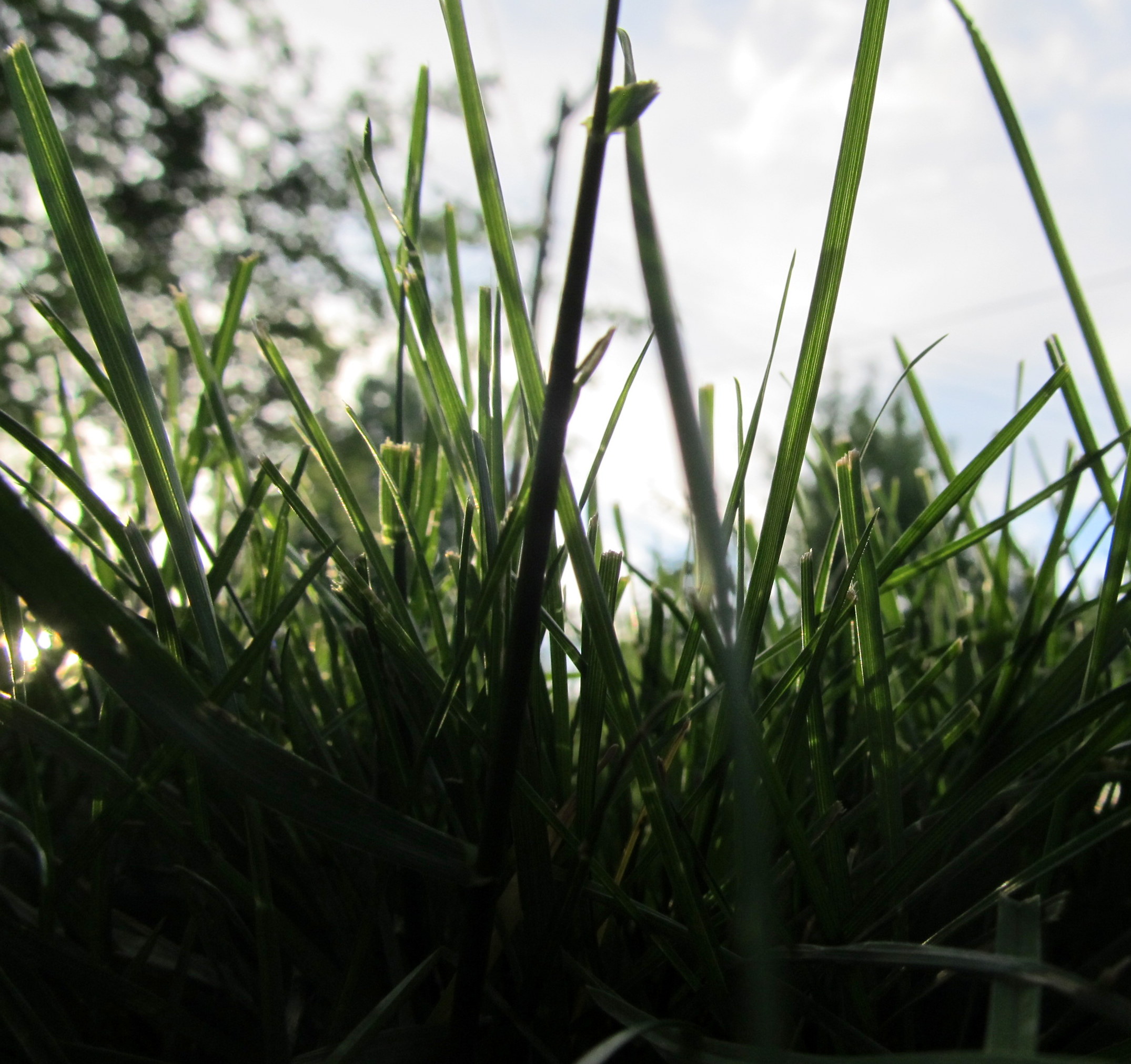
Gaze at the majestic grass in the sunset, said no one...ever.

Gaze at the majestic grass in the sunset, said no one…ever.

For years, my secret plot has been to rid myself of as much lawn as possible (oops, not so secret anymore, huh?) I have mulched, and created shrub beds, and laid out veggie beds, and perennials, and even sneakily scooted the edging bricks out, expanding the width of every bed by 4 inches each year.
I hate grass- hate mowing, hate fertilizing, hate the amount of water it takes, hate the judgement of people driving by who see my dandelions and shake their heads.
And yet, I just spent 30 bucks on “Revive” an organic, Colorado made fertilizer/soil amendment/wetting agent. Wetting agent sounds gross- it has chelated iron in it, and “pure chicken-shit” as my brother says. (The label actually calls it DPW, which stands for dehydrated poultry waste, which means my brother is right.) The idea is that water will be able to soak in more deeply, and we will be able to water less frequently, but the grass will grow better.
It won’t kill dandelions, but maybe the grass will be able to out compete them? Those judgey people driving by will just have to find something else to judge me on….What will that turn out to be?

(Sorry to anyone who has missed me- the day job plus gardening has left me less time to write…no disasters on the home front, just normal busy-ness.)

What is your deal, Asparagus?


I ate 4 spears of homegrown, organic, purple asparagus the other day. And that might be all the asparagus I get to eat this year from my garden. This really bugs me- I love asparagus. This patch has been growing for maybe 4 years, and I planted another one 2 years ago, and I see no shoots coming up this year at all.
What the heck?! What is your deal?!
I followed planting instructions, I watered the new bed faithfully, I really want asparagus. The universe should give me what I want, right?
I suspect the issue is water. The asparagus that does well around here grows near irrigation ditches and cattle waste lagoons (yeah, that’s what it sounds like). This has been a wet spring, but a dry winter. We do live in a semi-desert. So if I want to grow asparagus here I need to water more, all summer.
I think what has been difficult about that is that you only pick asparagus for a few weeks in spring, but it needs water all year, and I have a hard time watering ferny foliage that doesn’t feed me. In my head, I think the ferny foliage should take care of itself.
What I came up with last night was maybe I should interplant some things that I do want to eat with the asparagus. Carrots? okay. Lettuce? cool. Beans? okay. I’ll water it like any other veggie garden.

it only looks like it is as tall as the fence- that's just an error in perspective.  This stalk is smaller than a pencil. Sigh.

it only looks like it is as tall as the fence- that’s just an error in perspective. This stalk is smaller than a pencil. Sigh.

So, I’ll try it. I’ll let you know how it goes.

Pizza- you can grow that!


Well, not the whole pizza, there’s no such thing as a sausage tree or a mozzarella bush, after all, but we do veggie pizzas around here, mostly, and it is certainly possible to grow your herbs and veggies for pizza.
I have an oregano plant that has come up reliably for five years. I always swoop down and brush it with my fingers when I walk past, just to smell that evocative scent of …well…pizza.
You can plant onion sets simply by pushing them into the soil, pointy end up. Pull them throughout the summer for green onions.
Wait until after danger of last frost to plant tomatoes, peppers and basil. In my area, that is traditionally mother’s day. This has been a weird year, though, with hardly any snow all winter, then a couple big dumps- one that closed school on May first- this spring. The snow has melted, but the soil is still very cold. I’m going to set up Walls of Water, to warm up the soil in advance of planting.

Yes, this is our meat thermometer. Yes, I washed it! 43 Fahrenheit is around 4 degrees Celsius. Tomatoes are happier with warmer toes.

Yes, this is our meat thermometer. Yes, I washed it! 43 Fahrenheit is around 4 degrees Celsius. Tomatoes are happier with warmer toes.

I have designed my garden on purpose to mix in edibles with the flowers. Rather than having a big “vegetable garden” out back, each big border has an area without perennials or bulbs that I can turn over and plant annual vegetables. I think it is prettier, and easier to take care of, to have a couple of square feet of tomatoes right next to the asters and iris.

Mistakes in Scale


My tulips bloomed last week. I know this because as I was pulling into the driveway, I saw a flash of yellow, very far away.
Then it snowed, and I forgot about them. Now they are pitiful- squashed by a foot and a half of very wet snow.

See- way over there, by the bricks...under the window? Yellow and orange tulips?

See- way over there, by the bricks…under the window? Yellow and orange tulips?

Why, oh why won’t I learn to plant big things far away, and little things close?
I kind of learn it- I did put about 20 bulbs into a pot on the porch, where I can sit next to them in the morning sunshine, and I have some other tiny scilla mixed in with the grass just off the patio, so I can strum the ukulele and enjoy their tiny bell shaped blossoms. But putting 6 inch tall yellow tulips 30 feet away from where I walk, or sit, or drive, that’s just silly.
Mistakes in scale are super common- my favorite (now that it is gone) is the Russian sage that the previous owners planted underneath the mailbox. So, think about this- a shrubby perennial, beloved by bees, that gets to be 5 feet tall and 6 feet wide, in a 2 foot wide bed between the driveway and the front walk, right under the mailbox. Did I mention it was beloved by bees? Yeah. It was not beloved by mailmen.
I broke two separate digging forks trying to uproot it. DH was heard to comment one time after I cut it back severely and tried to dig it out, “I hope I never make you as mad as that russian sage made you.”
It didn’t make me mad, it just was in the wrong place. When you are in the wrong place, I let you know.

Another mistake in scale I see all the time is a narrow flower bed along the back fence, planted with geraniums and marigolds. A wooden stockade fence 6 feet tall, with 6 inch flowers in front of it, 20 or 30 feet away from the porch or the patio or the deck.
So, maybe size doesn’t matter, but scale does… what mistakes in scale with gardens to you see? What mistakes do you still make?

Vanilla orchid- surviving the winter…


I tried to crop out the messy kitchen...

I tried to crop out the messy kitchen…

Last fall, I brought my vanilla orchid inside after its summer vacation on the back patio. It was alive, and had grown quite a bit, but it hadn’t topped out the trellis….Now, as I look at the thermometer and begin to count down the days until it, and all my “house plants” can go outside, the vanilla vine is still alive, but still not huge.

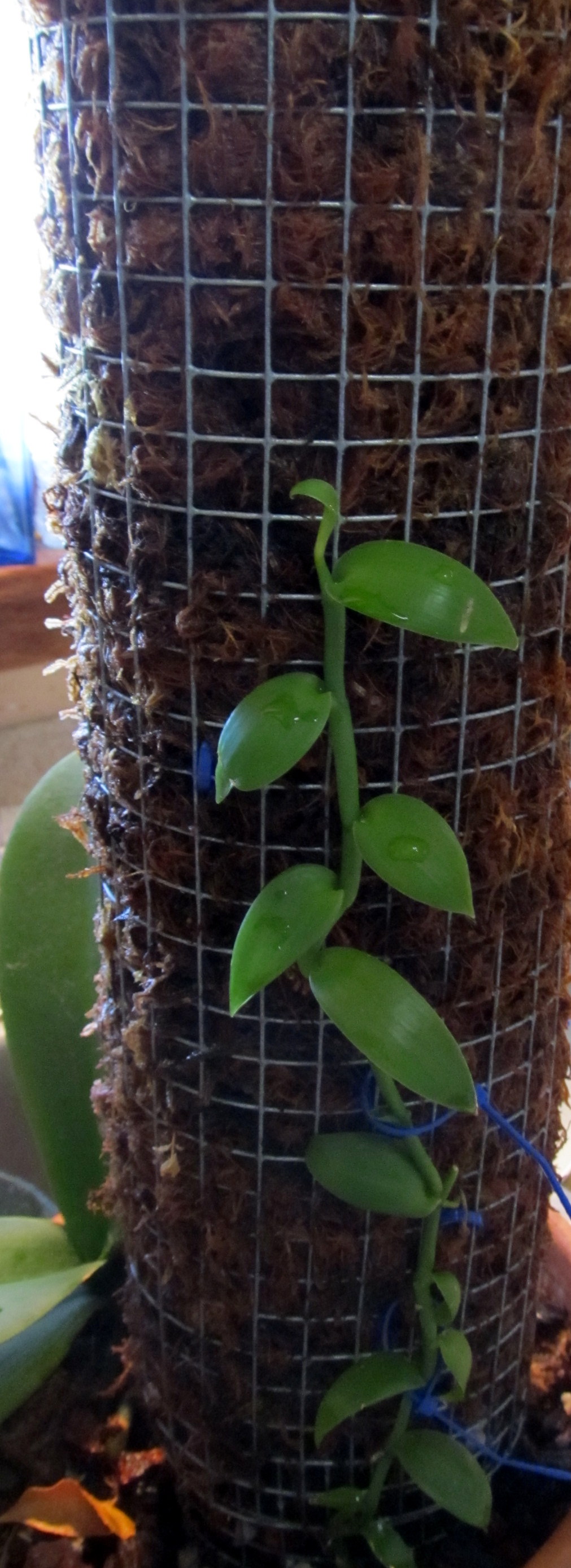
The trellis I built is basically a quilt made out of hardware cloth, wire fencing with smaller holes than chicken wire. The middle layer of the “quilt” is sheet moss. I rolled the quilt into a cylinder about 4 inches in diameter and 2 feet tall. I filled it with orchid mix, then set up a pop bottle with pinholes in the bottom.  It is both a tower for the vine to climb on, and an evaporator. It is also modular- I can build another cylinder that will fit into the top, if and when this little vine decides to grow up to the top of this one.

If you are wondering about how much support you need for your vanilla plant for the first year or two, the answer is, a chopstick would have worked for this guy. It doesn’t need a two foot tall tower.  However, the other design element was for a humidity source for the plant- it is dry here, inside and out, on the front range of Colorado, and the trellis also acts as a humidity tower. It spends the winter in The Boy’s room, which also has a fish tank, and a new anole habitat-( and the cricket habitat that goes with the lizard- I didn’t realize that when I said yes to the lizard, I was saying yes to crickets, as well) The fish tank evaporates quite a bit, as well as the anole habitat, but it is still a centrally-heated room in a house in a semi-desert.

When I first built the trellis, the vine was only 4 inches tall- now, roughly two years later it is about 12 inches tall. If I were starting again, I might just use a chopstick, or piece of bamboo, and maybe use a hurricane lamp as a terrarium.

Previous Older Entries Next Newer Entries