What is your deal, Asparagus?


I ate 4 spears of homegrown, organic, purple asparagus the other day. And that might be all the asparagus I get to eat this year from my garden. This really bugs me- I love asparagus. This patch has been growing for maybe 4 years, and I planted another one 2 years ago, and I see no shoots coming up this year at all.
What the heck?! What is your deal?!
I followed planting instructions, I watered the new bed faithfully, I really want asparagus. The universe should give me what I want, right?
I suspect the issue is water. The asparagus that does well around here grows near irrigation ditches and cattle waste lagoons (yeah, that’s what it sounds like). This has been a wet spring, but a dry winter. We do live in a semi-desert. So if I want to grow asparagus here I need to water more, all summer.
I think what has been difficult about that is that you only pick asparagus for a few weeks in spring, but it needs water all year, and I have a hard time watering ferny foliage that doesn’t feed me. In my head, I think the ferny foliage should take care of itself.
What I came up with last night was maybe I should interplant some things that I do want to eat with the asparagus. Carrots? okay. Lettuce? cool. Beans? okay. I’ll water it like any other veggie garden.

it only looks like it is as tall as the fence- that's just an error in perspective.  This stalk is smaller than a pencil. Sigh.

it only looks like it is as tall as the fence- that’s just an error in perspective. This stalk is smaller than a pencil. Sigh.

So, I’ll try it. I’ll let you know how it goes.

About these ads

Pizza- you can grow that!


Well, not the whole pizza, there’s no such thing as a sausage tree or a mozzarella bush, after all, but we do veggie pizzas around here, mostly, and it is certainly possible to grow your herbs and veggies for pizza.
I have an oregano plant that has come up reliably for five years. I always swoop down and brush it with my fingers when I walk past, just to smell that evocative scent of …well…pizza.
You can plant onion sets simply by pushing them into the soil, pointy end up. Pull them throughout the summer for green onions.
Wait until after danger of last frost to plant tomatoes, peppers and basil. In my area, that is traditionally mother’s day. This has been a weird year, though, with hardly any snow all winter, then a couple big dumps- one that closed school on May first- this spring. The snow has melted, but the soil is still very cold. I’m going to set up Walls of Water, to warm up the soil in advance of planting.

Yes, this is our meat thermometer. Yes, I washed it! 43 Fahrenheit is around 4 degrees Celsius. Tomatoes are happier with warmer toes.

Yes, this is our meat thermometer. Yes, I washed it! 43 Fahrenheit is around 4 degrees Celsius. Tomatoes are happier with warmer toes.

I have designed my garden on purpose to mix in edibles with the flowers. Rather than having a big “vegetable garden” out back, each big border has an area without perennials or bulbs that I can turn over and plant annual vegetables. I think it is prettier, and easier to take care of, to have a couple of square feet of tomatoes right next to the asters and iris.

Mistakes in Scale


My tulips bloomed last week. I know this because as I was pulling into the driveway, I saw a flash of yellow, very far away.
Then it snowed, and I forgot about them. Now they are pitiful- squashed by a foot and a half of very wet snow.

See- way over there, by the bricks...under the window? Yellow and orange tulips?

See- way over there, by the bricks…under the window? Yellow and orange tulips?

Why, oh why won’t I learn to plant big things far away, and little things close?
I kind of learn it- I did put about 20 bulbs into a pot on the porch, where I can sit next to them in the morning sunshine, and I have some other tiny scilla mixed in with the grass just off the patio, so I can strum the ukulele and enjoy their tiny bell shaped blossoms. But putting 6 inch tall yellow tulips 30 feet away from where I walk, or sit, or drive, that’s just silly.
Mistakes in scale are super common- my favorite (now that it is gone) is the Russian sage that the previous owners planted underneath the mailbox. So, think about this- a shrubby perennial, beloved by bees, that gets to be 5 feet tall and 6 feet wide, in a 2 foot wide bed between the driveway and the front walk, right under the mailbox. Did I mention it was beloved by bees? Yeah. It was not beloved by mailmen.
I broke two separate digging forks trying to uproot it. DH was heard to comment one time after I cut it back severely and tried to dig it out, “I hope I never make you as mad as that russian sage made you.”
It didn’t make me mad, it just was in the wrong place. When you are in the wrong place, I let you know.

Another mistake in scale I see all the time is a narrow flower bed along the back fence, planted with geraniums and marigolds. A wooden stockade fence 6 feet tall, with 6 inch flowers in front of it, 20 or 30 feet away from the porch or the patio or the deck.
So, maybe size doesn’t matter, but scale does… what mistakes in scale with gardens to you see? What mistakes do you still make?

Vanilla orchid- surviving the winter…


I tried to crop out the messy kitchen...

I tried to crop out the messy kitchen…

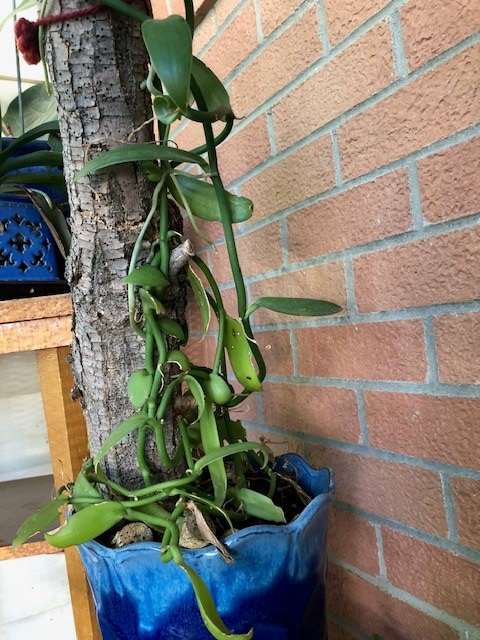
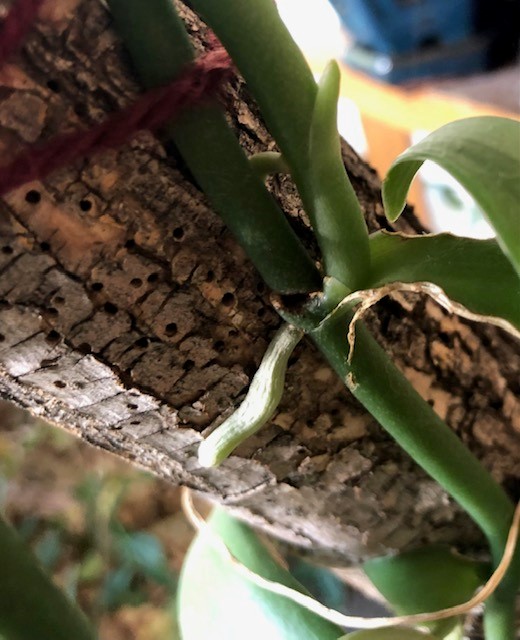
Last fall, I brought my vanilla orchid inside after its summer vacation on the back patio. It was alive, and had grown quite a bit, but it hadn’t topped out the trellis….Now, as I look at the thermometer and begin to count down the days until it, and all my “house plants” can go outside, the vanilla vine is still alive, but still not huge.

The trellis I built is basically a quilt made out of hardware cloth, wire fencing with smaller holes than chicken wire. The middle layer of the “quilt” is sheet moss. I rolled the quilt into a cylinder about 4 inches in diameter and 2 feet tall. I filled it with orchid mix, then set up a pop bottle with pinholes in the bottom.  It is both a tower for the vine to climb on, and an evaporator. It is also modular- I can build another cylinder that will fit into the top, if and when this little vine decides to grow up to the top of this one.

If you are wondering about how much support you need for your vanilla plant for the first year or two, the answer is, a chopstick would have worked for this guy. It doesn’t need a two foot tall tower.  However, the other design element was for a humidity source for the plant- it is dry here, inside and out, on the front range of Colorado, and the trellis also acts as a humidity tower. It spends the winter in The Boy’s room, which also has a fish tank, and a new anole habitat-( and the cricket habitat that goes with the lizard- I didn’t realize that when I said yes to the lizard, I was saying yes to crickets, as well) The fish tank evaporates quite a bit, as well as the anole habitat, but it is still a centrally-heated room in a house in a semi-desert.

When I first built the trellis, the vine was only 4 inches tall- now, roughly two years later it is about 12 inches tall. If I were starting again, I might just use a chopstick, or piece of bamboo, and maybe use a hurricane lamp as a terrarium.

Larkspur- you can grow that


Larkspur and yellow yarrow last July.

When I was first building my  garden, my wonderful mother-in-law gave me an envelope of larkspur seeds.  I had the hardest time remembering what they were- I’m not sure why the name didn’t stick with me- those, thingies… bird feet thingies…I would think in my head. I finally have them down, and I have them essentially everywhere. Love them: water efficient, good for pollinators, tall, that pretty blue that flowers don’t usually come in. Pretty cottage garden-y stuff, without needing much water.

They are not perennial, that is, the same plant does not come back year after year, like peonies or rhubarb. Instead, they drop their seeds nearby and plant themselves. I help them along by cutting them back and sprinkling their seeds where I want them.

It is a good thing I am not a super control freak, because often “they drop their seeds nearby” means in the path, or along the edge of the bed, or mixed in with the asparagus.  I have wide beds, with lots of shrubs which were tiny when I first planted them.  Back when my MIL gave me the envelope, the larkspur helped it look like the wide “mixed shrub borders” were something other than wide “expanses of mulch with twigs sticking up.” Now that 8 or 9 years have passed, and the shrubs have grown up, the larkspur can seed itself in the handful of gaps that remain.

To have your own spot of cottage garden-y goodness this summer, don’t wait until someone gives you an envelope of seeds from their yard. Instead, buy a pack, prepare a bed, sprinkle the  seeds and water them in. My self-seeded plants are already up, after having spent the winter on the ground, so it is not too early to plant them.  The first grown will be soft and ferny, and the flowers will grow to be 2-3 feet tall.

You can grow that

Larkspur, yarrow and chamomile blooming way back last summer.

Larkspur, yarrow and chamomile blooming way back last summer.

is an initiative by garden writer C.L. Fornari, to encourage people to get out in the sunshine and grow stuff. You should check it out.

Water Lily Transplant Team


At the pizza place last night, I told my kids I was planning on taking the water lily out of the pond to repot, and asked if they would help. They did not respond enthusiastically.
I clarified by saying I wanted to blog about it, so I would need photos.  I won’t say they were eager…the only eagerness came from each not wanting the other to get to use the camera. Oh well, I’ll take any assistance I can get.
To prep, I checked my pond reference book “The Pond Doctor” which has enough illustrations to be useful, but not so many that it counts as a coffee table book. The directions for repotting recommend lining a basket with burlap, then adding clay soil, then removing the lily from the pond, rinsing the old soil off, cutting off any dead material, and placing the rhizome at a 45 degree angle with the growing tip at the center, then covering with gravel, then placing it back in the pond in shallow water, until it starts growing. Whew. That seems doable.

The water on top is warmer than in the depths of the horse trough, but not by much right now. My “shallow water” zone is a couple of cinder blocks I placed at the south end of the trough, one vertical and the other horizontal. They make a stand for plants, and the holes create happy little hiding places for the fish.
Step 1 Basket: I got a basket at the dollar store. It cost a dollar… I ran into a preschool mommy- Someone I hadn’t talked to since we stood around waiting to pick up our kids, 5 years ago. We had a nice discussion about what size basket I should get for the water lily. Actually, we talked mostly about how big the kids were getting, and our conclusion about the water lily was that I might as well get 2 sizes of basket, since they were only a dollar.

Step 2 Burlap: I bought a yard at the hobby store, which is conveniently in the same mini mall as the dollar store. I cut it in half and crisscrossed it in the basket.

We used the bigger basket- the recently fished out lily is in the smaller one.

We used the bigger basket- the recently fished out lily is in the smaller one.

Step 3 Clay soil:   easy to find, in theory, since my yard is nothing but clay. I found an inconspicuous spot to dig a bucket full.

Step 4 Remove lily: When I fished the lily out of the pond, I was surprised at the size. I bought it two years ago in a mesh bag the size you might buy garlic in. There wasn’t any soil in the bag originally, I don’t think, just some gravel to make it sink, which made

Step 5 Rinse soil off rhizome  very easy. I cut away most of the mesh, and

Step 6 Trim: I cut away the mucky stems and leaves from last summer.  Kate was appalled by the smell. She is the one who won the “I get to take pictures” argument.  Honestly, it wasn’t that bad- if pond smell is the only thing keeping you from repotting a water plant, get over it.

Extreme close-up of fresh growth.

Extreme close-up of fresh growth.

Step 7 45 degree angle:  I nestled the rhizome into the soil at an angle, leaving the growing tip out of the soil in the center of the basket.Then I wrapped the lose ends of the burlap up around the soil on top.

Step 8 Gravel: I know I have a bucket of gravel around somewhere- I am sure it will turn up in the spring cleanup. When I find it, I will put some scoops of it on top of the burlap, to keep the soil from making the water cloudy.   That’s a little joke- the water is pretty cloudy on its own right now.

Next fall, I'm going to put some kind of a screen on top so we don't get a tree's worth of leaves in the pond. It's pretty darn gross.

Next fall, I’m going to put some kind of a screen on top so we don’t get a tree’s worth of leaves in the pond. It’s pretty darn gross.

Step 9 Shallow water: I placed the basket on one of the cinder blocks very gently. Some bubbles came up from the burlap, but fortunately the soil was pretty moist already. If it had been dry, I would have had to hold the bundle down until the air bubbles had all come up out of the soil, and it was fully moistened.

Step 10 Scrub arms: Okay, Kate, you’re right, it is pretty stinky, and my right arm, which is the one that went into the water to get the plant, is pretty gross smelling.

Science Fair- please, no wagering


“When is your science fair?” I asked the Boy one cool evening not long ago.

“I don’t know…” he responds.
Ooops. Hope it isn’t tomorrow, because we aren’t ready.
The Boy is a self proclaimed nerd, and loves science. He is memorizing the periodic table of elements (hint, if he asks you if you want to hear him say the first 37 elements, insist that he sing them. He’ll blush, but he’ll do it!)
He loves weather, and nature, and dinosaurs, and is getting into chemistry, and so there is a lot of pressure to have a really amazing science fair project. Pressure from his peers, but also from himself.
The problem is, we are pretty bad about follow through around here…
We brainstorm, and come up with things…then we get distracted by something shiny.

It turned out that the Science fair was a few weeks away, so we had time to follow through.
So,  the decision for this year was to examine the life growing in the jar of pond water we collected last summer . The 1 quart jar has been in his west-facing window, growing algae and stuff.

Look- follow through! With a map and a video and everything!

Look- follow through! With a map and a video and everything!

When we first collected the samples, we didn’t intend to make it a science fair project. I had read about the project in a garden book, and when I told the Boy about it, he thought it was a neat idea, and nagged me about it until I got a jar, and went with him to the park.

This made the “research question” portion of the science packet problematic… we couldn’t just say the question  was: “wouldn’t it be cool if we had a jar with pond water…?”

So, the research question became: “Can an ecosystem be formed by mixing materials from different sources?”
We took a video of the little critters that are swimming around, and looked at them with our thrift store microscope. With help from the interwebs, he determined that they were daphnia.

The science fair was a success- there was the usual supply of baking soda volcanoes, and several decomposition displays.  The Boy was the only one to have a jar of tiny critters with a water cycle. Our school fair is non-competitive- just an exhibition, not a competition.

This was on someone else's display. Now, I don't know Tyler or Jack H., but I am pretty sure they touched it.

This was on someone else’s display. Now, I don’t know Tyler or Jack H., but I am pretty sure they touched it.

Now we have to think about next year.

You can grow that- locally!


All politics is local, they say, and gardening is the same way. I have driven myself crazy for years reading books about organic gardening in Pennsylvania, or Upstate New York, or Maine, or Wales. I have tried to apply my learning to the ground here- dry, clay, and alkaline. I have finally learned to read Western-based garden books, or to temper my fantasies to something that is sustainable with the soil here, and the amount of rainfall here.

Every winter I am inundated with seed and plant catalogs. I read them, and place sticky notes, and highlight the varieties I want to buy. It is similar to the garden book thing- catalogs from Maine, or Oregon, or Pennsylvania won’t necessarily have what I need here- drought tolerant in Massachusetts is different from drought tolerant in Colorado.  Full sun in Michigan is different from full sun here.

This year, rather than placing an order to have seeds shipped to me, I will bike downtown, and go into our local greenhouse, where they order seeds in bulk, and will sell me little envelopes of whatever I want to plant. Well, not “whatever” …last year they didn’t have leeks in bulk, so I got a pre-packaged envelope off the rack, but they have many popular varieties that do well here. They have bareroot strawberries and asparagus and seed potatoes and onion sets. They also have people working there who, if they are not experts, they are informed, about where things are located in the store, and when to plant most things.

Your homework- find a greenhouse or garden center that is local to you. Locally owned businesses will only stay alive as long as we support them, and often the guys in the *cough orange aprons cough* don’t know much about the plants they are selling. You don’t have to bike (and in fact, I might not, but I should) but find a place that is local, and support it.

The lonely pile of seed catalogs this year- I am forsaking you for a local business.

The lonely pile of seed catalogs this year- I am forsaking you for a local business.

C.L. Fornari, amazing garden writer, has founded “You can grow that!” where on the fourth of every month, garden bloggers write posts encouraging anyone to grow anything.  Check her out at http://www.youcangrowthat.com/

Chris Kimball comes through again!


Because of a need to go lower fat, I was looking to substitute the foods we love with lower fat versions.

Spaghetti and meatballs is a meal we have in the rotation regularly-for years I have just been buying a bag of frozen meatballs, and microwaving a dozen or so while the pasta water boiled.  Then I read the label, and was astonished by the amount of fat.  This was low-hanging fruit- surely I could make meatballs with less than 12 grams per serving!

I borrowed a low fat cookbook from a colleague, and made calculations and adaptations for a meatloaf recipe. I was so proud- it was only 1.5 grams of fat for an entire serving of 6 meatballs. I used texturized vegetable protein, and 95% lean ground beef, and…Ummm…yeah. They were….really…I should have taken pictures of people eating them- glum. We did eat the whole batch, but not happily.
The thing is, the good people at Cook’s Illustrated/America’s Test Kitchens have done the math, and done the experimentation, and come up with a recipe for meatballs that aren’t as crazy lean as my experimental meatballs, but they are really tasty.
Because that is the thing- at only 1.5 grams of fat per serving, no one wanted to eat them. So, what’s the point?
The two secrets of CI’s recipe are buttermilk and gelatin. The buttermilk totally makes sense to me- tang and richness and mouthfeel. The gelatin was a surprise- they explained that sometimes meatballs are made with veal, which I guess naturally has more gelatin, so you get a creamy texture. It gives a velvety feeling without being greasy.
I tried them, and they are so good. The original recipe called for 2 pounds of beef, and 1 of ground pork. I didn’t want that many meatballs floating around the first time I made the recipe, so I used just 1 pound of 93% lean beef. Another modification was to use leftover Christmas ham rather than the finely chopped prosciutto called for in the original. This was pure laziness- we had the ham, didn’t want to go out for specialty deli meats.  I think the ham also adds saltiness and umami, without adding fat.  The original recipe would make around 120 meatballs, which seems like really a lot- more than my oven could handle, but I suppose if I were having a big spaghetti party, I might make that many.

(Weird note about Cook’s Illustrated/ America’s Test Kitchen- I had a dream that Chris Kimball lived in our town, and all his quirky small town New England stories were really about here, and he was giving cooking classes and we went and he wore his little bow tie and everything.)

Meatballs- based on Cook’s Illustrated, with adaptations

3/4 cups bread crumbs

1/2 cup buttermilk

1/4 cup egg beaters

1 pound 93% lean ground meat

2 oz chopped ham

1/2 cup parmesan cheese

2 teaspoons italian seasoning

1 clove pressed garlic

1 packet unflavored gelatin dissolved in 2 tablespoons water

Dissolve the gelatin in water according to directions. In a large bowl, mix the buttermilk, egg and the breadcrumbs. Add the other ingredients, and mix together by hand, thoroughly incorporating the gelatin.  Form into balls- you could weigh them…I guestimated and came up with about 40 of them that seemed about the right size. Place on a baking sheet and bake in a 350 degree oven for about 20 minutes.  At this point, you can bag them and put them in the freezer, or simmer some in sauce until the pasta is ready, and freeze the rest, or maybe you are having a big enough party, or you have a big enough family, to serve all of them at once.  Go for it.

Sorry, no photos…every time I cook something, I find myself admiring the photographers who take pictures of food. My photo shot of this recipe just turned up pink pasty stuff, then, you know, brown balls…of meat…

Self watering pot- a goldfish story.


Frozen Hillbilly Goldfish Pond.

Frozen Hillbilly Goldfish Pond.

I pinned something on Pinterest that was repinned more times than anything else I have put up. Then, my brother found it somewhere and sent it to me, as well.  It is a tutorial for a mini pond in a pot, with divisions for a wetland area with more soil and cattails, and a pond area, with a water lily. It is honestly adorable.

I have worked my way up in mini-ponds- from a 10 gallon tub, to a 20 gallon half barrel, to my current one, a 100 gallon horse trough, aka the Hillbilly Goldfish Pond. I have learned that the more water, the better the pond works. The fish like it better, (although there is some…attrition). The plants like it better. This experience tells me that the little patio pond depicted probably wouldn’t work, but it is adorable. People like adorable.
It makes me think, though, about adding more “wetland” area to my pond. And with that, it makes me wonder about combining the idea of a self watering pot and my pond. A self watering pot is a porous pot  with a reservoir underneath that holds a constant source of water. Roots are always able to access the water they need, so they tend to grow better than they would in regular containers. Earthbox is one brand. They seem expensive and  ugly. (that’s one way you can tell I don’t make money from these links.   If they were affiliate links, I would say, “kind of expensive, and kind of ugly.”)

In a six foot long pond, what about putting in some cinderblocks, and some pots that would keep the roots wet, but the tops dry, so the plants don’t rot? Or islands, out of floating styrofoam, for lettuce and spinach? Or grow bags with squash, and the vines could drape over the sides of the trough? I would still want enough open space for fish, and I wonder if the goldfish would wind up eating the roots?
That’s what’s great about winter- I can imagine these ideas all day and night, waiting for the pond to thaw.

Previous Older Entries

Follow

Get every new post delivered to your Inbox.

Join 224 other followers