Pizza- you can grow that!


Well, not the whole pizza, there’s no such thing as a sausage tree or a mozzarella bush, after all, but we do veggie pizzas around here, mostly, and it is certainly possible to grow your herbs and veggies for pizza.
I have an oregano plant that has come up reliably for five years. I always swoop down and brush it with my fingers when I walk past, just to smell that evocative scent of …well…pizza.
You can plant onion sets simply by pushing them into the soil, pointy end up. Pull them throughout the summer for green onions.
Wait until after danger of last frost to plant tomatoes, peppers and basil. In my area, that is traditionally mother’s day. This has been a weird year, though, with hardly any snow all winter, then a couple big dumps- one that closed school on May first- this spring. The snow has melted, but the soil is still very cold. I’m going to set up Walls of Water, to warm up the soil in advance of planting.

Yes, this is our meat thermometer. Yes, I washed it! 43 Fahrenheit is around 4 degrees Celsius. Tomatoes are happier with warmer toes.

Yes, this is our meat thermometer. Yes, I washed it! 43 Fahrenheit is around 4 degrees Celsius. Tomatoes are happier with warmer toes.

I have designed my garden on purpose to mix in edibles with the flowers. Rather than having a big “vegetable garden” out back, each big border has an area without perennials or bulbs that I can turn over and plant annual vegetables. I think it is prettier, and easier to take care of, to have a couple of square feet of tomatoes right next to the asters and iris.

Mistakes in Scale


My tulips bloomed last week. I know this because as I was pulling into the driveway, I saw a flash of yellow, very far away.
Then it snowed, and I forgot about them. Now they are pitiful- squashed by a foot and a half of very wet snow.

See- way over there, by the bricks...under the window? Yellow and orange tulips?

See- way over there, by the bricks…under the window? Yellow and orange tulips?

Why, oh why won’t I learn to plant big things far away, and little things close?
I kind of learn it- I did put about 20 bulbs into a pot on the porch, where I can sit next to them in the morning sunshine, and I have some other tiny scilla mixed in with the grass just off the patio, so I can strum the ukulele and enjoy their tiny bell shaped blossoms. But putting 6 inch tall yellow tulips 30 feet away from where I walk, or sit, or drive, that’s just silly.
Mistakes in scale are super common- my favorite (now that it is gone) is the Russian sage that the previous owners planted underneath the mailbox. So, think about this- a shrubby perennial, beloved by bees, that gets to be 5 feet tall and 6 feet wide, in a 2 foot wide bed between the driveway and the front walk, right under the mailbox. Did I mention it was beloved by bees? Yeah. It was not beloved by mailmen.
I broke two separate digging forks trying to uproot it. DH was heard to comment one time after I cut it back severely and tried to dig it out, “I hope I never make you as mad as that russian sage made you.”
It didn’t make me mad, it just was in the wrong place. When you are in the wrong place, I let you know.

Another mistake in scale I see all the time is a narrow flower bed along the back fence, planted with geraniums and marigolds. A wooden stockade fence 6 feet tall, with 6 inch flowers in front of it, 20 or 30 feet away from the porch or the patio or the deck.
So, maybe size doesn’t matter, but scale does… what mistakes in scale with gardens to you see? What mistakes do you still make?

Self watering pot- a goldfish story.


Frozen Hillbilly Goldfish Pond.

Frozen Hillbilly Goldfish Pond.

I pinned something on Pinterest that was repinned more times than anything else I have put up. Then, my brother found it somewhere and sent it to me, as well.  It is a tutorial for a mini pond in a pot, with divisions for a wetland area with more soil and cattails, and a pond area, with a water lily. It is honestly adorable.

I have worked my way up in mini-ponds- from a 10 gallon tub, to a 20 gallon half barrel, to my current one, a 100 gallon horse trough, aka the Hillbilly Goldfish Pond. I have learned that the more water, the better the pond works. The fish like it better, (although there is some…attrition). The plants like it better. This experience tells me that the little patio pond depicted probably wouldn’t work, but it is adorable. People like adorable.
It makes me think, though, about adding more “wetland” area to my pond. And with that, it makes me wonder about combining the idea of a self watering pot and my pond. A self watering pot is a porous pot  with a reservoir underneath that holds a constant source of water. Roots are always able to access the water they need, so they tend to grow better than they would in regular containers. Earthbox is one brand. They seem expensive and  ugly. (that’s one way you can tell I don’t make money from these links.   If they were affiliate links, I would say, “kind of expensive, and kind of ugly.”)

In a six foot long pond, what about putting in some cinderblocks, and some pots that would keep the roots wet, but the tops dry, so the plants don’t rot? Or islands, out of floating styrofoam, for lettuce and spinach? Or grow bags with squash, and the vines could drape over the sides of the trough? I would still want enough open space for fish, and I wonder if the goldfish would wind up eating the roots?
That’s what’s great about winter- I can imagine these ideas all day and night, waiting for the pond to thaw.

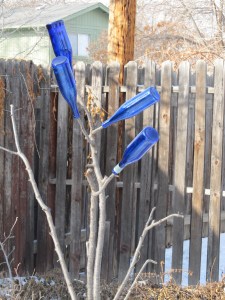
Bottle Tree- you can grow that


IMG_0022In the bleak midwinter,

frosty wind made moan

The earth stood hard as iron

Water like a stone…-Christina Rosetti

Nothing like being an English major- these words came to mind when I started thinking of what to write for a “You Can Grow That” post- what can you grow this time of year? yes, the houseplants, the Christmas cactus, the amaryllis and the paperwhites. But outside? Sigh.

I could flip through my seed catalogs, place post-it notes, sketch diagrams of my new bed in the front of the house where the junipers used to be, but I am mostly just sitting and looking out the windows, these days.  And the view from my desk is a happy little bottle tree.

I got the idea from a craptastic garden we visited in Idaho- I guess you could say a bottle tree seed was planted there.

It used to be an unhappy cherry tree, that died. Alas. (another benefit to being an English major, I get to use words like alas, and nobody is surprised)  I trimmed it back to stubs, and placed blue wine bottles on it.

It won’t last forever- the roots are decomposing underground, and at some point it will tip over. That’s fine. Until then, I have something to catch my eye when I look out my window this winter. And an excuse to buy blue bottles of wine.

Pronounced Di-NON-a-kus


Waiting for the paint to dry on the back porch.

The boy decided on his Halloween costume fairly late- he usually has lots of ideas, then settles on something with a few weeks lead time. Not this year- On Tuesday, he decided on dinosaur, specifically a Deinonychus (which I want to day dino- NIGH- kus but he assures me I am wrong. He is the expert.)

You would think that was a week of lead time, but not really, because he had an event Friday. Ack!
His thought was originally a wire framed puppet mask/hat thing, and he sketched and planned, and kept asking me to go wire shopping. He wanted the jaw to contain his candy bag, so people would be throwing candy into the dinosaur’s mouth.
It seemed complicated. And maybe not safe, what with the wires, and the not being able to see, and a jaw full of candy…
On Wednesday night we had a brainstorm. Why not sculpt it out of foam, instead? We made a paper model, and started cutting up a blue closed cell foam camping pad that the kitty has been chewing on.

We chose 2 shades of spray paint- light brown and olive drab, and sprayed in a kind of mottled pattern.  The fact that the pad was scarred and battered by the cat meant that it looks like the dinosaur has been in some battles…maybe that’s just my imagination.

Say, did anyone ever tell you your pupils are round? That’s a dinosaur pick-up line.

The part I love the most is the eye detail- we used some cat’s eye marbles and duct tape to create lids and folds. I put mineral oil on the marbles, so the paint wiped right off.
To make the hinged jaw, I used 2 buttons sewn together through the upper and lower jaw. The Boy can see through the mouth. The lower jaw can tuck into the top to qualify as a hat for events where masks are banned.

Quote of the day, “Wow, Stephen Spielberg would say you’re a naturalist.” I think he meant natural. I hope he meant natural.

Luckily for me, the Boy has just decided that he can wear his camouflage hoodie, so I don’t have to worry about how to make the rest of the dino tail, body, arms and etc. That’s a relief.

Radical Apple Pruning


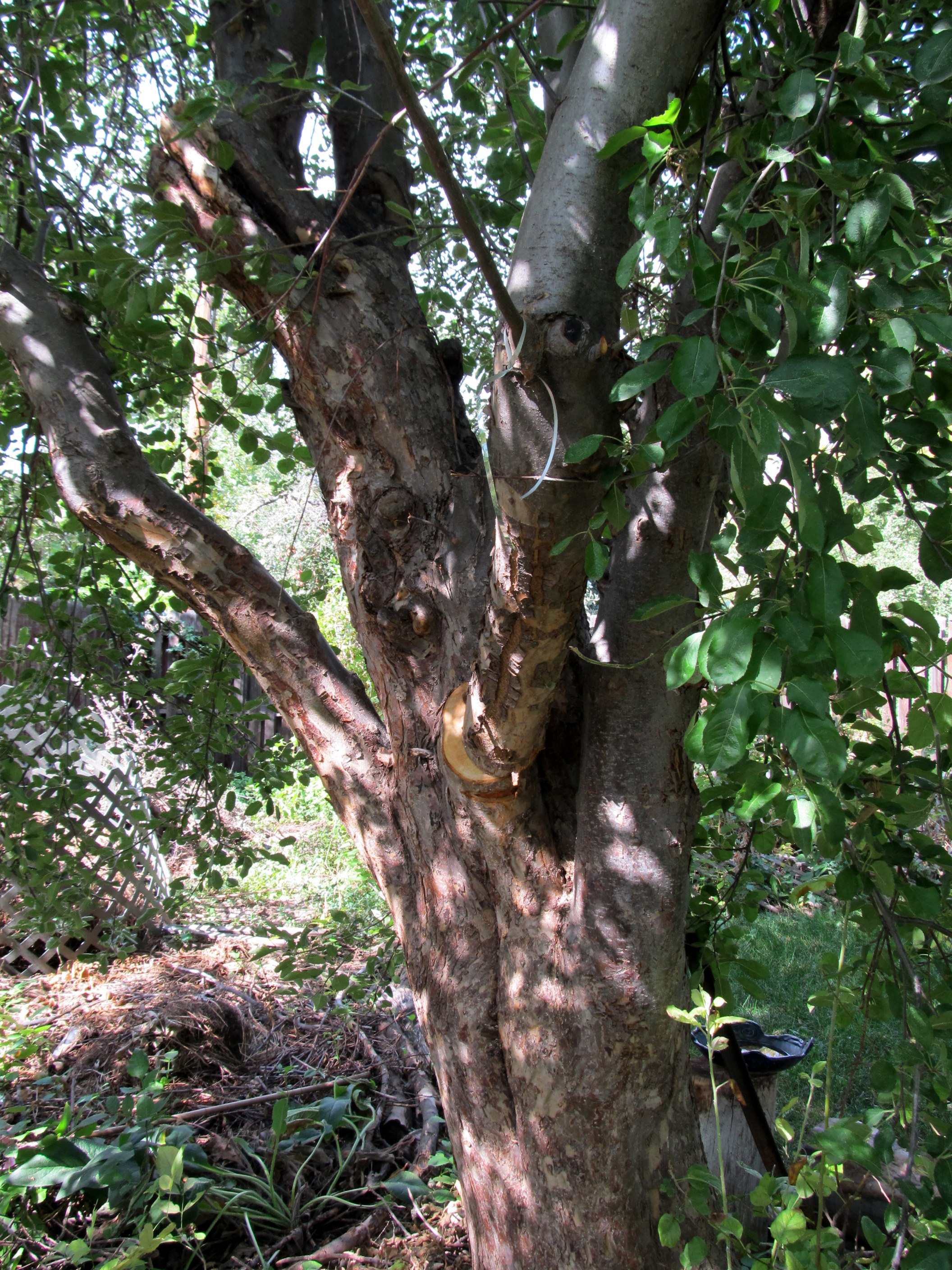
We have a giant apple tree that has been butchered in the past, then ignored, the butchered again, by the city tree trimming crew. It is probably about 50 years old, and most of the apples are developing way up high, because the major branches go up high, then bend over…after researching a lot, hemming and hawing and reading, online and in books, I have decided to renovate it. Slowly, over a few years, I’ll take off major limbs and train young branches to be the new major limbs, at a more convenient height. Convenient for me, not the squirrels.

Let me tell you about apical dominance… there is a chemical in plants that causes the  buds on the end of every branch to be dominant- it turns off the other buds back down the line. This chemical, auxin, is affected by gravity. If the end bud on a branch droops down, there aren’t many buds that will be activated. There will be buds on the tree up high, before the branch starts to droop. So we have very few apples down where we can reach them, and a bunch up high, which then fall down to be half-eaten by squirrels.


Another thing about apical dominance is that when the end bud is cut off,  other bud back down the line are activated. This is good when your pinch back flower chrysanthemums to make the plant bushier, so you get more flowers in fall, but not so good when the city crew whacks back your apple tree on a semiannual basis.

Since it is a standard tree, not a dwarf, it is really big. Branches are growing up into the power lines, and the city crews want to prevent that, but they don’t care much about the tree other than that. Every time the city comes to prune, they take out the center aggressively, which causes it to grow back aggressively. It’s pretty bad. There are seven major limbs, up to about 6 inches in diameter at the trunk, and they have kind of an umbrella effect, going up, then curving way down.
I have thought about it a lot, planning, and checking, and finally decided to take off one of the seven major limbs. Next year, I will take out another, never removing more than 25% of the leaf area at a time. Hopefully this will prevent major regrowth of water sprouts. I wanted to clean up the south side of the tree, since that is where I have recently sited a veggie bed and I wanted it to have more direct sun.

So, I chose my first limb, sawed it, then spent some quality time wondering how to get it down without seriously hurting myself. Seriously. It was tangled in so many other branches that even when it was cut all the way through, it just sat there.  I moved the ladder and made some more judicious cuts, then spent a pleasant afternoon cutting it into reasonable lengths for our chimenea.  Next year, I’ll select another limb from the North side of the tree, and work on that one.

The most helpful book for me in this project, which has mostly been a project about thinking, is Cass Turnbull’s Guide to Pruning. Tons of illustrations, tons of examples, written by a woman on a mission.

antique or vintage?


When I went to my hometown for the weekend, my mom offered me a quilt made by her grandmother Neal.

She cautioned me, “Now, back in those days, they just made things from scraps, it isn’t all fabrics that are matchy-matchy.” She said she had 2, and my sister had looked at them and told her to give me first choice.

Pretty nice for just being made from scraps.

I don’t have very many stories about my great- grandmother Neal- she lived on a farm in  Kentucky and my mom would visit them for holidays and in the summer. She would always buy store-bought bread, so the children could eat sandwiches, but my grandmother was embarrassed by how many homemade biscuits my mom and uncles would eat. I imagine them at dinner,  reaching for another biscuit, and my grandmother giving them that look that says, “I can’t believe you are reaching for another biscuit.” But then they eat it anyway.

.
So, at home in the more recent past,  mom climbed up on the step stool, and pulled out a zippered blanket bag. Wrong one- that one was little- a crib quilt made for my oldest brother by my paternal grandmother- amazing patchwork, and tiny hand quilting. My mom told me that she had made that one, then one for my second oldest brother, then was declared legally blind. No more quilting.
The next bag that came out of the linen closet was the right one- it had two quilts made by my mom’s dad’s mom, Hattie Hill Hutchcraft Neal.

My mom speculates that she was named after her aunt, who was Harriet Hutchcraft, and married a man whose last name was Hill, so she was Harriet Hutchcraft Hill, and the baby who became my great-grandmother was Hattie Hill Hutchcraft. You hear people talking about how much they like old-fashioned baby names, but you don’t meet very many Hattie Hills these days. Wonder why
The firstquilt to come out of the bag was a flower garden, hexagons in pastels and medium colors on a white field, with a scalloped border. The scalloped border was what sold me, Kate liked the hexagons. We laid it out on the recliner, and I looked closely at the tiny hand quilting. I’ve done some quilting and oh, my gosh, this woman knew what she was doing. If I were at all competitive I would quit, because, you know, I would be competing with someone born shortly after the time of the civil war.
The other quilt, that I left for my sister, had stars on a white background, also very fine quilting, just as good, really. (I feel a little guilty- did I pick the better one? Is it fair?)

So, now, what do I do with this beautiful old textile? Zip it into a blanket bag in

I can scraches ur quiltz?

linen closet? Hang it up somewhere? Use it on a bed for the cat to tear up? I love that it is an antique (actually, what are the rules on linens? is it vintage? antique? where do you draw the line?) and I would like it to survive to become even antiquer (I know, not a word…) I have passed by two separate quilt racks at a thrift store- clutter-y and not really my style. But it is a shame not to have it where I can enjoy it. What are your thoughts?

These Seven Pieces? Really?


At the bookstore the other day I flipped through Good Bones, a book about the seven essential pieces of furniture that you should buy and keep for a lifetime.

I was pleased to see a demilune table- I have one in teak, that I paid too much for, probably, but that I really love.

But the rest of the stuff threw me off. A dresser, obviously.

Wait…You have to write a book to tell people to buy a chest of drawers?

Slipper chairs…really?

A loveseat? ummm…I want a big couch that several people can flop on, especially as two of my favorite people to flop with get bigger and taller.

Bookshelves, a necesity for me, don’t get a mention in the book. Entertainment center… likewise not in the book. Coffee table? No. Rocker/recliner? Not in there.

So, what are your 7 essential pieces of furniture- if you were starting over, what would be the 7 first things you would get?

Dead Junipers- what next?


The new edge of the bed in the front yard- we’ll be adding some compost and lots of mulch.

Most people who know me would agree, that I don’t seem like the kind of person who would pound stakes into the ground, stretch out string between them, and then follow that string as a guide when making the edge of a  garden bed. I was a s surprised as anyone when I found myself doing just that this afternoon.

Yesterday evening, I was cleaning up the edge of the area where we took out the junipers (link) and I used the garden hose to kind of make a gently curving, voluptuous edge, nipping it in close to the faucet, easing it out near the corner of the house.

Then I thought about mowing that line. I thought about all the other curvy, sensual edges in the yard that have to be mowed, then edged. I decided it would be easier to make a straight edge, and let the plants be curvy.

The bed is about 20 feet long, and the outer line is 8 feet out from the house wall.  (when I said I was going to make the bed about 8 feet deep, DH had a moment where he thought I meant 8 feet from current ground level to top of bed.  No.) I bought 40 brick pavers, because I didn’t want to get out the measuring tape and then do math, so of course I have to pay for my laziness with another trip to the big box store.


So, the plan:

buy more bricks

when there’s grass inside the line, pop it out and transplant it outside the line, when possible

pile on 2-4 inches of shredded wood mulch

when the weather cools, start transplanting the plants I want to move from the backyard

order bulbs

snake soaker hose around the bed

Plant list

Hazel bush (transplanted from nursery bed)

Sedum Autumn Joy (thanks, Sharon!)

Purple coneflower (divided from back yard)

Bearded Iris (divided from back yard)

Yarrow (divided from back yard)

Lamb’s Ear (divided from back yard)

Thyme (divided from back yard)

Comfrey (divided from back yard)

larkspur (seeds)

columbine (seeds)

lily (ordering- probably dark reds and oranges)

tulips (ordering, probably red and yellow triumph)

daffodil (basic yellow)

Most of these plants I already have, so this is a very cheap design for me. I also know they do well here, so I am not taking much risk that everything will keel over and die. The exposure is a little different- the north end of the bed is pretty shaded from the ash tree and the house, and the south end gets morning sun. The coneflower and lilies will go that direction, because they need the light to flower.  My “largish” plant is a hazel nut bush, and I want it to form one corner of a triangle with the ash and the Korean dwarf lilac under my window.

The plan for the tuteur- the exact measurements will depend on the wood I find.

I am also planning some structure- as you can see in the picture, there is a big expanse of plain wall, so I will put in at least one trellis, and some containers,  and am thinking about building some tutuers, which are french teepees- using lumber,rather than round wood or sticks. And, you know my policy, it should be done with the wood that is already piled up, going to the lumberyard is cheating! There are still some 1×2’s sitting behind the garage left over from taking down the playhouse, so I will start with those.

Resilience- you can grow that!


Purple Coneflower and Yarrow, extremely drought tolerant herbs. They’re loving the heat.

It has been hot here. Crazy hot. Typically, in June we get nice moisture, soaking rains, heavy thunderstorms, nice misty days when it’s just cool and gloomy. Not this year. I realize it is hot pretty much everywhere right now.
We went LA on vacation last week, and it was cool and pleasant- too cool for the ocean almost. Then we ended the vacation in Las Vegas, and it was ridiculously hot. You expect that for Las Vegas, but we kept watching the weather for home, here on the front Range of Colorado, and it was ridiculously hot in Colorado, too.
The guy who mows our lawn was checking in on the cat, and a friend popped over to water the container plants and the tomatoes, but otherwise, we didn’t provide for sprinkling. I expected the worst when we got home, but I was pleasantly surprised.

The grass in the front looks awful, of course, but it almost always looks awful. It’s on the list for future projects.

The beds in back, though, look pretty good. They have plenty of mulch, to hold onto what moisture they get. They have plants that are drought tolerant, or native, or both. I designed them that way so they wouldn’t take much water, and would attract bees and birds and butterflies.

The golden currant is dripping with fruit, the lavender is blooming like crazy, the yarrow and coneflower and chamomile are standing tall.  They look better than I do, dripping and drooping, and praying for rain.

Plan for resilience- xeric doesn’t have to mean rocks and cow skulls, it can be dragonflies and birds and fruits and berries. It takes less water and other resources, and it bounces back from hard times. Resilience is a trait we all can use.

This is pretty much the same shot, from the same angle, as I took 3 weeks ago. It’s been watered once with a soaker hose.

Two books that influenced me tremendously are “Herbs in the Garden” by Rob Proctor, and “Gaia’s Garden” by Toby Hemenway.  Both books helped me learn to think beyond “vegetable garden here, lawn everywhere else.”

Previous Older Entries Next Newer Entries