Chipotle Buttermilk Grilled Chicken


I’ve been sold on marinating chicken in buttermilk for a while- for fried chicken, it makes the meat tender, and the crust, which for me is the whole point, crispy. For a long time I used smoky paprika as the spice, with garlic powder and whatever other random spices. Then I saw a jar of leftover chipotle chilies in the fridge, and wondered what would happen if I used them. Miracles, that’s what.
Well, maybe not miracles.
I had opened the can for soup or something- pulling out one of the chilies to puree with tomatoes from my garden. You don’t have to use the entire can at once- the rest can go into a jar in the fridge. Not forever, obviously, but it can be stored.

Chipotles are jalapeno peppers that have been ripened, then smoked. They can be purchased dried, in bags, or canned with adobo sauce. They are hot and smoky and rich tasting. For me, jalapenos are just heat, with no depth. Chipotles have depth. Also, the tang of the buttermilk calms down the heat- you can adjust the proportion of chilies to buttermilk until you get a level you like. That is what I’ve been doing since March.

As this recipe has evolved, I take “a few” chilies, with sauce, and mix them with “some” buttermilk and “some” salt.  It depends on how much chicken you are doing. In these pictures, it was 3 chilies, 1 cup of buttermilk and a pinch of kosher salt. This was more than enough for a whole young chicken that I cut up to grill. In these photos, I put the mixture underneath the skin, which made the skin extra crispy, and the meat very moist- even the breast meat.I have also used this with “convenience” frozen skinless chicken breasts, and it is good with that, too.


Chipotle Buttermilk Chicken

Chicken parts and pieces- I used a whole chicken that I cut up

2 or 3 chilies in adobo

1 cup buttermilk

generous pinch salt


Puree the chilies and salt, add buttermilk and blend well

 

I used my stick blender to puree everything.
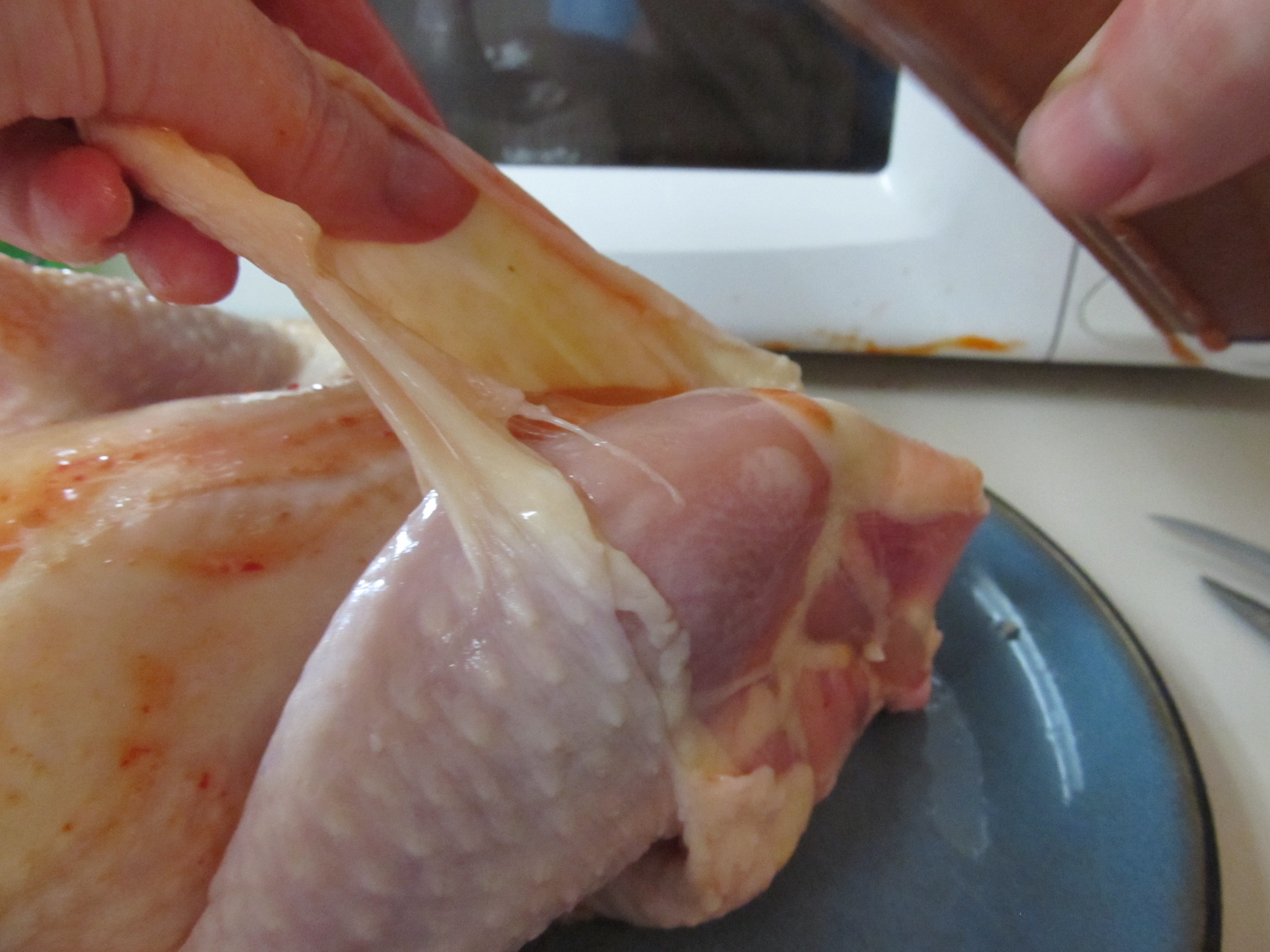
Thanks to the Boy for taking this picture.


Pull the skin away from the meat, and pour the marinade between the skin and meat. Yes, this is gross, but it tenderized the meat and crisps up the skin. It is easiest on breasts and leg quarters. With the wings, I just tossed them in the buttermilk mixture.

Marinade for an hour or so.

Set up a gas grill or charcoal grill for indirect heat- that is, outer burners on, inner burners off, put the chicken in the center, lid down. Or, on a charcoal grill, pile your charcoal on one side, put the meat on the other side.

Place chicken skin side down and cook for around 15 minutes, then flip and cook until a thermometer reads 165.

Yummy. Smoky and crispy, and hot, without being painfully hot.


Dead Junipers- what next?


The new edge of the bed in the front yard- we’ll be adding some compost and lots of mulch.

Most people who know me would agree, that I don’t seem like the kind of person who would pound stakes into the ground, stretch out string between them, and then follow that string as a guide when making the edge of a  garden bed. I was a s surprised as anyone when I found myself doing just that this afternoon.

Yesterday evening, I was cleaning up the edge of the area where we took out the junipers (link) and I used the garden hose to kind of make a gently curving, voluptuous edge, nipping it in close to the faucet, easing it out near the corner of the house.

Then I thought about mowing that line. I thought about all the other curvy, sensual edges in the yard that have to be mowed, then edged. I decided it would be easier to make a straight edge, and let the plants be curvy.

The bed is about 20 feet long, and the outer line is 8 feet out from the house wall.  (when I said I was going to make the bed about 8 feet deep, DH had a moment where he thought I meant 8 feet from current ground level to top of bed.  No.) I bought 40 brick pavers, because I didn’t want to get out the measuring tape and then do math, so of course I have to pay for my laziness with another trip to the big box store.


So, the plan:

buy more bricks

when there’s grass inside the line, pop it out and transplant it outside the line, when possible

pile on 2-4 inches of shredded wood mulch

when the weather cools, start transplanting the plants I want to move from the backyard

order bulbs

snake soaker hose around the bed

Plant list

Hazel bush (transplanted from nursery bed)

Sedum Autumn Joy (thanks, Sharon!)

Purple coneflower (divided from back yard)

Bearded Iris (divided from back yard)

Yarrow (divided from back yard)

Lamb’s Ear (divided from back yard)

Thyme (divided from back yard)

Comfrey (divided from back yard)

larkspur (seeds)

columbine (seeds)

lily (ordering- probably dark reds and oranges)

tulips (ordering, probably red and yellow triumph)

daffodil (basic yellow)

Most of these plants I already have, so this is a very cheap design for me. I also know they do well here, so I am not taking much risk that everything will keel over and die. The exposure is a little different- the north end of the bed is pretty shaded from the ash tree and the house, and the south end gets morning sun. The coneflower and lilies will go that direction, because they need the light to flower.  My “largish” plant is a hazel nut bush, and I want it to form one corner of a triangle with the ash and the Korean dwarf lilac under my window.

The plan for the tuteur- the exact measurements will depend on the wood I find.

I am also planning some structure- as you can see in the picture, there is a big expanse of plain wall, so I will put in at least one trellis, and some containers,  and am thinking about building some tutuers, which are french teepees- using lumber,rather than round wood or sticks. And, you know my policy, it should be done with the wood that is already piled up, going to the lumberyard is cheating! There are still some 1×2’s sitting behind the garage left over from taking down the playhouse, so I will start with those.

Resilience- you can grow that!


Purple Coneflower and Yarrow, extremely drought tolerant herbs. They’re loving the heat.

It has been hot here. Crazy hot. Typically, in June we get nice moisture, soaking rains, heavy thunderstorms, nice misty days when it’s just cool and gloomy. Not this year. I realize it is hot pretty much everywhere right now.
We went LA on vacation last week, and it was cool and pleasant- too cool for the ocean almost. Then we ended the vacation in Las Vegas, and it was ridiculously hot. You expect that for Las Vegas, but we kept watching the weather for home, here on the front Range of Colorado, and it was ridiculously hot in Colorado, too.
The guy who mows our lawn was checking in on the cat, and a friend popped over to water the container plants and the tomatoes, but otherwise, we didn’t provide for sprinkling. I expected the worst when we got home, but I was pleasantly surprised.

The grass in the front looks awful, of course, but it almost always looks awful. It’s on the list for future projects.

The beds in back, though, look pretty good. They have plenty of mulch, to hold onto what moisture they get. They have plants that are drought tolerant, or native, or both. I designed them that way so they wouldn’t take much water, and would attract bees and birds and butterflies.

The golden currant is dripping with fruit, the lavender is blooming like crazy, the yarrow and coneflower and chamomile are standing tall.  They look better than I do, dripping and drooping, and praying for rain.

Plan for resilience- xeric doesn’t have to mean rocks and cow skulls, it can be dragonflies and birds and fruits and berries. It takes less water and other resources, and it bounces back from hard times. Resilience is a trait we all can use.

This is pretty much the same shot, from the same angle, as I took 3 weeks ago. It’s been watered once with a soaker hose.

Two books that influenced me tremendously are “Herbs in the Garden” by Rob Proctor, and “Gaia’s Garden” by Toby Hemenway.  Both books helped me learn to think beyond “vegetable garden here, lawn everywhere else.”

Toad in the grass


Eggs and bacon, on top of spinach and greens. Squeeze of lemon, pop the yolks, mmmmmm

My college roommate introduced me to a dish called Toad in the Hole- a fried egg in a hole torn in a slice of bread. I don’t know how I grew to adulthood without knowing about this concept- combining eggs and toast in a happy little unit.

It has taken me another 20 years to find out about cooking an egg on a bed of sauteed greens- the same homeliness of the egg, with the virtuous feeling of eating a pile of spinach. I have been calling it Toad in the Grass, which I realize is a horrible name, but I have seen it elsewhere as “baked eggs” which seems like an even more horrible name.

This batch is made with spinach and beet greens from my garden (the beets were supposed to be micro greens, but I kind of forgot, and now they’re macro).

Saute the greens in olive oil and the water left on the leaves from washing them.

This is about two cups of mixed spinach and beet.

When the greens have reduced by about half, crack an egg or two on top. Cover and let cook until the eggs are mostly done. Then turn on the broiler and cook the gooey stuff on top. I added parmesan cheese this time, but I don’t always.

T

The eggs look kind of like eyes, maybe call it green monster? Another horrible name.

I also had 2 slices of pre-cooked bacon (you should cook bacon in the oven- it works really well) that I threw on top. Sooooo yummy.

Fracking junipers*


I asked the tree trimmers who had worked for us before to come do an estimate of pruning the big old tree in back, the big old (slightly younger) tree in front, and ripping out the juniper bushes entirely. As I remember, when they came out last time, they pruned both ashes and the old apple, and removed an upright juniper, and the whole thing cost about $55o.

Umm… this estimate is higher. By a lot
$1600 for the ash in back, $600 for the ash in front. $450 to take out the junipers.
Seriously. $450 for the junipers?
I plan to get another estimate for the big trees, because this seems high. They did come highly recommended, and I was happy with the work they did before, and I am not going to climb up in my 50 year old ash tree and chop things up. But still. Cadillac prices.
I came to a conclusion in the shower, where I do my best thinking, and decided that for 450 I can rip out my own junipers.

Day 1  I started Saturday, tentatively at first, sitting in front with loppers, looking for the trunk, hoping I could just get in there and saw it down. Then I stood up and went around behind the northern-most bush, and saw that where the kids had tried to chop out a playhouse, it was pretty easy to access bigger branches. Lop lop lop, throw into a pile. After a while, I broke out the pruning saw, to get the branches that were too big to get with the lopper.
I discovered 3 wasp nests, unoccupied, and a bird nest, also unoccupied.

Little bird nest.

On the first afternoon, I got most of two shrubs cut up, waiting for the main trunk to be cut as close to the ground as possible. The temperature was about 75 degrees, not too bad for working outside, but my arms got scratched up, and I got dust and stuff in my eyes, even with safety glasses, and there were little pieces of prickly stuff everywhere. I kept thinking, “$450… $450”

DH suggested buying a chain saw when I was halfway into it. I may have growled at him.

.

Day 2 had record breaking temperatures. High temperatures, in case you are wondering. I loaded the pick-up, then discovered the waste yard was closed on Mondays. D’oh. Then I crawled into the house, and waited for it to cool off, investing the time in looking at wholesale bulb catalogs and drawing plans for the new bed. I also took a nap.

Day 3, the weather was cooler, but not by much. I drove the pick-up to the city waste yard, dumped the trimmings, then reloaded twice. The third time I stopped for iced coffee and a brownie, then stocked up on epsom salts.

Day 4: We sawed up the last of the shrubs, loaded up the truck, this time with help from DH, who didn’t have to go into work until late.

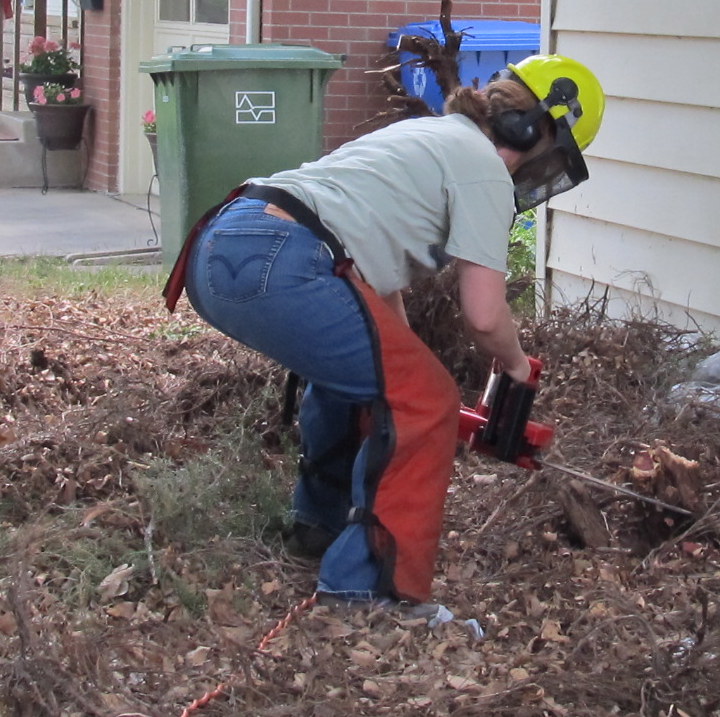
We also rented a small electric chainsaw. The stumps are just too big for the pruning saw. It cost about $40, and made the stumps go much more quickly.

Thank you Kate, for taking pictures…maybe we’ll have a conversation sometime about flattering angles.

I’m glad we rented, because safety equipment came with it. If we had bought a saw, I know we would have half-assed the safety part. Sure, I would have worn safety goggles, but the kit from the rental place had chaps, and goggles, and a hard hat with hearing protection.

I’m coming after you, stumpy!

At the end of day 4, the only thing left is clean up- the remaining stumps and branches, and sweeping.  The next time I get mulch, a thick layer will go onto this area, and when the weather cools in fall, I’ll transplant things into it.

My thought throughout this project was “We’re saving $450” every time I cussed, and complained, and found little tiny prickly juniper needles in my bra (in my bra!) I would think about the money I was saving. What is a project you could have hired out, but didn’t, or you did it yourself, but would never do it again? What would you do with $450?

*my original working title for this post was a different F word, which expressed how I was feeling toward the bushes. The boy saw it when I was working on it, and attempted to cover my eyes, to protect me. He thought someone bad on the internet had written that word, and he wanted to protect me, bless his heart.

A little birdhouse for your soul


Last year, I wrote about my half-assed attempt to mount birdhouses in my garden, on posts from the thrift store, with rebar and duct tape.
Today, I have a more fully-assed attempt, where I actually used wood and a drill, and screws to build a kind of trellis structure. No duct tape at all.

I have drilled 1/2 inch holes in the bottoms of the posts, and driven 1 foot rebar stakes into the ground, at the right distance apart from the holes. Trust me, I measured! I stepped on some plants in the meantime, but I did measure.

I laid out the pieces on the ground before screwing them together- here you can see where the hole is drilled for the rebar. Having a 2×4 on both sides of the base makes the whole structure sturdier.

I had some wood left from taking apart the playhouse (no worries- there will be a new and better shed playhouse in the future) so I used it to brace the posts. Screwing it onto both sides makes the structure stable by triangulating it. I let the length of the wood determine the size of the structure- the posts are roughly 42 inches tall, the leftover wood was roughly 50 inches long, I used three of the posts for the structure. The fourth might become  a bottle tree. Too tacky?
I painted the top cross bar and the posts bright blue, but not the base- the weathered gray wood will become kind of invisible against the ground.

I used “Surebonder Clear 9001” glue to attach the birdhouses, which we painted 5 years ago? A really long time ago, and they have been sitting around. I realize the glue won’t be permanent, but I am not too worried about it.

Larkspur, yarrow and chamomile blooming, silver buffalo berry bush and lilac in background.

I decided this space needed a structure because it is so green- shrubs, self seeded annuals, weeds, perennials. I like having a frame to make it more formal, but not in a “pinkie-up while you drink your tea” kind of way. Formal like having a frame around a picture- any structure works for this, a flowerpot, a trellis, a headboard.

There has been a forest fire to the northwest of here- we are not at any risk, other than from the smoke. The smoke has made it really unpleasant to get out and garden. It is better today, so I hope to get some stuff done.

Funky or Fugly?


See, the pink fading into brown, and then the baby poop green? I just don’t know.

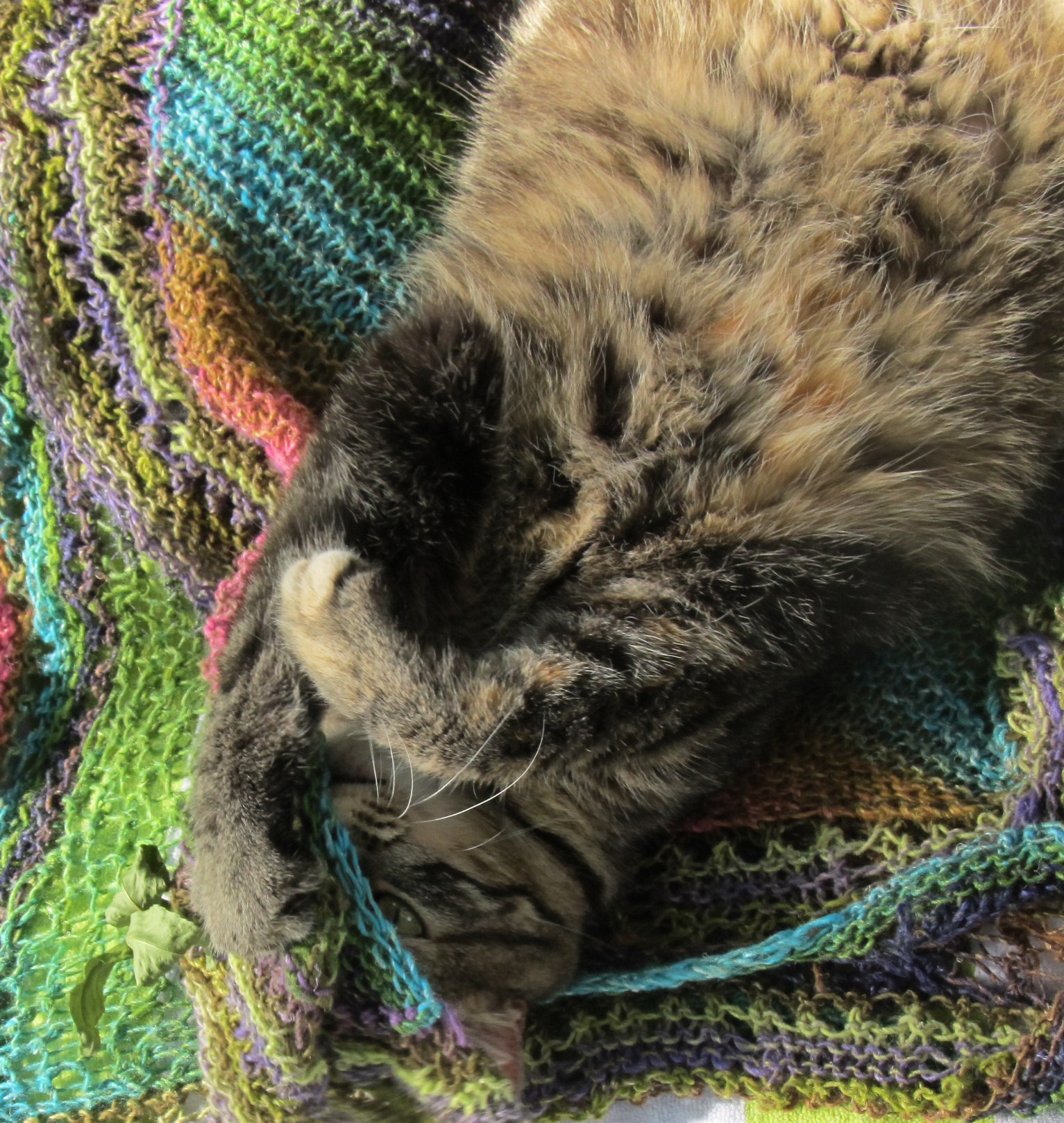
I’m making a baby blanket out of Noro Silk Garden sock yarn. I love this yarn– it is from Japan, and has lovely color gradations- I made a cowl and leg warmers from a colorway with copper and greens and blues. I am working on a scarf in a colorway with deep purples and teals.

This baby blanket makes me wonder…on the one hand, it has bright pink and turquise…fading into brown. Then on the other hand it has purple and indigo and green…and green…and another green…a green that can really only be described as “macrame green.” Or avocado green- some kind of green from the 70’s.

I’ve been working on it a while, and I go back and forth between thinking it’s super cute…and thinking it is ghastly.

There is a kindergartner whose brother takes a Tae Kwan Do class while my kids do, and Erin, the kindergartener, keeps track of my progress. She is very interested in the baby, and the process of the blanket. She has serious doubts about the color combo, though.  She’s polite, and she’ll say she likes the pink, but then she gets a crinkle in her forehead. I get a crinkle in my forehead, too.

The pattern is from Knitting Wrapsody and it has an interesting construction- it starts with a square, which is divided into quarters, then triangles are picked up along each edge, then more triangles are picked up along those edges, then a rectangular border. Because of the way the colors fade into each other, sometimes the stripes on the picked up edges… clash. I don’t know. every time I look at it, I change opinions. So, look at the pictures- funky or fugly?

Alice really likes it- you’d think I made it out of catnip.

Strawberries- you can grow that


One of my peak experiences in gardening was not in my own garden, and in fact, I didn’t do any of the cultivation. Friends of mine in college lived in a house with a strawberry bed, next to a flagstone path. One beautiful June, I would go to their house, sit in the sun on those red sandstone pavers, and eat perfect, ripe strawberries.

Of course, I had to have strawberries and a flagstone path at our house, when we finally bought one.

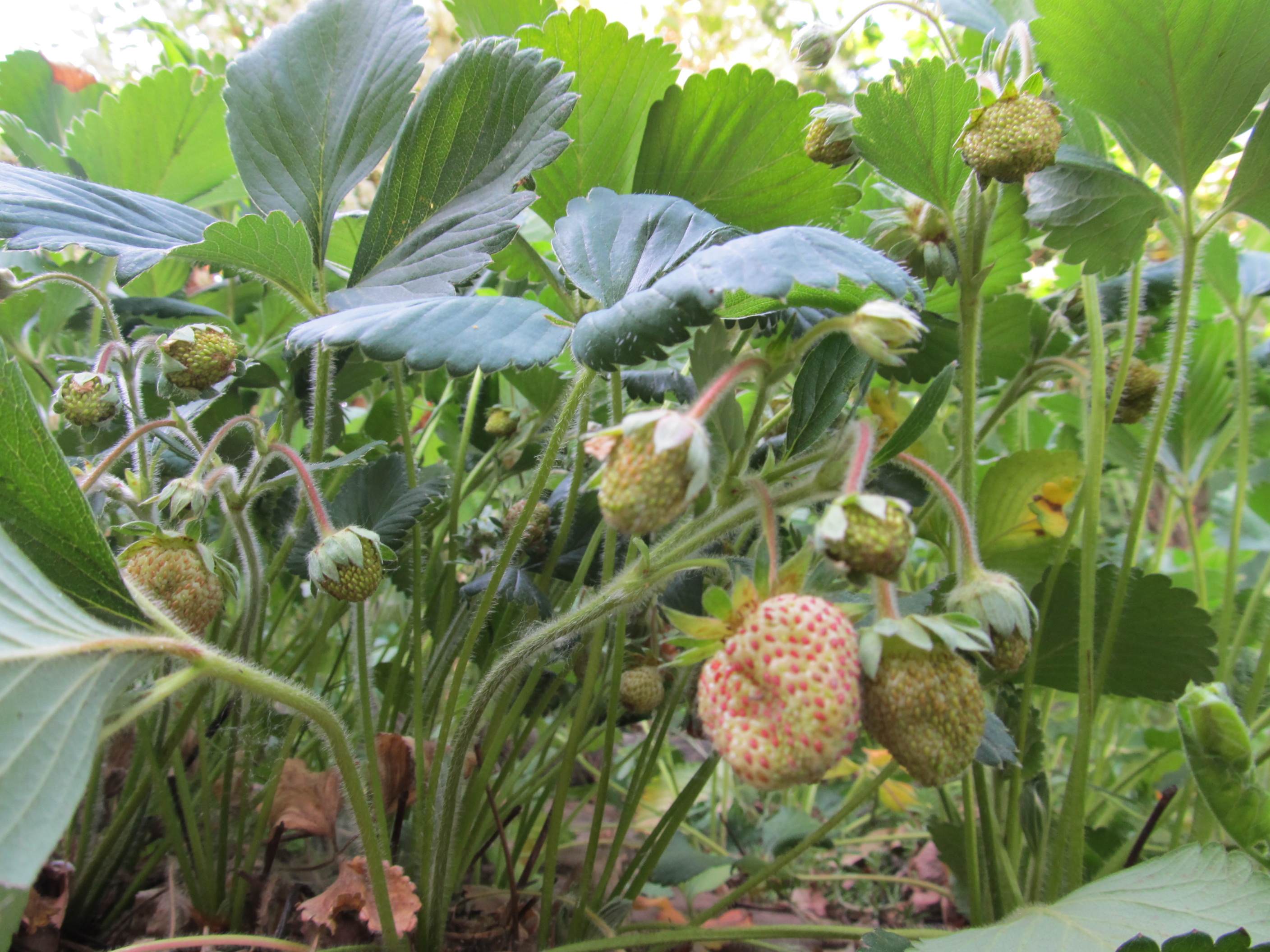
just a few more days…just a few more days…

I actually have planted strawberries in many locations- before I got married, and moved every year or so, after I got married, and …moved every year or so. It may seem ridiculous- planting a fruit that takes several years before it produces in house and apartments that I knew I would be moving out of. Maybe it is ridiculous, but it seemed like a good investment in karma.

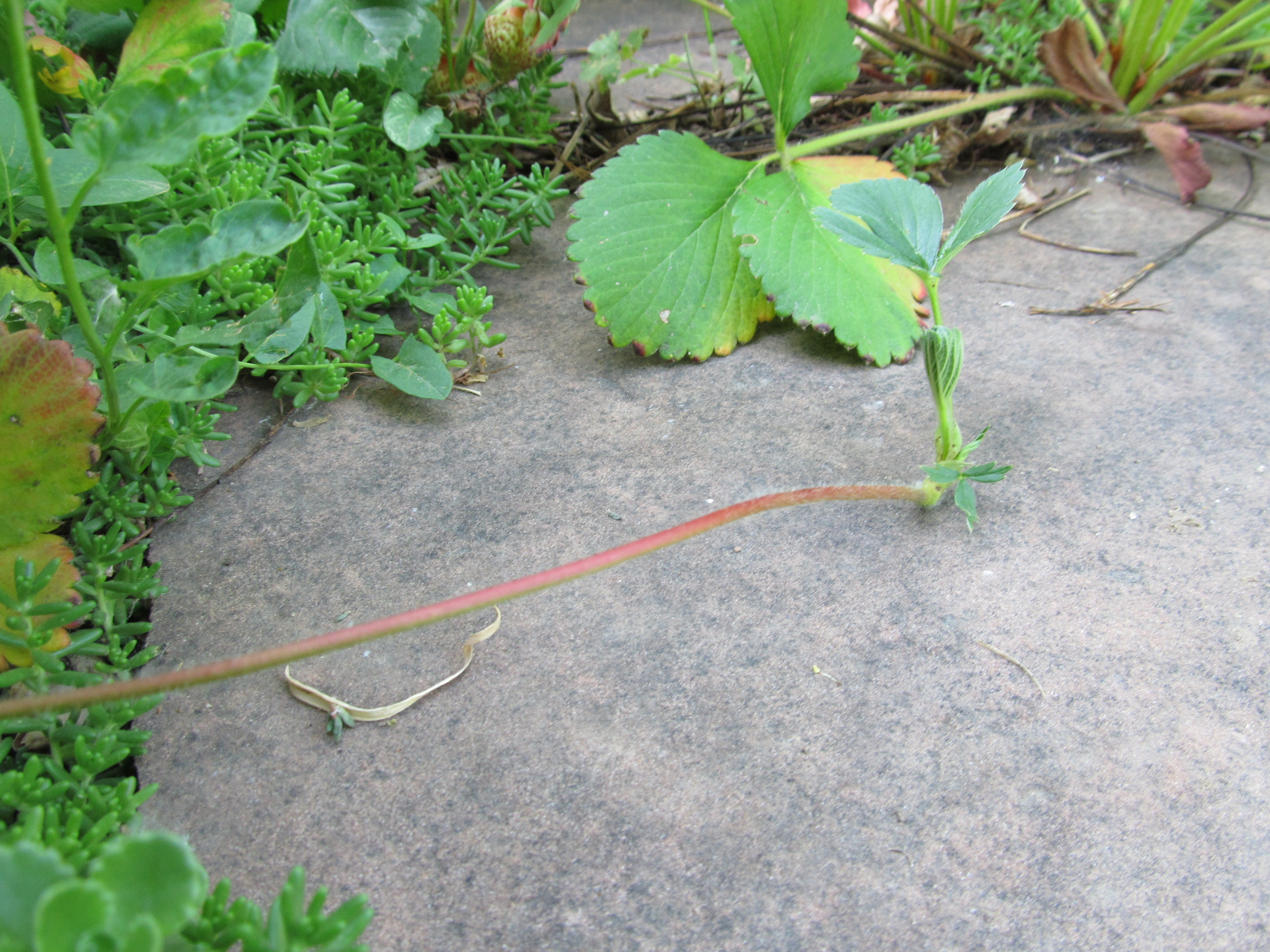
Strawberries do produce sparingly the first year, but after that, they spread and produce more. They reproduce by sending out stolons, or runners, with baby plants on the end.  I let the “daughter plants” take root and grow, so I always have some plants that are 3 or 4 years old, and about to peter out, some 2 year old plants that produce well, and some baby plants that are getting established. Most gardening books recommend cutting off the stolons the first year so you get more fruit.

New vocabulary word for the day- stolon.

A few years ago, I was at my sister-in-law’s house, and she was transplanting strawberry plants out from under a huge pine tree. Apparently, the birds that stole her berries perched on the tree, and ummm…seeds grew…in perfect packets of fertilizer. Yeah, you know what I mean, bird poo. They didn’t get enough sun under the tree to produce very well, but it made a perfect nursery for baby plants.

Strawberries are heavy feeders, so I give them compost, and mulch them pretty heavily, except where they have grown into the gaps in the path, where I can’t get mulch to go.

I plan to transplant these guys out of the gaps in the path, and may try them in containers.

Here in zone 5, the front range of Colorado, they ripen in early to mid June, this is later than you can get them in the grocery store, but oh so much tastier. And organic. And with a very small carbon footprint. Here’s where I get preachy and link you to a story about strawberries from California.

If you order plants in winter, you can get a bundle of 25 for around 25 dollars. They go a foot apart, so that is a lot of space to devote to  strawberries, but you can tuck them around other things- for example, there is a giant rosebush in the same bed with my strawberries, as well as iris and a mock orange. They are also available this time of year in nurseries. In fact, at the grocery this weekend, they had hanging baskets of them in the doorway.

I have had slug issues in the past, but this year has been so dry, I don’t expect them. I’ll put out saucers of cheap beer just in case.

I figured out why bike panniers are so expensive


We have a reservoir with a community beach very close to our house- totally within biking distance. (I know, everything’s in biking distance if you have enough time) but this one really is- literally a ten minute bike ride.
We always drive though, because of the baggage factor- towels and lunch and sunscreen and sand buckets. (actually, the kids usually bully other kids into letting them use their buckets. Ugly, but it works)
We are also within a mile of a grocery, a small hardware store, a coffee place and a thrift store. And a farmer’s market.  I shouldn’t be driving to those places either. But again, the baggage problem.
Backpacks are okay, but they make me hot and sweaty, and commercial panniers cost more than I want to spend, so I decided to make some.

What separates panniers from just a regular tote bag is that panniers are bags that have a rigid, or semi-rigid side, that hook onto the rack on back of my bike. The interwebs have lots of tutorials on how to make your own, using army surplus bags or cat litter buckets.  Not exactly the look I’m going for, though.
I got a yard of natural denim, and 1/2 yard of super cute oilcloth. Actually the oilcloth came first, I got it on impulse because it was so super cute, then thought of it for the pannier project. The oil cloth will make the bags splash proof, but not really rainproof. It doesn’t rain here much anyway, and honestly, when it’s raining, I’m in the car. Wimpy, I know.

Look how cute it is!

I spent about $15 on fabric, and another 5 on hardware. The bags will wind up being fraternal twins, rather than identical, because as I made the first one, I figured out an easier way of constructing the second. It also winds up being smaller, though.

I thought of ways to make these with pre-made canvas tote bags- it would probably be cheaper as well as taking less time. I had plenty of time to think about this as I changed the burnt out light bulb on my sewing machine. (is that the difference between really expensive machines and cheapo ones like I have? On a $1300 sewing machine, do you just flip open the side and pop out the light bulb? On mine, I have to unscrew a thing on the back, pull the plastic panel off the front, get my fingers in there and unscrew the light bulb, and there is a plastic flap right at cuticle level that scratches every time the bulb goes around. It’s awful!

This is a very basic bag with a flap, and parachute clips to close it. The key to making the bag work as a pannier is to add another layer of fabric so there is a pocket for a rigid piece of plastic or thin wood to screw the hooks onto. In my case, I sewed the bags from scratch and added the layer of oilcloth as the extra layer, but it probably could be done with tote bags you have sitting around the house.

I found thesereally good instructions for doing the hardware.

Mirror clip, machine screw, split washer, nut and acorn nut.

I used a piece of 1/8th inch thick hard board that I had in the garage from another project (as always) that I cut to 12″ by 12″ and slid into the pocket. Then I attached mirror clips, from the hardware store with machine screws and nuts and stuff. I actually wrote down what I needed, as found on the link above, on a post-it and biked to the hardware store. Then I found a guy in an apron and thrust the post-it at him. “I’m making bike bags” I grunted. He found all the bits and pieces for me.

Bag number 1 fits great- now to finally change that bobbin and finish bag number 2- then it’s off to the farmers’ market.

Tree Killer


There are 2 types of people, tree planters, and tree murderers. No. Not really. Sometimes people who plant trees also kill them. Me, for example.
I have killed trees through benign neglect, bad cultural practices, and laisse faire policies. And occasionally, I have hired hit men to practice premeditated tree murder. (We’ve been watching a lot of Monk lately- I think it’s rubbing off.)

It’s like Justin Beiber’s bangs, in shrub form…

We have juniper bushes that were probably planted when the house was built, almost 50 years ago.They are hideous and over-mature- we have trimmed them in past years, but not the past couple of years. They half block the windows, making the front bedroom cavelike all year round. They have to go.
What has been holding me back?

  • Possible insulation value
  • Prickliness
  • Snake habitat

Does anyone know how to figure out the R value of 50 year-old juniper bushes? Me neither. Actually, there are places on the web where you can figure it out, but as far as I have been able to determine, the most value comes from bushes stopping the wind in winter. These uglies are on the east side of the house, and winter wind hits us from the north. I am not convinced they make much difference in gas bills in the winter. They do make a comfort difference in summer, I suspect, since, as I said, they make the front bedroom cave-like.
Prickliness- I don’t want to take these out myself. They poke, and make my skin rashy, and whaa whaa whaa. Plus they smell like cat pee. That is why I am hiring hit men to do the job- tree guys to get the junipers as well as clean out some dead wood on the ash trees. Since it is family policy to spend as little money as possible on anything, it has taken me a while to come around to this decision (and I am not bad mouthing DH here- the crazy penny-pinching mostly comes from me…unless we’re talking about lattes…)
Snake habitat- animal habitat in general, actually. Dense, prickly bushes make great protective homes for wildlife, not just the cute cuddly birds and butterflies that people want to attract, but also the garter snakes and rodents who are part of the environment but who don’t get the kind of  press that butterflies do. By taking out shrubs that are close to 7 feet tall and 4 feet wide, I am affecting beings other than myself.
Sigh.
I’m doing it anyway. I’ll let you know how it goes.

Previous Older Entries Next Newer Entries