Radical Apple Pruning


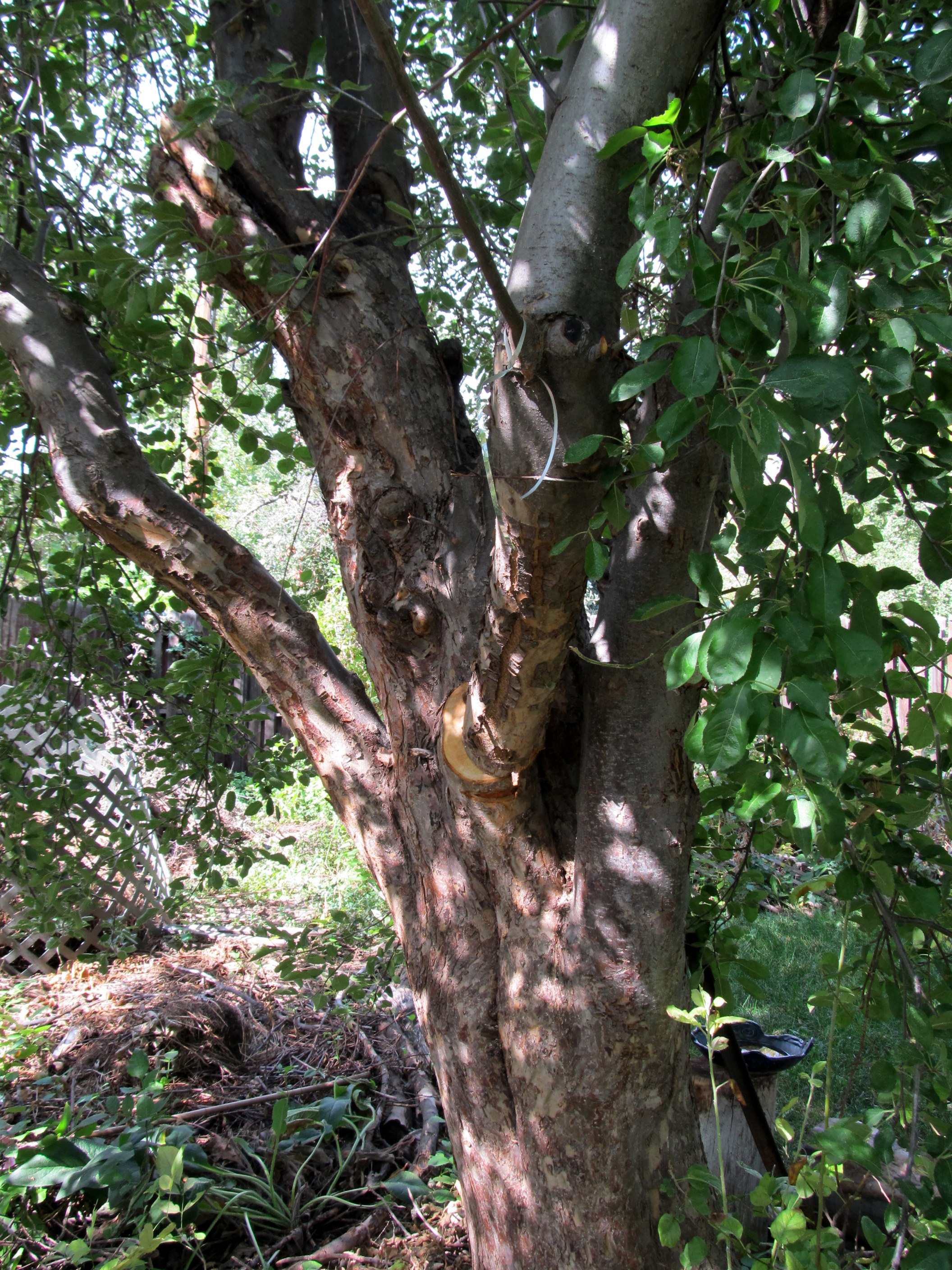
We have a giant apple tree that has been butchered in the past, then ignored, the butchered again, by the city tree trimming crew. It is probably about 50 years old, and most of the apples are developing way up high, because the major branches go up high, then bend over…after researching a lot, hemming and hawing and reading, online and in books, I have decided to renovate it. Slowly, over a few years, I’ll take off major limbs and train young branches to be the new major limbs, at a more convenient height. Convenient for me, not the squirrels.

Let me tell you about apical dominance… there is a chemical in plants that causes the  buds on the end of every branch to be dominant- it turns off the other buds back down the line. This chemical, auxin, is affected by gravity. If the end bud on a branch droops down, there aren’t many buds that will be activated. There will be buds on the tree up high, before the branch starts to droop. So we have very few apples down where we can reach them, and a bunch up high, which then fall down to be half-eaten by squirrels.


Another thing about apical dominance is that when the end bud is cut off,  other bud back down the line are activated. This is good when your pinch back flower chrysanthemums to make the plant bushier, so you get more flowers in fall, but not so good when the city crew whacks back your apple tree on a semiannual basis.

Since it is a standard tree, not a dwarf, it is really big. Branches are growing up into the power lines, and the city crews want to prevent that, but they don’t care much about the tree other than that. Every time the city comes to prune, they take out the center aggressively, which causes it to grow back aggressively. It’s pretty bad. There are seven major limbs, up to about 6 inches in diameter at the trunk, and they have kind of an umbrella effect, going up, then curving way down.
I have thought about it a lot, planning, and checking, and finally decided to take off one of the seven major limbs. Next year, I will take out another, never removing more than 25% of the leaf area at a time. Hopefully this will prevent major regrowth of water sprouts. I wanted to clean up the south side of the tree, since that is where I have recently sited a veggie bed and I wanted it to have more direct sun.

So, I chose my first limb, sawed it, then spent some quality time wondering how to get it down without seriously hurting myself. Seriously. It was tangled in so many other branches that even when it was cut all the way through, it just sat there.  I moved the ladder and made some more judicious cuts, then spent a pleasant afternoon cutting it into reasonable lengths for our chimenea.  Next year, I’ll select another limb from the North side of the tree, and work on that one.

The most helpful book for me in this project, which has mostly been a project about thinking, is Cass Turnbull’s Guide to Pruning. Tons of illustrations, tons of examples, written by a woman on a mission.
Pretty petal baby hat


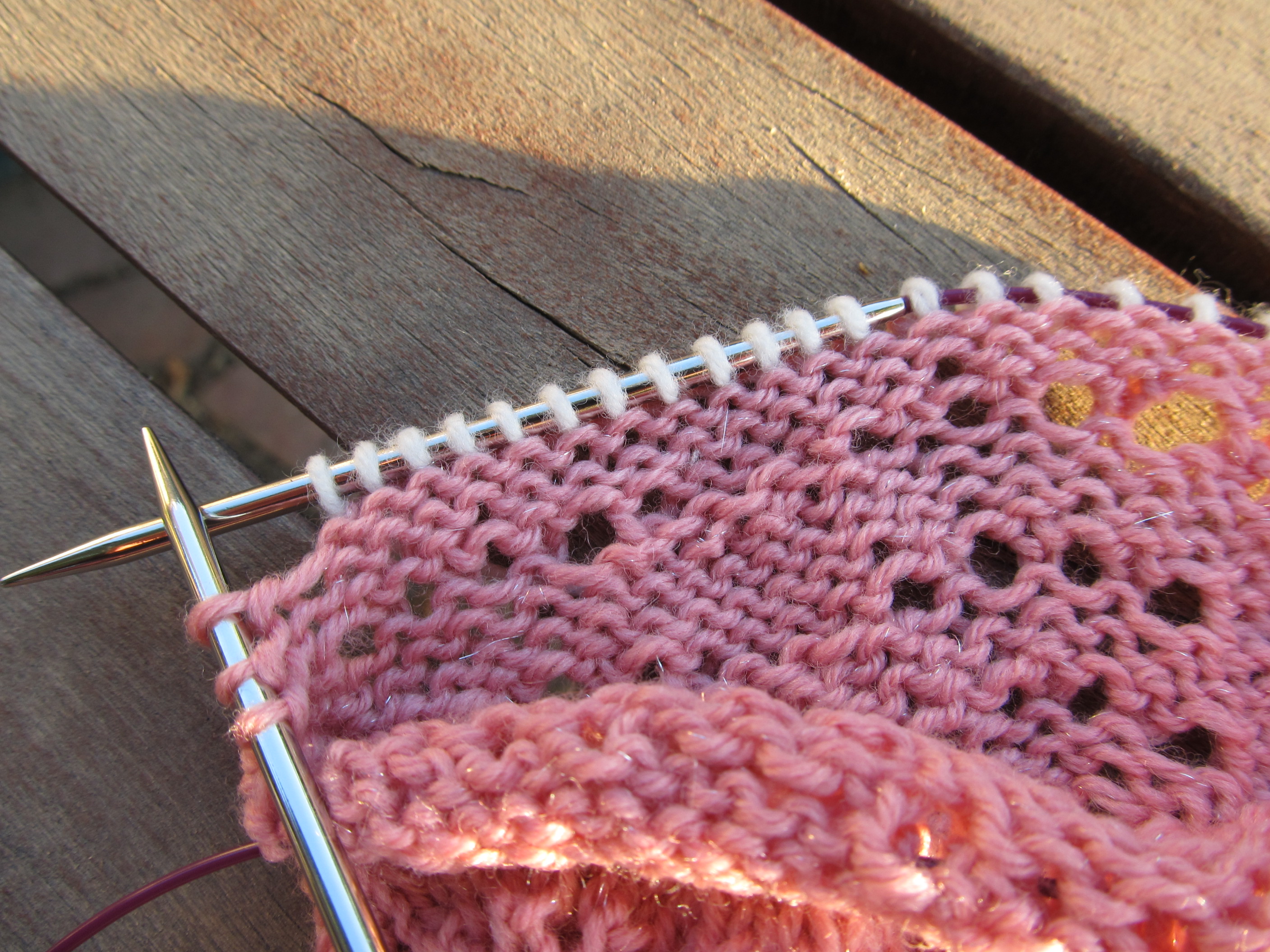
I had a precious little ball of pink sparkly yarn that I thought might be enough for  a baby hat…but not quite. I was in a bit of denial- I cast-on and started knitting, thinking that lace would stretch it out and I would get most of it done… yeah. No. Rip out and start over, with a bit more pre-planning.

I’m a little obsessed with the sparkly yarn- I have a pair of socks for myself, a pair of socks for someone who doesn’t read my blog, so I can talk about them all I want. I made a pair of sparkly blue socks for Kate as well. I love this yarn. It’s just so subtly sparkly- it isn’t ugly Christmas sweater sparkly, it just has a thin filament of sparkle spun in. Sigh. It is from Knitpicks, if there happens to be a sparkly yarn-shaped hole in your life. I think the gray would be really classy…

Anyway, I had a golf-ball sized chunk of it left, and a great-niece on the way, and I thought, what better use for this perfect little… shoot, not enough.  I wasn’t in complete denial, as I went along I considered ways of making it work. Maybe making it deliberately little- just a beanie? Nah.  Maybe a rapid flat-topped decrease on top, like a pillbox. Nah. Then I thought about it backwards and inside out- what if we considered the pink lacy part to be a cuff, to folded up over a white background? that way the lace would be more defined, and there would be some adjustability in the ear coverage.

My favorite lace pattern is Old Shale, also called feather and fan. It is easy to memorize, and makes the cast-on edge scalloped and ruffly. I originally got the pattern from The Twisted Sister Sock Workbook (not affiliated with Dee Snyder), but it is a traditional pattern- no one really owns it.

If you are considering learning a different lace pattern for a shawl or something, and want to practice, this could work as a swatch, and you have a hat at the end of (can you tell I hate swatching?)

This pattern is adjustable, either by using bigger needles and thicker yarn (perhaps for a big sister?) or by adding repeats to the old shale pattern- each repeat is 11 stitches, which makes about 1 and 1/4 inches in the circumference of the hat.

Some people test really well on being able to visualize and rotate shapes inside their minds, seeing how puzzle pieces go together, spinning parts around in three dimensions.  At least one of my brothers is gifted at this.  I am not.

I had to concentrate really hard to figure out how the heck I would turn this around so that the pretty side of the lace would show through the holes in the lace of the folded up cuff part, but I wouldn’t have to construct the entire hat backwards…. I am sure the mental exercise was good for me.

Then I was sitting next to the hillbilly goldfish pond, enjoying the sunshine, and had a thought. What if I just turned it inside out, and knit in the other direction? Yeah. That works. There is kind of a hole from going the other way, but since I changed colors there, the hole can get filled in with the woven-in ends.

Gauge is not super important here- baby heads come in a wide range of sizes- this is for a baby due in December/January. I would make it bigger for babies born at different times of the year… with my gauge, using this yarn and these needles the hat is 16 inches around. Your mileage may vary.

Squeeee!

Knitpicks Glimmer sock yarn in carnation

Knitpicks Stroll sock yarn in bare

size 3, 16 inch circular needles

Old shale lace pattern- cast on a multiple of 11, join round, being careful not to twist.

round 1 and 2 knit

round 3 perl

round 4 knit two together 2x ,* yo k 4x, knit 2 together 4x*

Cast on 99 stitches in pink and work old shale pattern as written for 3 repeats. (Making the third row perl makes it so the edge does not roll.) Then continue without perling the 3rd row until the piece measures 3 inches from cast on edge- which will be scalloped. Or, if you have a tiny amount of contrast yarn, go until you run out of yarn, as I did.

Switch to white yarn. Turn the piece inside out, so that the wrong side faces you. You will have to go backwards over what you have knit. There will be a slight gap, but you have to weave in the ends if you change colors, so the gap will be filled.

In the next row, knit two together 3x spaced evenly, 96 stitches so that you decrease to 96. Knit stockinette 4 inches, and begin decreases. Place markers every 12 stitches-* knit to 2 stitches before marker*, and knit two together, 1 row plain*. You will hit a point when your circular needle is too long, either add another circular, or switch to double pointed needles. Repeat these two decrease rows until 8 stitches remain- break yarn and sew end through all remaining stitches, then weave in ends.

Wash in wool wash and block.

Start on a hat in big sister’s favorite color…

Two shades of green, and a leafy lace pattern…

Citrus- you can grow that


The leaves are falling, must be time to cover the tomatoes and bring in the houseplants.

Freeze predicted tonight-the radio people keep saying “temperatures in the 30’s” which seems unfairly vague. It is  time to move my pots of citrus inside for the zone 5 fall and winter. and much of spring, if we are honest.
When I was pregnant with my daughter, now 12, I bought a lemon, a lime and an “orange” tree for about 10 bucks, for all 3 from a catalog- don’t remember which one. I thought I was getting a huge bargain- when they arrived, they were twigs.
The biggest was the lemon, which had a trunk as big around as a pencil, and about 4 leaves. The other two were like q-tips. So I planted them and waited.
I didn’t just wait- I had a baby, and watched the baby grow, and taught middle school, and then had another baby and watched that baby grow, and when that baby was walking, the orange tree bloomed.
Heavenly smell, tiny bb sized fruit, that grew to marble sized, then…what’s smaller than a ping pong ball? A big marble? Yeah, big marble-sized. They ripened to orange, but remained small and sour.
Since then, the lemon has produced actual real sized lemons, but not very many, and the lime has produced actual real sized limes, but, again, not very many.
Why bother, then?
They are pretty plants. I have other house plants that don’t do much of anything other than purify the air. When these bloom, they smell amazing, even on the patio. In the Boy’s room, which has the best light, they fill the air with fragrance when they bloom in the winter. The novelty is another reason- one year I brought them to school for the winter, when I had a classroom with windows, and students would bring their friends in and dare them to eat the oranges.
Order them, or if you have a good local nursery with citrus, buy there. Once they are big, they take a big pot- mine are about 12 years old now, and are in 14 inch pots. I use a dolly to move them outside in the spring and back inside in October.
When they come in, spray with the hose attachment of the kitchen sink, under the leaves especially to get rid of any hitchhikers. Looking at this, I realize it might make more sense to spray them outside, instead of in the kitchen, especially if by “hitchhikers” I mean “tiny bugs.”  Which I do.
Citrus like bright indirect light, and humidity. Much like myself. Not too much humidity, though. Dry air can make them drop leaves. It hasn’t been cold enough for the heat to come on very much yet, so there isn’t too much difference in humidity bringing them inside. The Boy’s room has a fish tank which evaporates enough that the plants do okay.
You don’t have to buy a plant, if you are in it to experiment. A neighbor of my mom’s planted a grapefruit seed, or her toddler did, probably close to 50 years ago. It grew big enough that they couldn’t fit it in their house, so they donated it to the public library, where it brushed the ceiling in the children’s section when I was a kid. Don’t know if it is still there.

antique or vintage?


When I went to my hometown for the weekend, my mom offered me a quilt made by her grandmother Neal.

She cautioned me, “Now, back in those days, they just made things from scraps, it isn’t all fabrics that are matchy-matchy.” She said she had 2, and my sister had looked at them and told her to give me first choice.

Pretty nice for just being made from scraps.

I don’t have very many stories about my great- grandmother Neal- she lived on a farm in  Kentucky and my mom would visit them for holidays and in the summer. She would always buy store-bought bread, so the children could eat sandwiches, but my grandmother was embarrassed by how many homemade biscuits my mom and uncles would eat. I imagine them at dinner,  reaching for another biscuit, and my grandmother giving them that look that says, “I can’t believe you are reaching for another biscuit.” But then they eat it anyway.

.
So, at home in the more recent past,  mom climbed up on the step stool, and pulled out a zippered blanket bag. Wrong one- that one was little- a crib quilt made for my oldest brother by my paternal grandmother- amazing patchwork, and tiny hand quilting. My mom told me that she had made that one, then one for my second oldest brother, then was declared legally blind. No more quilting.
The next bag that came out of the linen closet was the right one- it had two quilts made by my mom’s dad’s mom, Hattie Hill Hutchcraft Neal.

My mom speculates that she was named after her aunt, who was Harriet Hutchcraft, and married a man whose last name was Hill, so she was Harriet Hutchcraft Hill, and the baby who became my great-grandmother was Hattie Hill Hutchcraft. You hear people talking about how much they like old-fashioned baby names, but you don’t meet very many Hattie Hills these days. Wonder why
The firstquilt to come out of the bag was a flower garden, hexagons in pastels and medium colors on a white field, with a scalloped border. The scalloped border was what sold me, Kate liked the hexagons. We laid it out on the recliner, and I looked closely at the tiny hand quilting. I’ve done some quilting and oh, my gosh, this woman knew what she was doing. If I were at all competitive I would quit, because, you know, I would be competing with someone born shortly after the time of the civil war.
The other quilt, that I left for my sister, had stars on a white background, also very fine quilting, just as good, really. (I feel a little guilty- did I pick the better one? Is it fair?)

So, now, what do I do with this beautiful old textile? Zip it into a blanket bag in

I can scraches ur quiltz?

linen closet? Hang it up somewhere? Use it on a bed for the cat to tear up? I love that it is an antique (actually, what are the rules on linens? is it vintage? antique? where do you draw the line?) and I would like it to survive to become even antiquer (I know, not a word…) I have passed by two separate quilt racks at a thrift store- clutter-y and not really my style. But it is a shame not to have it where I can enjoy it. What are your thoughts?

Organic Apples- you can grow that


I have a list of the “dirty dozen” on a post-it note over my desk- the fruits and vegetables that you should eat organically grown versions of, if you can get them, because of pesticide residues. Number 1 on the list, and in our hearts, is apples.
Celery, spinach, and bell peppers are on the list, but nobody around here eats enough of those to make a difference. Apples, though…we eat a lot of.
We have a giant old tree that produces sour apples, not our favorites, and about 7 years ago I planted a Golden Delicious tree. After falling down, but not being entirely uprooted, in an early fall storm last fall, it has produced prolifically this year. Prolifically enough that I thinned once in June, then again in July, taking off unripe fruit that I was worried would break off the branches.
Backyard Orchard (link) has helped figure out what to take off and what to leave, how to prune, and when.
Now the organic part… I didn’t do anything. Last year I stapled paper lunch bags to fruit I could reach, and that was effective, but this year, I was talking to a colleague, who said that since she had put up bird feeders, her apples were much cleaner. A few got wormy, but the birds came for appetizers, and stayed for dinner.
I didn’t put up feeders- the squirrels tend to get to those anyway, but I have a lot of plants that feed birds, like coneflowers, We have been building up the garden for about 12 years, making habitat for pollinators, and birds and snakes and us. Several years of building soil and habitat has made it so this summer, we didn’t have to do much- the apples kind of took care of themselves. After a summer of doing nothing, my apples look great. They are small, which tells me I need to thin more aggressively next year, and probably water more. However, they are bug-free, and pesticide free.
I am a few days late in posting this for the “You can grow that” meme, created by C.L. Fornari, a garden writer who wanted to get other writers involved in writing encouraging posts, letting people know that it isn’t that hard. It strikes me funny that Miracle Gro has a marketing plan called “you can gro that” that kind of tramples over the top of C.L. Fornari’s meme, which I have been participating in since March. I am not sure what the future holds for the meme http://wholelifegardening.com/blog/. But you should know, you can grow (yes, with a w) apples.

The Big Yellow Monster


I have been a member of the National Geographic Society for many years. The primary benefit of the membership in this prestigious society is the receipt of a magazine every month. Depending on the amount of spare time, and the topics, we either devour the magazines, or they pile up on the end table. The recent issue with the story about how dogs were domesticated, fascinating, and hit all the right notes on the Boy’s interest in dogs and evolution and selective breeding.

The thing is, I can’t get rid of these magazines- we hold on to them as reference material, in case we want to look back at the maps, re-read the articles. Cutting them up for collages? Never! People do, I know, but not us.
The reality is, though, we don’t look back at old issues, or at least we haven’t, so far. So we hold on to them. I have a vivid memory of going out to the icy cold garage one February, to find an issue with Olmecs in it, to do a school report when I was in Junior High.

Why the garage? I don’t know the origin of the decision, but there were so many issues of the magazine, and so little storage space inside, that somehow it seemed logical to keep them in the garage.
Get rid of them? Never!
Ours, almost 20 years worth, have been fitting well in a lovely built-in shelf in our entrance way. That is, they were fitting in well, when they were only occupying the bottom shelf, then they encroached on the second from the bottom, displacing my cookbooks, and craft books. The front hall is terrribly lighted as well, so even when you want to look for a map, or a story on the Mongols, it is hard to do.
Long story short…I’m not getting rid of them. Never! But I am moving them to the basement, where with some clever re-arrangement, they can have their own bookshelf, with a lamp nearby.
Philosophically, what is this hold that National Geographics have on me? I can recycle or give away other magazines and books, but not these. What do you have that you can’t get rid of?

These Seven Pieces? Really?


At the bookstore the other day I flipped through Good Bones, a book about the seven essential pieces of furniture that you should buy and keep for a lifetime.

I was pleased to see a demilune table- I have one in teak, that I paid too much for, probably, but that I really love.

But the rest of the stuff threw me off. A dresser, obviously.

Wait…You have to write a book to tell people to buy a chest of drawers?

Slipper chairs…really?

A loveseat? ummm…I want a big couch that several people can flop on, especially as two of my favorite people to flop with get bigger and taller.

Bookshelves, a necesity for me, don’t get a mention in the book. Entertainment center… likewise not in the book. Coffee table? No. Rocker/recliner? Not in there.

So, what are your 7 essential pieces of furniture- if you were starting over, what would be the 7 first things you would get?

Demolition


Need some elbow grease to finish scraping off that mastic.

If  remodeling all starts with a throw pillow, or a pretty Martha Stewart towel rack,or paint colors, or choosing tile, there’s still a lot of stuff in the middle to get through, before any of the fun pretty stuff can get accomplished.

Our basement bathroom remodel started with a sluggish drain, and it is turning into a big deal. And we have kind of a deadline- I go back to school soon, and I will be teaching full time, rather than half, as I have been for the past several years. More money=nice, less time= not so nice.
The clock is ticking.
So, I ripped off the ceramic tile from the walls. At first I was dainty, sliding the scraper under the edge, prying gently, removing it with my other hand and placing it gently into the trash barrel.
Then it got fun. It was loose enough in most places that it would just pop off- whoever applied my tile so many years ago did it the same way they constructed the shower. That is, they did it  half-assedly. There was no grout, and I think it was mastic, rather than thin-set mortar. The mastic comes off the concrete foundation wall pretty easily, but not so much on the drywall. It’s pretty sloppy.

I used the gentlest tool first, and it worked really well- I read a lot of advice on the web that advocated crowbars and stuff, and implied that the best case scenario for most people was replacing the sheet rock. In our case, it popped off pretty easily.
The main tool I used was a scraper- it has removable 4 inch blades, and I found it in the tile section of the home improvement store.
If you are looking at this as a how-to, rather than just an opportunity to laugh at my hapless DIY skills, make sure you wear shoes, and gloves, and probably long pants, and definitely DEFINITELY DEFINITELY EYE PROTECTION. Seriously. There are tiny chips of ceramic flying around. Your eyes are what you see with. Protect them.

The next step was yanking out the dry wall from behind the shower wall. Rotten drywall. Pretty gross. I used a claw hammer to pull it up and break off pieces. About an hour by myself. I’m not complaining about doing it by myself- it is a 5×8 bathroom- I don’t think anyone else could get in there with a hammer without either taking longer, or someone getting hurt.

The next step is mental- the reason the drain was so sluggish was because the hole in the shower pan didn’t line up with the hole in the floor. I need to figure out how to “fur out” the wall so that the backer board can line up with the shower pan.

The book that has been super helpful is Stanley’s Complete Baths– I read it when we were up in the mountains last weekend.  My niece would say, “what are you reading?” and I would say, “shhh, I’m learning how to tile.”

So, we are working through the messy part, and soon will get through to the fun parts, expect more photos!

Holy Smokes- it worked!


Every picture should tell a story, right? This picture tells the story of the nasty stuff in my shower drain.

Our basement shower has been draining sloooowly for a long time, and when we had the plumber out to look at it, Dave was his name, wearing his cute little booties to protect our rugs, he just shook his head and said there was nothing he could do. Seriously?
We had already tried to snake it, but the problem was, the shower pan drain didn’t overlap with the floor drain- it was a little 3 dimensional Venn Diagram- this side was the water that came down in the shower, and this was the water that pooled up on the floor, and there in the middle, was the water that went down the drain. Gross.

We needed to do something, so I thought about remodeling. For a while. I set up a board on Pinterest, even.
After putting it off most of the summer, I tore out the shower pan last week, and tried the snake again. Not effective. Then I read somewhere that using a wet-dry vacuum would work.
Really? Okay.
It does work- I borrowed my friend Molly’s, and plugged it in, wrapped a rag around the end of the hose and turned it on.
At first, I wondered how you would be able to tell if it was working, then I felt little jerks on the hose, and looked inside the canister. Globs. Nasty globs of, let’s admit it, mostly my hair. And a piece of plastic that the installers had used to bridge the gap between the drain holes.
I poured an exploratory gallon or 2 of water down the drain, and it made contented gurgling sounds. Yea!
Next step, doing something about the decomposing wallboard behind the shower wall. Seriously? Who installed this thing?

The Ubiquitous Mason Jar


lots of duckweed, little bit of water

We went to the river park this week. There are steps down to the Big Thompson river, where you can float or splash, or put in your tubes and drift down the river. We didn’t bring tubes, but ran into friends who shared with Kate.  There are sprayers where the little kids can shriek and splash and get soaked in relative safety, and there is a bridge under which the water slows down a little, spreads out into shallows, where you can look for crawdads. This is where we spent the bulk of our time. The boy discovered that when crawdads are really little, they just tickle when they pinch.

In Gaia’a Garden (I know, terrible title, great book) there is a description of a project where you take water samples from several different places, with plants and muck and life, mix them in a mason jar, put the lid on and then watch. The idea is that you are mixing elements and creating an ecosystem that is not quite pond, not quite river, not quite lake, but a blend of the three.
I told the boy about the mason jar project at bedtime, and he was fired up- he couldn’t think about anything else. Right after breakfast he asked for a jar, and kept asking when we could go. Obviously, I needed coffee first. And there was that pesky dental appointment…

We went out in the afternoon, after a wonderful thunderstorm. There is a wetland by Kate’s school, but no way to get to open water, so we wound up going to the Sculpture park near our house. This park has a chain of wetlands, culverts and open water, so we were able to find swampy still water, fast running aerated water, and duckweed covered water.

This lake is usually deeper than this…

The final piece of the puzzle was mud, from the reservoir. They have been lowering the water level alarmingly, and we had to walk out quite a ways in the mud. It was pretty gross.

The water is clearing, and the mud has settled, and we can see stuff swimming around.  The boy had high hopes for a minnow, but I don’t think we caught one.

Yes, I am aware of what 3 cups of pond water would smell like if it spilled on top of legos. We would probably have to move. But, we are also trying not to spill.

Previous Older Entries Next Newer Entries